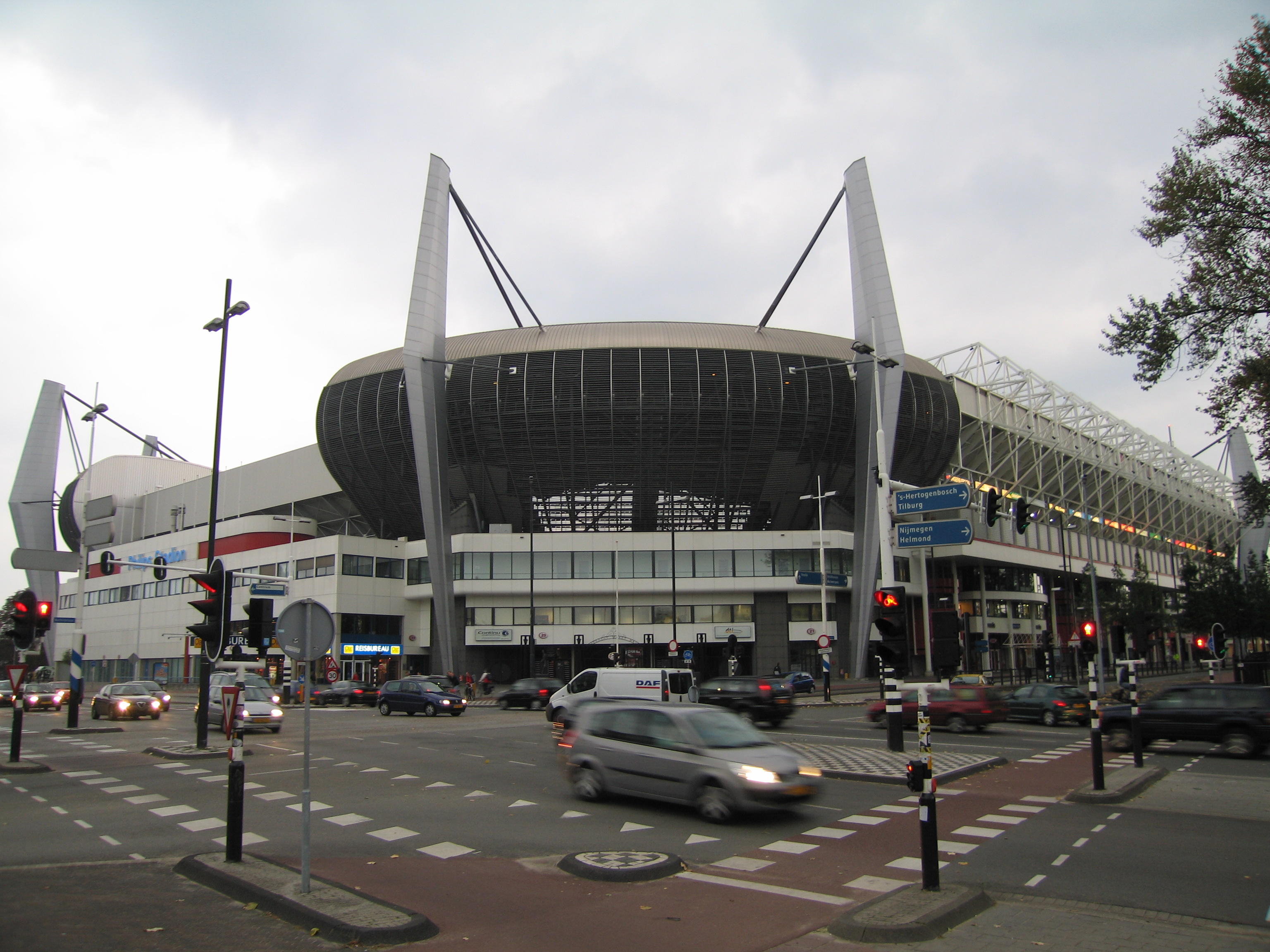
Philips Stadion
Long before the floodlights and the European nights, there was a village green. In 1910 Philips was throwing up a new neighbourhood called Philipsdorp - the Philips Village - to house its swelling workforce on the edge of Eindhoven. The town planner Gerrit Jan de Jongh sketched a generous open space at its centre, with room for a football pitch, a korfball field, and a bandstand. On 15 January 1911 the company team, the Philips Elftal, played there for the first time. Two years later they handed the ground over to a new club, founded in 1913 and named Philips Sport Vereniging. The patch of grass has been PSV's home ever since.
The Slow Enclosure
For its first decades the field had no proper seating at all. The first wooden stand went up in 1916, funded by Philips for its own 25th anniversary; it held 550 viewers. A larger main stand for 900 followed in 1933. In 1941 PSV ringed the pitch with stands in an oval shape, complete with a running track that turned the ground into an arena for athletics, cycling and ice skating. Capacity climbed to 18,000. Then came the war: the German occupiers requisitioned the ground for military use, and in the final days of fighting around Eindhoven the stadium was badly damaged. After repairs the club kept building, decade by decade, until a sweeping renovation finished in 1977 completely enclosed the stadium under a roof.
Building Toward Euro 2000
The big modern push came in the 1990s. PSV raised the east and west stands in 1993, the north stand in 1996, and closed the four open corners in 2000 and 2001 - just in time to host UEFA Euro 2000, which the Netherlands shared with Belgium. The Philips Stadion staged three group matches: Portugal beat England 3-2, Sweden and Turkey ground out a goalless draw, and Italy beat Sweden 2-1. The new corners did more than add seats. They were fitted with louvered, window-blind constructions that let air flow through the bowl so the grass underneath could breathe. Today the ground holds 35,119, the third-largest in the country, and UEFA awards it four stars.
The Night the Coach Stopped the Fans
In March 2001, during a UEFA Cup tie against 1. FC Kaiserslautern, the visiting players provoked the home end. Fans surged at the fence between the stands and the field; the gate cracked. PSV's coach Eric Gerets and several of his players ran over and physically held the crowd back themselves. It was an extraordinary scene - a Belgian football manager turned bouncer - and it became the unofficial end of the era of high pitch-side fences in Eindhoven. By the summer of 2005 the PSV board simply took them down, and the trouble faded with them.
Concerts, Grass, and Trains
The stadium also moonlights as a concert venue. In 1992 a staging of Carl Orff's Carmina Burana filled the bowl with about 30,000 people. Two years later Eros Ramazzotti played, and the grass paid for it - so thoroughly trampled that the PSV board grew wary of letting concerts back in. BLOF, the Zeeland rock band, finally returned in 2007. For big matches and events the ground has its own railway platform, Eindhoven Stadion station, reached by a pedestrian bridge that drops fans straight into the away section. It is one of the only stadiums in Europe where the train deposits you, quite deliberately, on the opposing supporters' side.
Still in the Same Field
Plans once existed to push capacity to 45,000, but those died when the Netherlands lost the 2018 World Cup bid. In 2011 PSV sold the land beneath the stadium to the Eindhoven municipality for 48.4 million euros in a leasehold arrangement - a deal that kept the club solvent during the lean post-2008 years. The modernisations now come piecemeal: a renovated floor here, new sponsor lodges there. What is remarkable, walking up to the ground today, is that it is still in exactly the same field where the Philips Elftal beat Hollandia from Woensel one Sunday in January 1911. A century of brick, steel and ambition has been built around a workers' village green.
From the Air
The Philips Stadion is at 51.4417 degrees north, 5.4674 degrees east, in the Strijp district just northwest of central Eindhoven. Eindhoven Airport (EHEH) is roughly 4 km west; the city's central train station is about 1.5 km southeast. From cruise the stadium reads as a distinct oval among the dense brick housing of Philipsdorp, with its own rail spur curving in from the north. Best viewed from 3,000-10,000 ft in daylight.