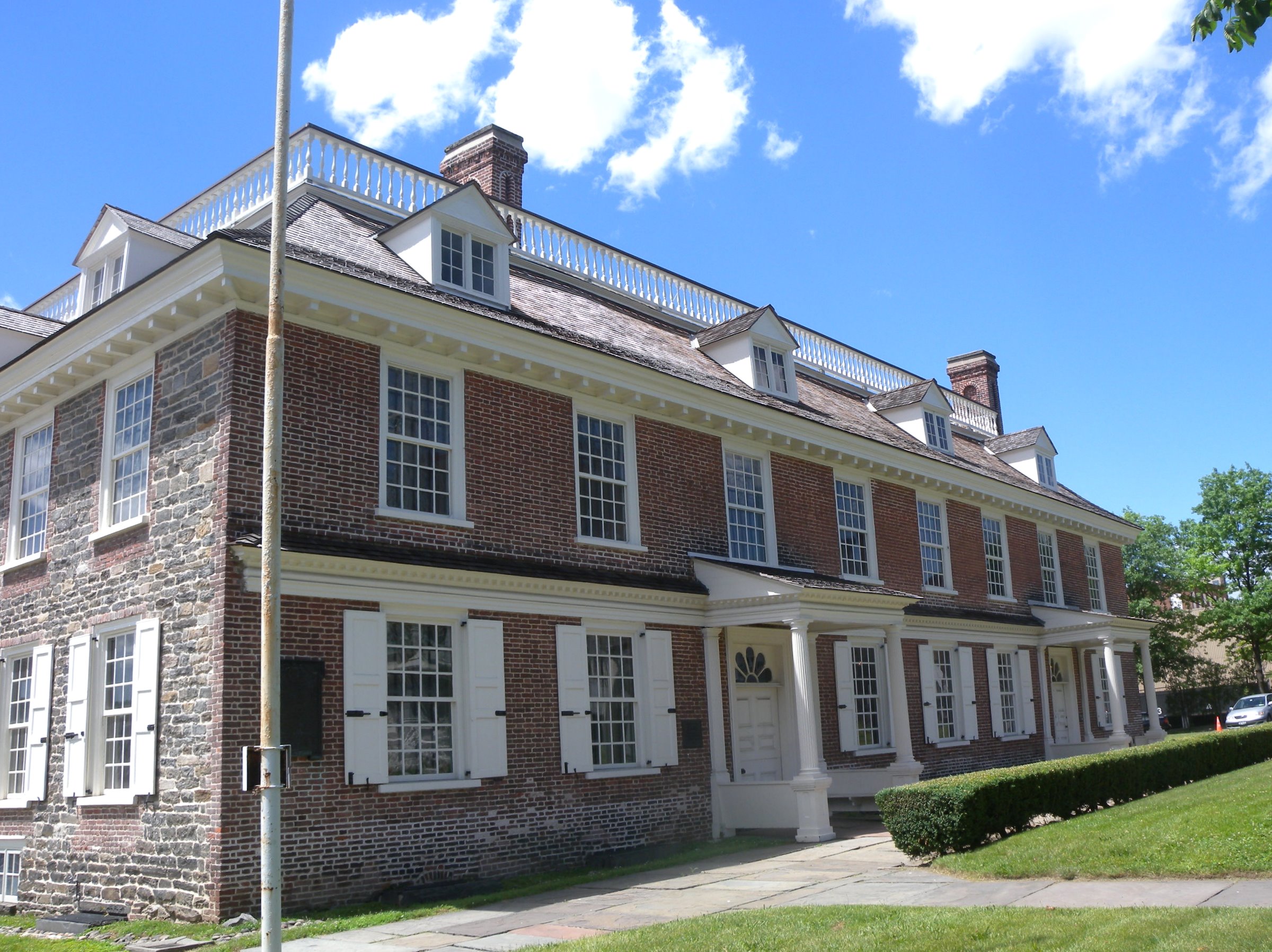
Philipse Manor Hall State Historic Site
Look up in the parlor of Philipse Manor Hall and you will see something that exists in only one other place in the United States: a papier-mache and plaster Rococo ceiling, installed around 1750, its surface alive with lute players, bagpipers, hunting dogs, game birds, and busts of Alexander Pope and Isaac Newton. Frederick Philipse III commissioned this ceiling to reflect his refined life -- music, hunting, literature, science. What it does not depict is the source of the wealth that made such refinement possible. For more than thirty years, the Philipse family shipped hundreds of enslaved African men, women, and children across the Atlantic, building one of the largest slaveholdings in the colonial North.
A Merchant's Empire on the Hudson
The oldest section of the building dates to around 1682, when Dutch-born merchant Frederick Philipse and his first wife, Margaret Hardenbroeck -- a formidable trader in her own right -- constructed the southwest corner of what would become a sprawling manor house. Philipse amassed a 52,000-acre estate along the Hudson River that encompassed all of modern Yonkers and much of western and lower Westchester County. The manor hall in Yonkers served primarily as a waystation on the long river journey between New Amsterdam and the family's northern holdings, where a second house still stands as the Philipsburg Manor historic site in Sleepy Hollow. The Philipse Patent, a separate 250-square-mile tract, became today's Putnam County and part of Dutchess County. By the mid-eighteenth century, the family's reach extended across a landscape that would take days to cross.
Revolution and Betrayal
The American Revolution forced a choice, and Frederick Philipse III chose Britain. Branded a Loyalist traitor, he was arrested on orders signed by George Washington and held in Connecticut. Authorities granted him permission to return to the manor hall to settle his affairs, on the condition that he not aid the British cause. He violated that parole almost immediately, fleeing with his family to British-occupied New York City and eventually to Great Britain. The estate was attainted in 1779, and New York's Commissioners of Forfeiture auctioned off the Philipse holdings during the war. The manor hall passed through various hands and eventually became Yonkers' city hall, a role it served until 1908, when the growing complexity of municipal government made the old building obsolete. Debate swirled over whether to add wings or tear it down entirely.
Saved by a Carpet Heiress
The building survived thanks to Eva Smith Cochran, matriarch of a wealthy local carpet-milling family. She donated $50,000 to the city as nominal reimbursement for decades of upkeep, clearing the way for ownership to transfer to the State of New York. Her son, Alexander Smith Cochran, assembled the Cochran Collection of American Portraiture that now fills the house -- 60 paintings including works by Charles Willson Peale and John Trumbull, depicting nearly every president from Washington to Calvin Coolidge along with war heroes, historical figures, and members of the Philipse family. The 1868 City Council Chamber, designed by John Davis Hatch with a vaulted ceiling and woodwork deliberately evoking an English manor's great hall, adds another architectural layer to a building that spans nearly three and a half centuries of continuous use.
Reckoning with the Enslaved
In recent decades, the site has turned toward the history it long left unspoken. Outside the manor hall, the Enslaved Africans' Rain Garden features five life-sized bronze sculptures by Yonkers artist Vinnie Bagwell, commemorating people who were held in bondage at the manor and who were among the first to be legally manumitted in the United States. The law that freed them predated all other emancipation-related landmark events in the nation. The manor hall now serves as a stop on heritage trails that trace the African American experience in Westchester County, reframing a building once celebrated for its architectural elegance and presidential portraits as a site where the full weight of American history -- wealth and exploitation, revolution and betrayal, oppression and eventual freedom -- can be confronted honestly.
From the Air
Located at 40.936N, 73.900W in the Getty Square neighborhood of Yonkers, New York, near the Hudson River at Warburton Avenue and Dock Street. The manor hall is a colonial-era stone building near the Yonkers waterfront. Look for the cluster of historic structures along the Hudson's east bank, south of the Saw Mill River confluence. Nearest airports: Westchester County (KHPN) 12nm north, Teterboro (KTEB) 10nm south. Best viewed at 1,500-2,500 ft AGL following the Hudson River. The Palisades cliffs are visible across the river to the west.