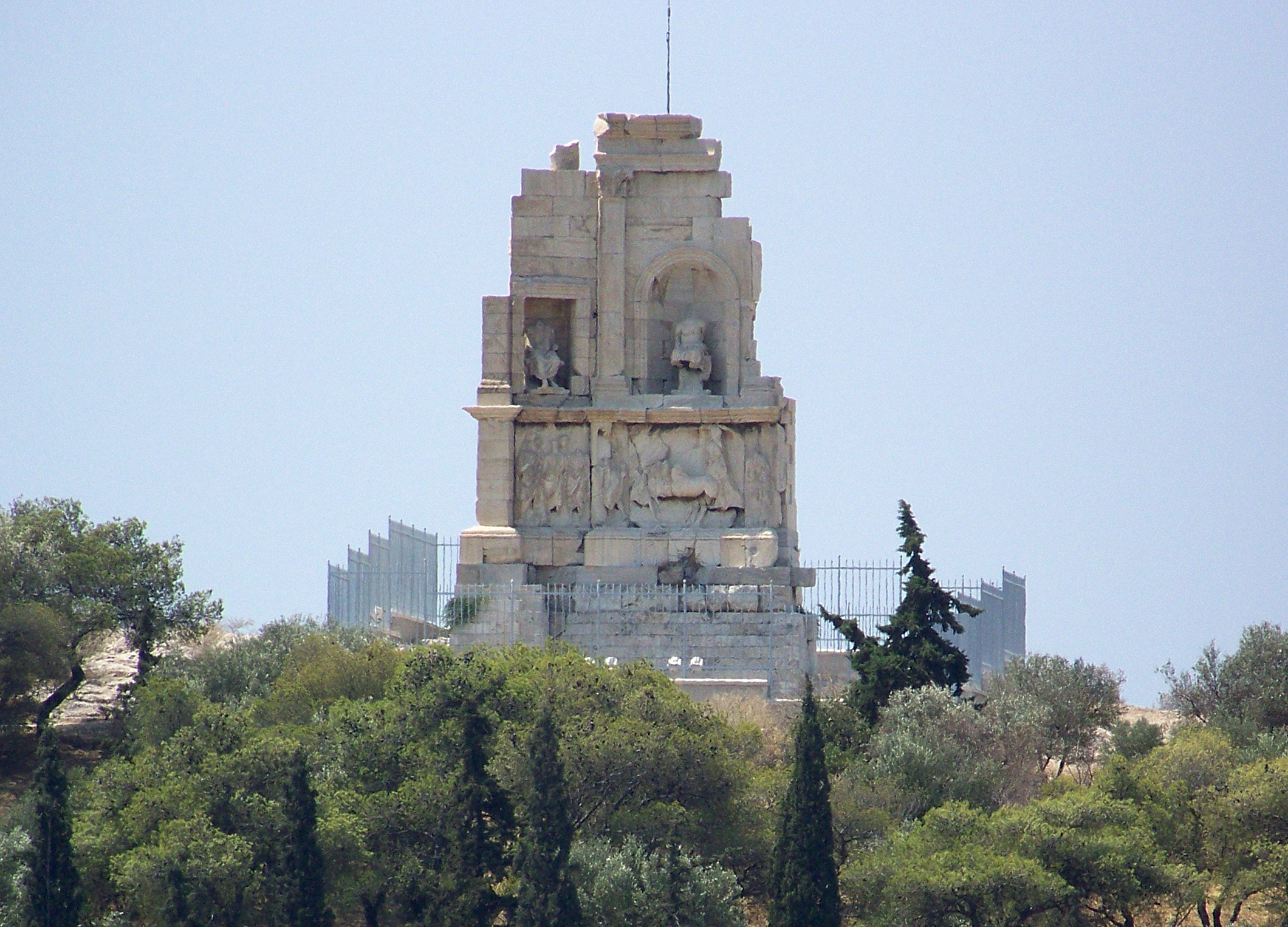
Philopappos Monument
On the night of 26 September 1687, a Venetian artillery officer set up his mortar on the summit of a low hill southwest of the Athenian Acropolis, sighted carefully on the Parthenon a kilometer away, and fired the round that detonated the Ottoman gunpowder magazine inside. The hill is named for the man who built the largest tomb on it sixteen centuries before that ill-fated shot. Gaius Julius Antiochus Epiphanes Philopappos was a Syrian prince, a Roman consul, and the last of his line, and the marble mausoleum his sister built for him in 116 AD has been watching over Athens for almost twenty centuries. The hill carries his name. The tomb still carries his face, what remains of it, and his Latin titles, and the inscriptions that record him as a king without a kingdom, a Roman without an heir.
A Prince Without a Country
Philopappos was born in 65 AD into a royal house that had recently lost its throne. His grandfather, Antiochus IV of Commagene, had ruled a small kingdom in what is now southeastern Turkey, on the upper Euphrates, until the Roman emperor Vespasian deposed him in 72 AD on suspicion of disloyalty during a regional war. The family kept their wealth and most of their honors but lost their land. Philopappos's father carried the family memory; Philopappos himself adapted to the new reality with skill. He moved to Athens, became a Roman citizen of the Fabian tribe, served as a magistrate at Trajan's court, and was admitted to the priestly college of the Arval Brethren, the closest thing the Roman world had to an aristocratic men's club. By the time he died in 116 AD at age 51, he was a Roman consul, an Athenian citizen of the deme of Besa, and probably the wealthiest private citizen in the city.
The Sister Who Mourned
Julia Balbilla mourned her brother in the way Roman aristocrats mourned each other, with money and stone and inscriptions. She and the citizens of Athens together commissioned the monument on Mouseion Hill, the Hill of the Muses, where the sixth-century BC priestly poet Mousaios was held to be buried. The location was an honor unusual even by Athenian standards. Philopappos's tomb stood directly opposite the Acropolis and within the formal religious boundaries of the city, where ordinary burial would not have been permitted. He had married into the family of a Syrian queen mother, his charm had survived the loss of his crown, and Athens had decided to keep him. Pausanias, the Greek geographer who described the monument a few decades later, called it a tomb built for a Syrian man. The phrasing mixes admiration with a reminder that Philopappos was, even in death, a foreigner.
Three Faces in Marble
The monument is a two-story structure of white Pentelic marble standing on a porous marble socle 3.08 meters high, the platform veneered with slabs of Hymettian marble for color contrast. The upper level held three statues in niches: Philopappos in the center, his grandfather Antiochus IV of Commagene on the left, and Seleucus I Nicator, founder of the Seleucid Empire and the dynastic ancestor of the Commagene kings, on the right. The Seleucus statue is now lost. Below Philopappos's central niche, a Latin inscription records his Roman career: consul and Arval brother, raised to praetorian rank by the emperor Trajan. Greek inscriptions on the side niches identify him to the citizens of Athens as Philopappos, son of Epiphanes, of the deme of Besa. Below his grandfather's statue, the inscription names King Antiochus, son of King Antiochus, the dynastic chain that the Romans had broken in 72 AD. Underneath was the burial chamber proper, now destroyed except for its base.
The Mortar Hill
The hill the monument stands on changed names along with the centuries. Mouseion Hill in antiquity, named for the Muses, became Hill of the Muses became Philopappou Hill in modern Greek, named after the most prominent burial on it. In 1687, during the Morean War between the Republic of Venice and the Ottoman Empire, the Venetian general Francesco Morosini brought his army to Athens and laid siege to the Acropolis. The Venetian artillery emplacements, including the mortar that destroyed the Parthenon, were set up on Philopappou Hill. The angle from the hill to the Acropolis is shallow but unobstructed, and the elevation gives a slight advantage. From the platform of the Philopappos monument today, looking northeast, you can see exactly the line that mortar round took. The Roman tomb watched a Venetian gunner ruin the Parthenon, and now it watches the millions of tourists who come every year to see what the Venetian gunner left.
Two Thirds of a Tomb
Only about two-thirds of the monument's facade survives. The burial chamber behind it is destroyed except for its base. The traveler Cyriacus of Ancona, the same humanist scholar who first identified the Parthenon as such in 1436, visited the Philopappos monument in 1436 and described it as still intact. Most of the destruction must have happened after that. Recent investigations have shown that some of the marble blocks from the monument were used in building the Ottoman minaret on the Parthenon, an awkward continuity in which the Roman tomb was disassembled to decorate the building it would later witness being destroyed. Archaeological excavations took place in 1898 and 1899, with smaller follow-up work by H. A. Thompson and J. Travlos in 1940. The monument now sits in a paved plaza on Philopappou Hill that doubles as one of the best viewpoints in Athens. From there, the Acropolis fills the eastern sky, the modern city extends to the south, and the marble figure of a Syrian prince in his consular robes faces both.
From the Air
The Philopappos Monument stands at 37.967 N, 23.721 E on Philopappou Hill (Mouseion Hill), at approximately 147 meters elevation, southwest of the Acropolis. The hill is part of a chain that includes the Pnyx and the Hill of the Nymphs. Best viewed from 2,000-3,500 ft AGL with the Acropolis visible immediately to the northeast. The Acropolis is restricted airspace; the Philopappos area is just outside the most restricted zone. Nearest airport: Athens International Airport Eleftherios Venizelos (LGAV / ATH), 30 km east.