The Philosopher's Path: Two Kilometers of Thought
Nishida Kitaro walked to work the same way every day. From his home in Kyoto's Higashiyama district, the professor followed a narrow stone path beside a canal, passing beneath cherry trees and alongside temple walls, lost in thought about the nature of pure experience. The two-kilometer route between Ginkaku-ji and Nanzen-ji became so identified with the philosopher and his colleague Hajime Tanabe that locals simply began calling it the Philosopher's Path -- Tetsugaku no Michi. What Nishida pondered on those walks changed Japanese intellectual history. He founded the Kyoto School of Philosophy, the first major attempt to synthesize Eastern and Western philosophical traditions, and his daily commute along this canal became one of the most famous walks in Japan. Today, hundreds of thousands of visitors retrace his steps each year, though most come not for philosophy but for the cherry blossoms that turn the canal into a tunnel of pale pink every April.
Water from the Largest Lake
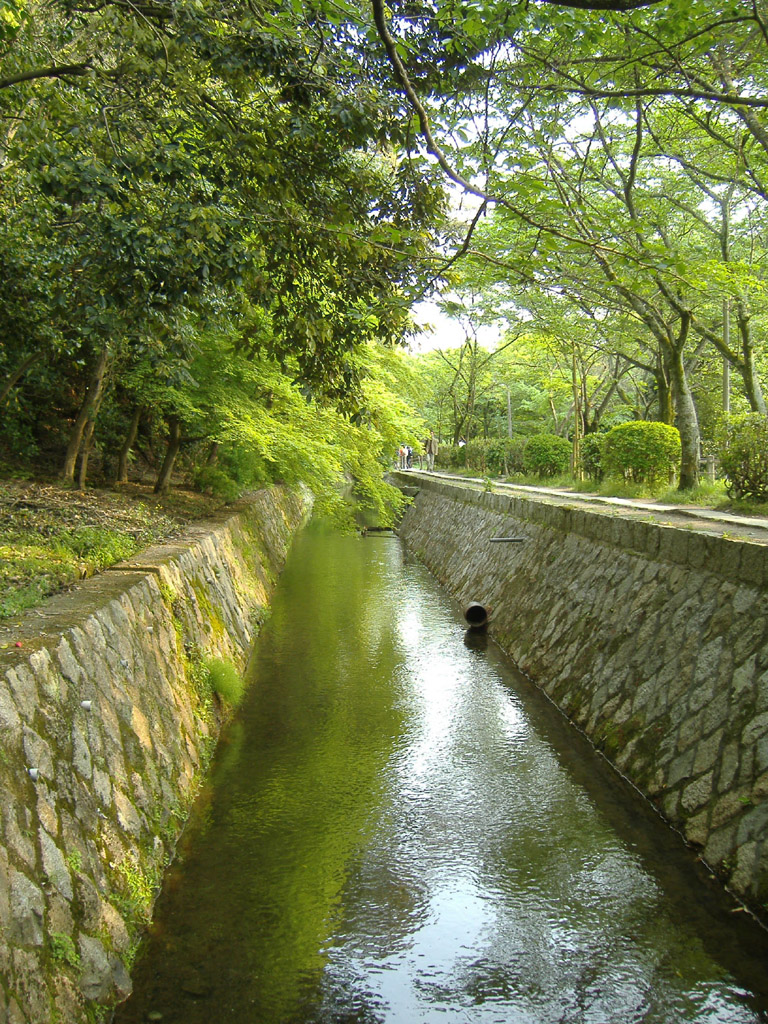
The canal that gives the Philosopher's Path its shape was not built for contemplation. First opened in 1890 and extended in 1912, it carries water from the Lake Biwa Canal, an engineering project that channeled fresh water from Japan's largest lake in neighboring Shiga Prefecture into Kyoto. The shallow irrigation channel runs through the eastern hills of the city, and the path that follows its course was originally just a maintenance trail. But someone planted cherry trees along the banks, and the combination of flowing water, overhanging branches, and the quietness of the eastern foothills created something that drew walkers. The path stretches approximately two kilometers through the northern reaches of the Higashiyama district, connecting two of Kyoto's most celebrated temple complexes. It takes about thirty minutes at a steady pace, but most people linger far longer.
The Mind That Named the Path
Nishida Kitaro was born in 1870, during the Meiji era when Japan was absorbing Western knowledge and technology at a voracious pace. He became a professor at Kyoto University and the most influential Japanese philosopher of the twentieth century. His central concept -- 'pure experience,' the idea of reality before the mind divides it into subject and object -- drew from both Zen Buddhism and Western phenomenology. He used his daily walks along this canal as a form of moving meditation, and his colleague Hajime Tanabe, another Kyoto University philosopher, walked the same route. Together they anchored the Kyoto School, a philosophical movement that grappled with fundamental questions about consciousness, nothingness, and the relationship between Eastern and Western thought. Nishida died in 1945, but the path retained his name, and a stone monument along the route bears one of his poems.
Temples in the Treeline
Walking the Philosopher's Path is less a hike than a slow drift past centuries of sacred architecture. At the northern end stands Ginkaku-ji, the Silver Pavilion, a fifteenth-century Zen temple built by Shogun Ashikaga Yoshimasa as a retirement villa. Its famous sand garden, raked into precise cones and waves, represents Mount Fuji and the sea. Moving south along the canal, the path passes Honen-in, a quiet Thatched Gate temple founded in 1680, and the small Otoyo Shrine, where guardian stone mice replace the more common fox or lion statues. Further along sits Eikan-do Zenrin-ji, renowned for its autumn maple foliage and its unusual statue of Amida Buddha looking back over his shoulder. At the southern terminus, the path reaches the grand precincts of Nanzen-ji, one of the most important Zen temples in Japan, its massive sanmon gate offering sweeping views across Kyoto.
A Tunnel of Blossoms
The cherry trees that line both sides of the canal transform the Philosopher's Path into one of Kyoto's most celebrated hanami destinations. Usually in early April, hundreds of Somei Yoshino cherry trees burst into bloom simultaneously, their branches arching over the water to form a canopy of white and pale pink. Petals drift down onto the canal surface, carried slowly downstream in a phenomenon the Japanese call hanafubuki -- flower blizzard. The path becomes crowded during peak bloom, with visitors walking shoulder to shoulder between the flowering branches, but the spectacle justifies the company. Outside cherry blossom season, the path has its own quieter beauty: fresh green leaves in summer, fiery maples reflected in the canal during autumn, and bare branches sketched against winter skies. Small cafes, craft shops, and noodle restaurants line short side streets branching off the main path, offering places to sit and watch the water flow.
Daimonji and the View North
From the northern stretches of the Philosopher's Path, walkers can look up to see the slopes of Daimonji-yama, the mountain where every August 16th an enormous bonfire is lit in the shape of the kanji character 'dai,' meaning great or large. The Gozan no Okuribi festival marks the end of the Obon season, when the spirits of ancestors are believed to return to their families. Five bonfires burn on mountains surrounding Kyoto, but the Daimonji fire is the most famous, visible from much of the city. Seeing the dark hillside from the Philosopher's Path, with the character's outline faintly visible even when unlit, connects the quiet daily ritual of walking to the larger seasonal rhythms that have shaped life in Kyoto for centuries. Nishida would have seen the same slopes, the same water, the same play of light through the same trees -- though the city beyond the canal has changed around them.
From the Air
Located at 35.03°N, 135.80°E in Kyoto's Higashiyama district on the eastern side of the city. The path runs roughly north-south along the base of the Higashiyama hills. From 3,000-5,000 feet AGL, the green corridor of the path and canal can be discerned among the temple complexes along the hillside. Ginkaku-ji (Silver Pavilion) at the northern end and Nanzen-ji at the southern end are significant architectural landmarks. The Daimonji character on the mountainside above is visible from altitude. Nearest airport is Osaka Itami (RJOO), approximately 35 nautical miles southwest. Kansai International (RJBB) is about 55 nautical miles south.