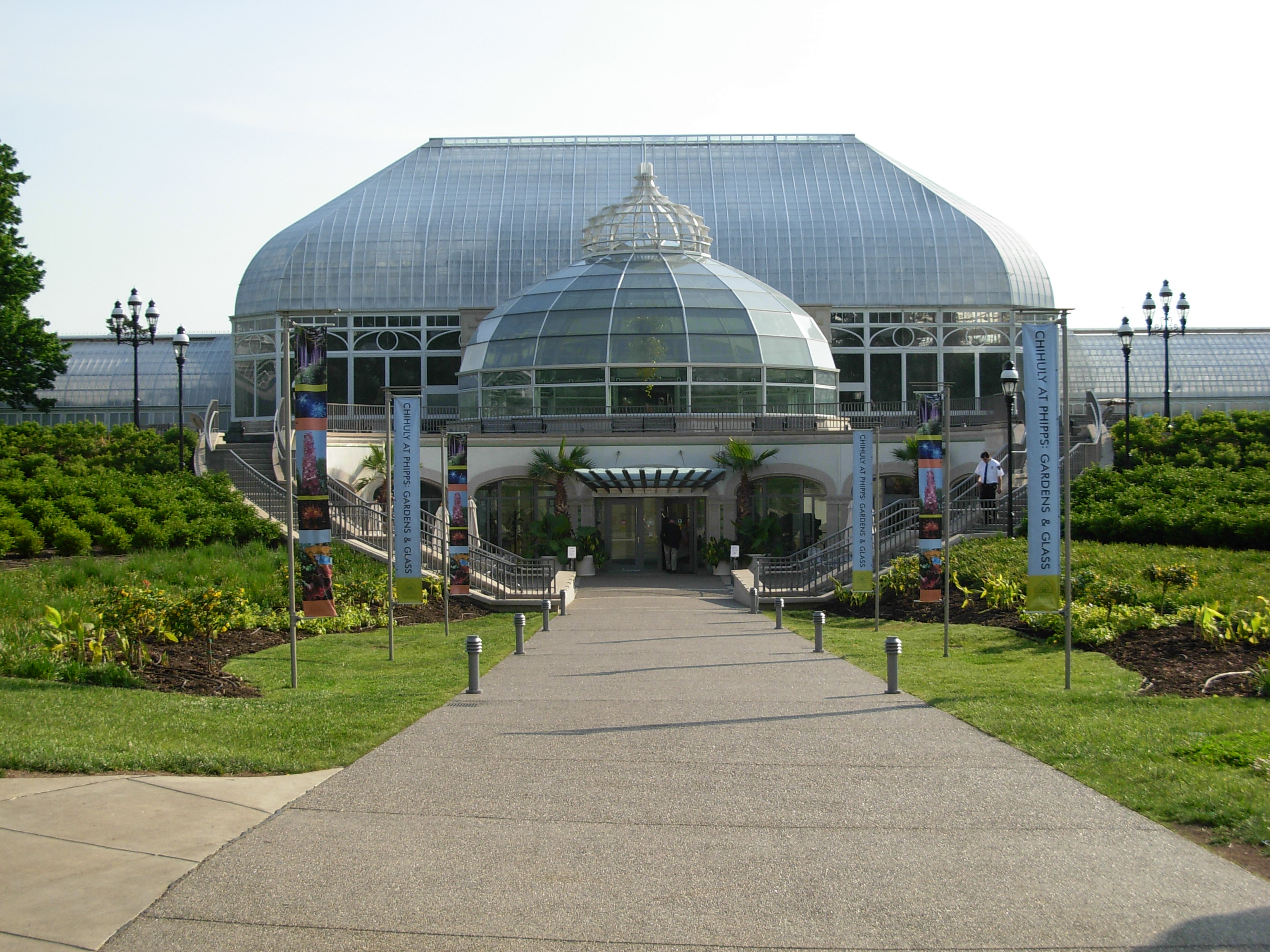
Phipps Conservatory: A Steel Baron's Glass Gift
The plants arrived from the 1893 World's Columbian Exposition in Chicago, and the glasshouse was ready to receive them. Henry Phipps Jr., Andrew Carnegie's business partner in steel, had spent $100,000 to build Pittsburgh a conservatory in Schenley Park, commissioning the renowned firm Lord & Burnham to design nine display rooms of Victorian glass and metalwork. On December 7, 1893, the doors opened and the exotic plants of the Chicago fair found a permanent home in a city still darkened by mill smoke. More than 130 years later, the conservatory has grown to fourteen rooms, earned the distinction of housing one of the greenest buildings in the world, and proved that a gift from the Gilded Age can keep evolving.
Under the Glass Peak
The Palm Court greets every visitor with a high glass ceiling built to accommodate full-grown tropical palms. The original wood and annealed glass had to be replaced in the 1990s, but the new aluminum extrusions were crafted to match the original Victorian specifications exactly. From here, the conservatory unfolds in all directions. West leads through the Serpentine Room, named for its curved brick pathway, to the Fern Room, where cycads and tree ferns represent the Triassic period, a time before flowering plants existed. Munch's cycad, Eastern Cape cycad, staghorn fern, Australian tree fern: these are living fossils under glass. The Orchid Room next door began with a single donation of 800 rare orchids from Charles D. Armstrong in 1931, then valued at $50,000.
Glass Art Among Living Plants
In 2007, Phipps invited Dale Chihuly and his Tacoma-based team of glass blowers to create an installation merging hand-blown glass with living plants. The collaboration left a permanent mark. Four major pieces stayed after the exhibit closed: a chandelier illuminating the Welcome Center's neo-Victorian dome, a hanging gold star in the Desert Room, a celadon and purple gilded Fiori in the Tropical Fruit and Spice Room, and a bronze, apricot, and chartreuse Ikebana in the Palm Court. Phipps then purchased 26 additional smaller pieces, including six multicolored Macchia bowls, thirteen amber Cattails, and seven Paintbrushes. The total Chihuly collection is valued at $1.2 million. Two years later, glass artist Hans Godo Frabel contributed more realistic work, including intricate glass orchids and lotus plants.
A Greenhouse That Leads in Green
Phipps has transformed from Victorian curiosity to sustainability pioneer. Its production greenhouse was the first and only greenhouse in the world to achieve LEED Platinum certification. The Center for Sustainable Landscapes, opened in 2012, goes further: it produces all of its own energy, treats and reuses all water captured on site, and has achieved LEED Platinum, the Living Building Challenge for net-zero energy, and the first-ever Four Stars Sustainable SITES Initiative certification. Earth tubes running underground cool the Tropical Forest Conservatory. A solid oxide fuel cell produces 5 kilowatts of electricity from natural gas. Computer-controlled shades block excess sunlight by day and insulate at night, while roof panes open automatically for ventilation. The conservatory proves that even a 19th-century glasshouse can adapt to 21st-century environmental standards.
Rooms That Travel the World
The Tropical Forest Conservatory, the largest indoor display space, reinvents itself every three years with a new region: Thailand in 2006, Peru in 2009, India in 2012, Congo in 2015, Cuba in 2018, Hawaii in 2022, and Panama in 2025. Each iteration brings waterfalls, winding pathways, fish ponds, and interactive learning stations. Elsewhere, the Broderie Room recreates the formal embroidery gardens of French chateaux during Louis XIV's reign, a popular setting for weddings. The Desert Room houses Joshua trees, saguaros, and a Chihuly gold star. The Japanese Courtyard Garden, designed by Hoichi Kurisu in 1991, offers bonsai and quiet contemplation. The outdoor hardscape, built by the Works Progress Administration in 1935, still forms the foundation of the Outdoor Garden today.
A Gift That Keeps Growing
Henry Phipps funded the original conservatory, then returned in 1896 to add the South Conservatory and again in 1901 to build Botany Hall for local teachers. The expansion never really stopped. A Rooftop Edible Garden now produces fresh vegetables for the Welcome Center cafeteria. The Children's Discovery Garden attracts birds, butterflies, and bees. A Neptune statue from 1893 still presides over the Aquatic Garden's pools. From altitude, the conservatory's glass roofline catches light in Schenley Park's green expanse, a Victorian jewel set against the urban grid of Oakland. What Phipps built as a gift to entertain and educate Pittsburgh has become something its steel-baron founder likely never imagined: a model for how buildings and nature can sustain each other.
From the Air
Phipps Conservatory is at 40.439N, 79.948W in Schenley Park, the large green space in Pittsburgh's Oakland neighborhood. The glasshouse structures are visible from moderate altitude as distinctive reflective rooflines within the park. Nearby landmarks include the University of Pittsburgh's Cathedral of Learning (tall Gothic tower) and Carnegie Mellon University campus. Pittsburgh International Airport (KPIT) is about 17 miles west. Allegheny County Airport (KAGC) is approximately 8 miles southeast. Best viewed at 2,000-4,000 feet AGL to see the conservatory in its park context against the Oakland institutional district.