Phoenix Indian School
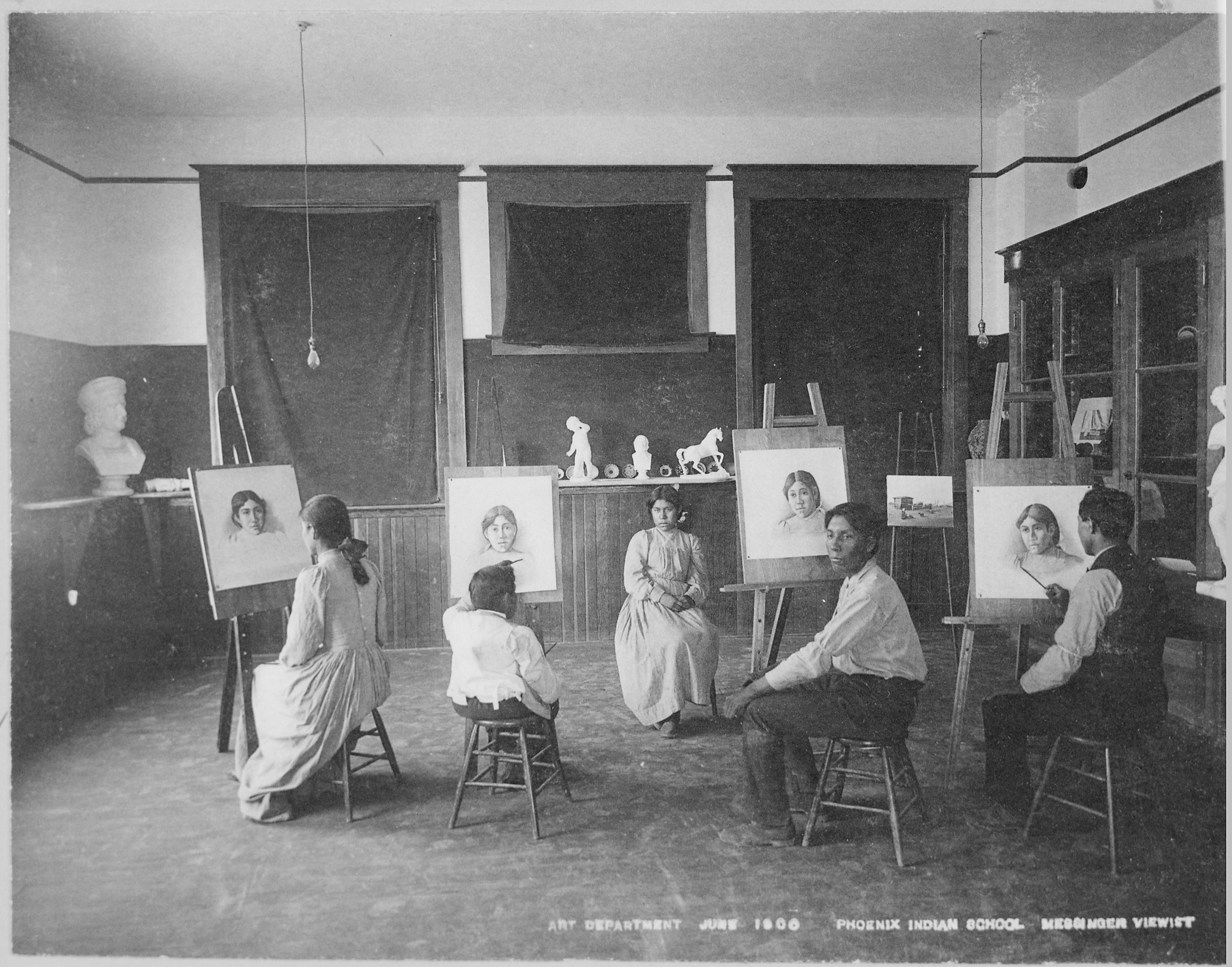
Ira Hayes walked these grounds before becoming one of the most iconic figures in American military history. The Akimel O'odham Marine who helped raise the flag on Iwo Jima was just one of thousands of Native American children who passed through the Phoenix Indian School between 1891 and 1990. Today, where students once marched in military formation at 5 a.m., families stroll through Steele Indian School Park, past a tranquil lake and the three preserved buildings that bear witness to one of the most contentious chapters in American educational history.
The Assimilation Machine
When the Phoenix Indian School opened in 1891, it embodied the federal government's explicit mission to erase Native American identity. The philosophy was brutal in its simplicity: take children from their families, forbid their languages, cut their hair, dress them in uniforms, and remake them as Americans. By 1896, enrollment had surged from 100 to 380 students, with children arriving from Mojave, Hopi, and other tribes across the Southwest. The "outing system" sent students to work for white Phoenix employers, but unlike similar programs elsewhere, these children became cheap contract labor rather than cultural apprentices. Four academic teachers served nearly 400 students. The message was clear: vocational training mattered more than education, and assimilation meant submission.
Warriors Before Citizens
In 1912, Arizona formed Company F of its National Guard entirely from Phoenix Indian School students and alumni, the first all-Indian military unit in the nation. These young men, trained in the school's rigid military discipline, were willing to fight for a country that did not even recognize them as citizens. When President Wilson declared war on Germany in April 1917, sixty-four PIS students and alumni volunteered within four months, despite having no legal obligation to serve. Company F joined the 158th Infantry Regiment and saw distinguished combat in Europe. Their sacrifice helped shift attitudes in Washington, contributing to the passage of the Indian Citizenship Act in 1924. The school's Memorial Hall, built in 1922 for $50,000 with student labor, commemorates their service.
The Meriam Report and Reform
By the 1920s, cracks appeared in the assimilation facade. Overcrowding, budget cuts, and declining health care plagued Indian schools nationwide. Reformer John Collier began documenting abuses, and in 1928, the Meriam Report delivered a devastating critique of the entire boarding school system. The section on education called for an end to assimilation policies. In May 1930, the Senate Subcommittee on Indian Affairs heard testimony about brutal treatment and mismanagement at Phoenix Indian School. Though charges were never proven, the hearings catalyzed change. Superintendent John Brown, who had defended the old ways, retired in disgrace in 1931. His successor, Carl Skinner, arrived with a doctorate in education but no Indian Service experience. Military discipline ended. Uniforms became optional. The band stopped marching students to meals.
A School Transformed
Under Skinner and new Indian Bureau chief John Collier, Phoenix Indian School reinvented itself. Lower grades moved to reservation day schools, and enrollment dropped from 950 to 425. World War II brought another wave of change. Native Americans served in every military branch, and their widespread participation exposed the ongoing failure to meet educational treaty obligations. The Special Navajo Program, created in 1947, enrolled thousands of Navajo children seeking eighth-grade educations. By 1960, the school earned accreditation and joined Arizona's high school sports association. Phoenix Indian High School competed alongside Brophy, Xavier, and Central High in an area serving 5,000 students combined.
Memory in the Desert
The Reagan Administration recommended closure in 1982, and the last students departed in 1990. After years of vacancy, the campus became Steele Indian School Park in 2001. The Phoenix Indian School Preservation Coalition, led by Creek activist Jean Chaudhuri and representing 18 Arizona tribes, fought to ensure the park honored its complex history. Three buildings survive on the National Register of Historic Places: the 1902 Dining Hall, the oldest structure on site; the Mission Revival Memorial Hall; and the Moderne-style grammar school. Bird Lake reflects the desert sky where students once drilled. Native American poems line the Entry Garden ramps. The alumni list reads like a roster of twentieth-century Native achievement: Peterson Zah, first President of the Navajo Nation; Charles Loloma, Hopi master jeweler; Anna Moore Shaw, first Native woman to earn an Arizona high school diploma. Their stories, and thousands of others, echo through grounds that transformed from a place of forced forgetting into one of deliberate remembrance.
From the Air
Located at 33.4975N, 112.0694W in central Phoenix, Arizona. The park is bounded by Central Avenue, Seventh Street, Indian School Road, and Camelback Road. From the air, Bird Lake is the most visible feature. Phoenix Sky Harbor International Airport (KPHX) lies 6 miles southeast. Best viewed at 2,000-3,000 feet AGL. The site sits among dense urban development with several high schools visible in the surrounding blocks.