Phoenix Shot Tower
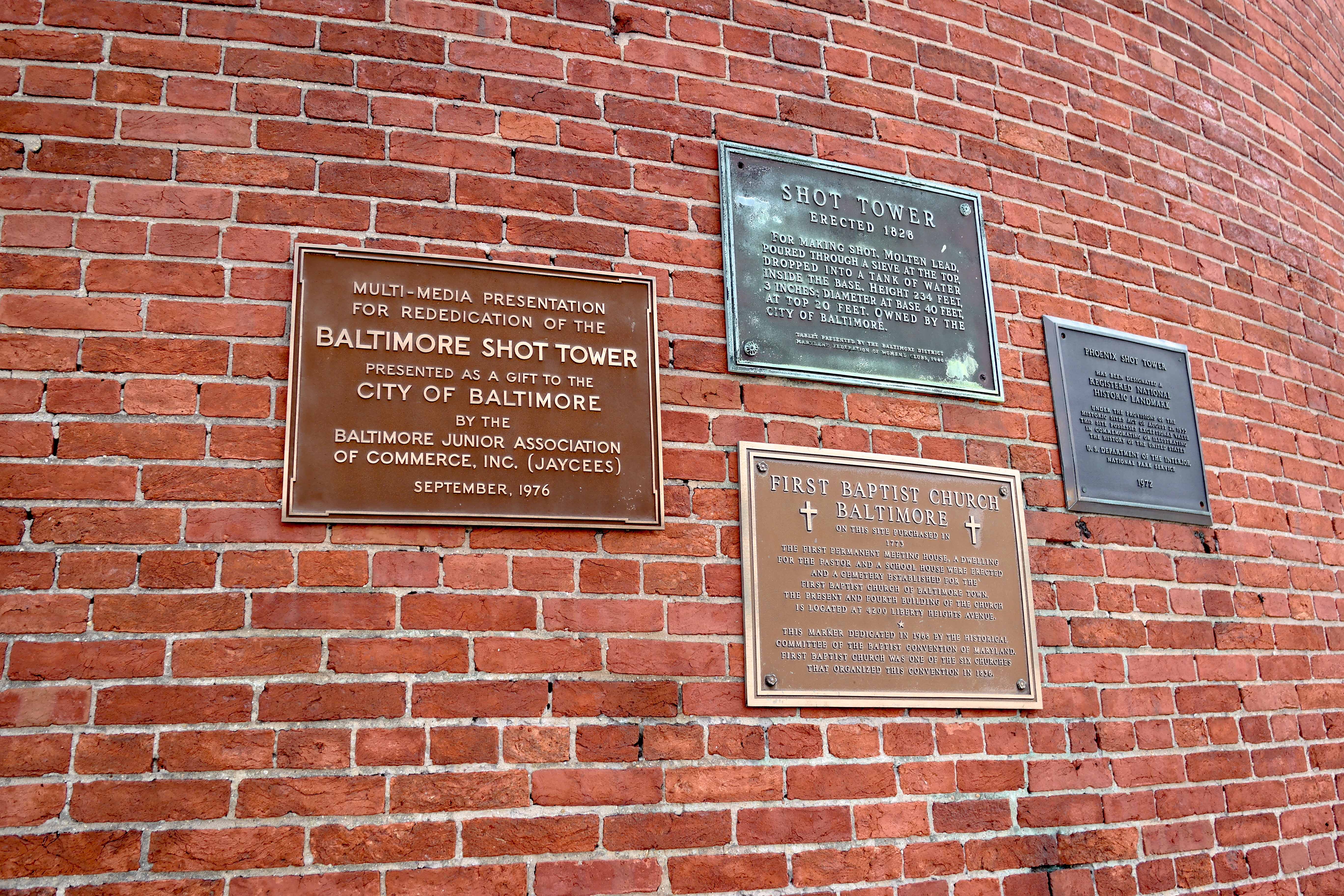
On the Fourth of July, 1828, the last surviving signer of the Declaration of Independence laid a cornerstone in Baltimore. Charles Carroll of Carrollton -- Roman Catholic lay leader, wealthiest man in America, ninety years old and still sharp enough to know a good ceremony -- pressed the first stone into place for a tower that would rise higher than anything else in the country. The Phoenix Shot Tower was completed that same year, built from roughly 1.1 million bricks in less than six months. At its full height, it was the tallest structure in the United States. Its purpose was bluntly industrial: drop molten lead from the top, let gravity and air shape it into perfect spheres, catch it in cold water at the bottom. Ammunition, made by falling.
The Physics of Falling Lead
The process inside the tower was elegant in its simplicity. Workers on the 13th and 14th floors heated lead in furnaces until it became liquid, then poured it through a sieve-like device at the top of the tower. As each droplet fell through the open interior, surface tension pulled it into a sphere while the air cooled it. At the bottom, a vat of cold water caught and hardened the shot. The finished pellets were dried, polished, and sorted into 25-pound bags. The tower could produce one million of these bags per year, and could double that output if needed, making it one of the largest shot producers in the country. The method, invented by an Englishman named William Watts, turned a simple physical principle -- that falling liquid forms spheres -- into an industrial-scale manufacturing process that required nothing more than height, heat, and gravity.
A Million Bricks, Six Months
Jacob Wolfe built the tower using bricks manufactured by the Burns and Russell Company of Baltimore. The circular structure's walls are thick at the base and narrow in stages as they rise, each step reducing the wall thickness until reaching the thinnest section at the crenellated top. The design is purely functional: the thick base supports the enormous weight above, while the tapering walls reduce material without sacrificing strength. Heavy metal doors guard the bottom. Windows are placed seemingly at random along the exterior, but they follow the spiral of an interior staircase, lighting the long climb upward. Charles Carroll's winter house stood just one block south, giving the elderly statesman a view of the tower he had helped inaugurate.
Saved from the Wrecking Ball
The tower produced shot from 1828 until 1892, reopened briefly at the start of the twentieth century, then went silent for good. By 1921, the tower seemed destined for demolition: the Union Oil Company purchased it for $14,500 with plans to tear it down and build a gas station on the site. But Baltimore's citizens pushed back. Community fundraising saved the tower, and in 1928, exactly a century after its construction, it was presented to the City of Baltimore as one of its first preserved local historic landmarks. The structure was designated a National Historic Landmark on November 11, 1971, and a Baltimore City Landmark on October 14, 1975.
Bullets, Trains, and Borrowed Names
The tower's legacy extends beyond its bricks. The nearby Baltimore Metro subway stop bears its name: Shot Tower station. More unexpectedly, the tower gave its identity to professional basketball. The original Baltimore Bullets, founded in 1944, took their name from the ammunition once produced here. That franchise eventually relocated and became the Washington Wizards, but the connection to this brick cylinder on the edge of Jonestown remains part of basketball history. The tower stands at the intersection of downtown Baltimore, the old Jonestown neighborhood, and Little Italy, a crossroads of communities that have shifted and evolved around it for nearly two centuries.
Still Standing
In 1982, the tower underwent a thorough rehabilitation. Workers added new electrical systems, lighting on each level, reinforced support beams, and installed metal railings and grates for visitor safety. The climb from the 14th floor to the rooftop received additional protections: higher railings, wire mesh, and structural trusses. Lightning protection was added to the roof. Today the tower is open to the public on summer weekends, a quiet monument to an era when manufacturing was vertical and ammunition was made by letting gravity do the work. At 39.29 degrees north, 76.61 degrees west, the Phoenix Shot Tower remains one of Baltimore's most distinctive silhouettes -- a narrow red-brick column rising above the low rooftops of East Baltimore, daring you to imagine what it was like when molten lead rained inside its walls.
From the Air
The Phoenix Shot Tower stands at 39.291°N, 76.606°W in East Baltimore, near the intersection of Jonestown, downtown, and Little Italy. From the air, it is identifiable as a tall, narrow red-brick cylinder rising above the surrounding low-rise neighborhood. The Inner Harbor lies to the southwest, and the distinctive green diamond of Oriole Park at Camden Yards is visible about half a mile to the west-southwest. Nearest major airport is Baltimore/Washington International (KBWI), approximately 9 nm to the south. Martin State Airport (KMTN) is about 10 nm northeast. Shot Tower station on the Baltimore Metro subway line is at the tower's base.