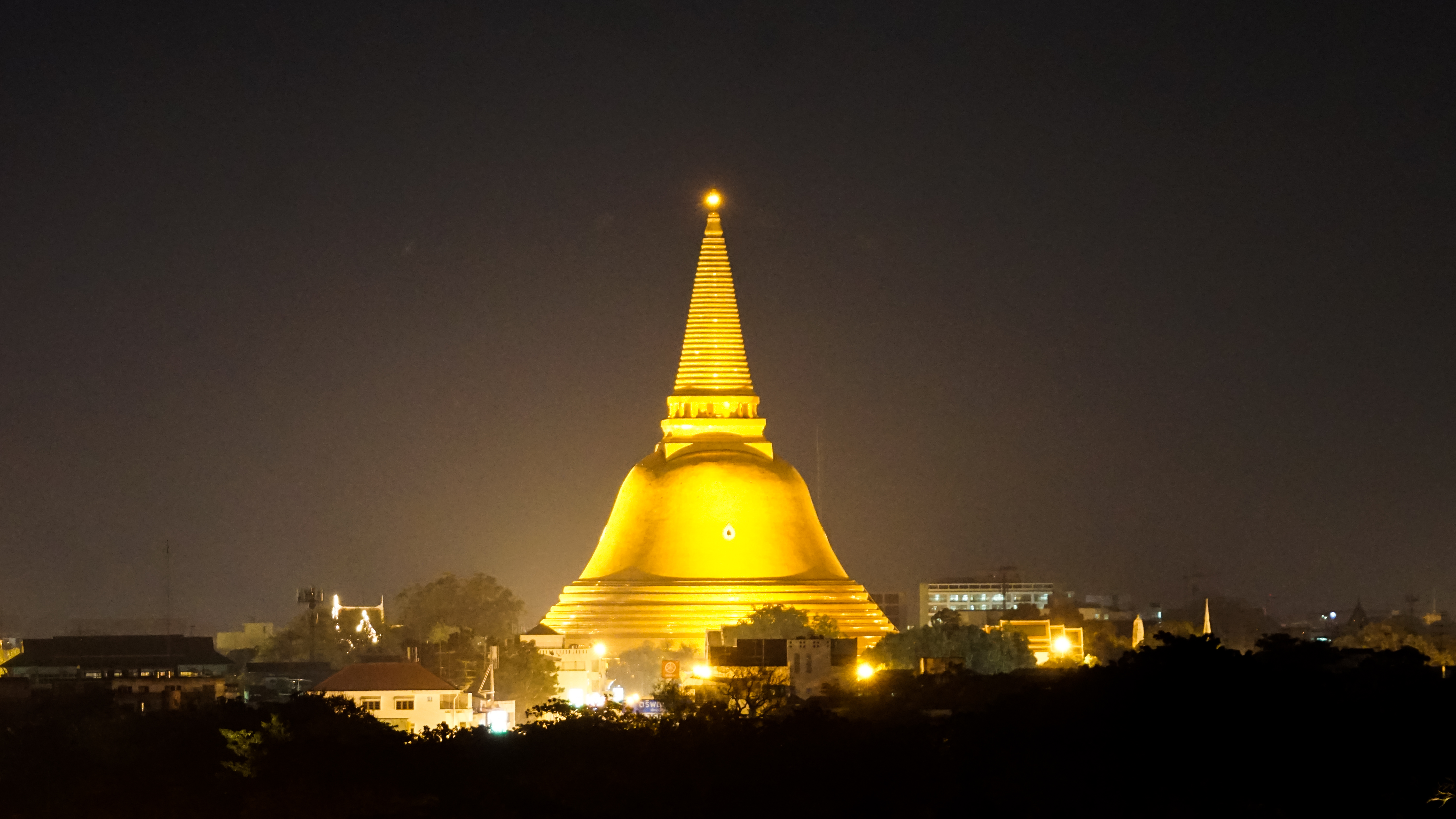
Phra Pathom Chedi: The Stupa That Swallowed a Stupa
Before he was king, Mongkut was a monk. In 1831, wandering the countryside of central Thailand during a 27-year monastic period, the prince stumbled upon a massive ruin near the town of Nakhon Pathom -- the remains of an 84-meter prang-topped stupa that archaeological evidence dates to the 4th century. He recognized it as one of the earliest Buddhist monuments in the region, a relic of the Dvaravati civilization that had flourished here between the 6th and 8th centuries. He asked King Rama III for permission to restore it. Rama III refused. When Mongkut finally took the throne in 1851, he did something more ambitious than restoration: he built an entirely new stupa around the old one, encasing the ancient ruin inside a bell-shaped Sri Lankan-style monument that now rises 120.45 meters above the temple grounds -- the tallest stupa in Thailand.
Layers Upon Layers
The name Phra Pathommachedi translates as "the first holy stupa," and the monument lives up to that claim through sheer geological accumulation. At its core sits the original structure, first mentioned in Buddhist texts from the year 675 but likely older, built in the Dvaravati style with a simple hemispherical brick dome. Over centuries it collapsed and was rebuilt, each iteration adding a new skin over the old. Mongkut's reconstruction, begun in 1853, took seventeen years to complete. Workers encased the ruined prang in a new bell-shaped form, covered it in golden-brown tiles, and anchored the whole structure on a foundation of timbers strapped together with enormous metal chains. The result is a stupa within a stupa -- a monument that contains its own history.
A Mandala in the Landscape
Seen from above, the complex reveals its organizing logic. The temple layout forms a giant Buddhist mandala, with Phra Pathommachedi at the center representing Mount Meru, the cosmic axis of Buddhist cosmology. Four viharas mark the cardinal directions, each housing significant Buddha images. The northern vihara contains the Phra Ruang Rojanarit, a standing bronze Buddha erected by King Vajiravudh in 1913. At its base, a gilded niche at each cardinal point holds a Buddha image. The circumference of the stupa's base measures 235.50 meters -- wide enough that walking around it at a contemplative pace takes real time. Pilgrims make this circuit as an act of devotion, circling the monument clockwise as Buddhist tradition prescribes.
The Legend of Patricide
Because the stupa's true origins are lost, legends have grown around it. The most famous is the tale of Phraya Gong and Phraya Phan. Phraya Gong, a king of Nakhon Chai Si, received a prophecy that his infant son Phan would one day kill him. He abandoned the child, who was raised by a woman called Granny Hom in the vassal city of Ratchaburi. Years later, grown and powerful, Phan accidentally fulfilled the prophecy -- killing Phraya Gong without knowing the man was his father. Overwhelmed with grief, Phan built Phra Pathommachedi as an act of atonement, enshrining a relic of the Buddha inside. The legend echoes the Oedipus myth in its broad strokes, and whether or not it contains any historical kernel, it anchors the stupa to a story of guilt, consequence, and the attempt to build something sacred out of tragedy.
The Festival and the Living Temple
Every November, on the full moon of the 12th month in the traditional Thai lunar calendar, the Phra Pathommachedi Festival transforms the temple grounds. Since 1974, the festival has raised funds for the stupa's maintenance over five to nine nights of markets, performances, and candlelit processions. On November 2 each year, a separate ceremony marks the birthday of Phra Ruang, the sacred image installed in the northern vihara. The stupa is not a museum piece. It sits in the center of Nakhon Pathom, a working temple surrounded by the rhythms of a Thai city. Monks chant in the viharas. Pilgrims circle the base. The golden-brown tiles catch the central Thai sunlight, and the monument that Mongkut built around a ruin continues to function exactly as he intended -- as a living assertion that Buddhism arrived here first, and has never left.
From the Air
Phra Pathom Chedi (13.82N, 100.06E) is in the center of Nakhon Pathom, about 56 km west of Bangkok. The golden stupa, 120.45 meters tall with a 235-meter base circumference, is the dominant vertical feature in the city and clearly visible from altitude. Nearest airports are Don Mueang (VTBD) approximately 70 km east and Suvarnabhumi (VTBS) approximately 80 km east. The city lies in the flat central Thai plain, making the stupa's height especially prominent against the landscape.