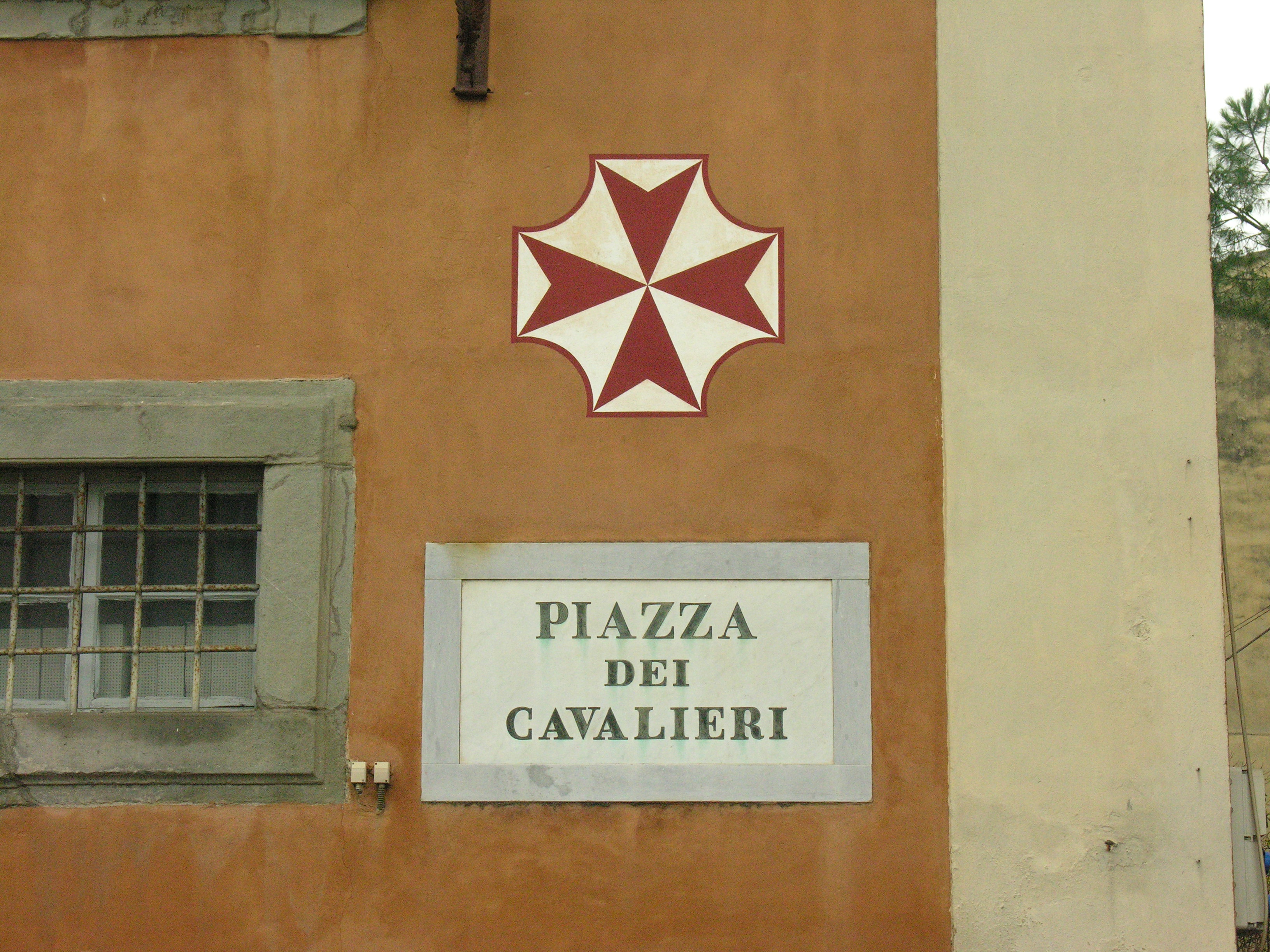
Piazza dei Cavalieri
Enrico Fermi studied here. So did the poet Giosue Carducci. The square where they walked to class each morning had already seen a thousand years of power shift hands -- from Pisan elders to Florentine conquerors, from crusading knights to Napoleon's university reformers. Piazza dei Cavalieri is Pisa's other great square, less famous than the Piazza dei Miracoli but arguably more interesting for what it reveals about how Italian cities reinvent themselves, century after century, on the same stones.
The Republic's Beating Heart
In 1254, the People of Pisa -- the Popolo Pisano -- triumphed in their internal power struggles and built the Palace of the People and the Elders directly on this square. They joined existing buildings together into something grander, a statement that governance belonged here. The Captain of the People took residence in the nearby Clock Palace beginning in 1357, its structure incorporating older towers into its walls. Courts of law, administrative offices, and the residence of the Podesta filled the southern edge. Even a church stood here, Saint Sebastian alle Fabbriche Maggiori, named after the blacksmith workshops -- the fabbri -- that once clanged and hammered in the surrounding streets. The church had been present since at least 1074, anchoring the civic life of the quarter long before the palace rose beside it.
A Republic Falls, a Knight Order Rises
On this very pavement, in 1406, a Florentine emissary proclaimed the end of Pisan independence. The buildings remained, but the names on the doors changed -- Florentine commissioners replaced Pisan elders, and a chief of custody took the Captain of the People's chair. The square waited a century and a half for its next transformation. In 1558, Grand Duke Cosimo I de' Medici commissioned Giorgio Vasari to rebuild the entire square in Renaissance style, converting it into the headquarters of the Order of the Knights of Saint Stephen, a crusading order Cosimo founded to combat Ottoman piracy in the Mediterranean. Vasari demolished the old church of Saint Sebastian and reshaped every facade, creating the harmonious ensemble that survives today. The Palazzo della Carovana, with its elaborate sgraffito decoration, became the order's training house -- the carovana referring to the obligatory naval expeditions young knights undertook.
From Knights to Nobel Laureates
Napoleon Bonaparte saw something else in these buildings. When he founded the Scuola Normale Superiore di Pisa, modeled on Paris's Ecole Normale Superieure, the Palazzo della Carovana became its home. The knights' training hall became lecture rooms. Where young nobles once prepared for Mediterranean combat, some of Italy's finest minds would gather instead. The university has produced extraordinary alumni: Carducci won the Nobel Prize in Literature in 1906, and Fermi's work in nuclear physics would reshape the twentieth century. The transformation feels almost too neat -- a building designed to produce warriors of the body becoming a factory for warriors of the mind -- but the continuity is real. The square still functions as a place where young people are shaped by demanding institutions, just as it has for seven centuries.
Shadows in the Clock Tower
The Palazzo dell'Orologio, the Clock Palace, holds one of Pisa's darker stories within its walls. The tower incorporated into its structure is the Torre dei Gualandi, also known as the Muda Tower, where in 1289 Count Ugolino della Gherardesca and his sons and grandsons were imprisoned and starved to death after political intrigues. Dante immortalized the scene in the Inferno, making it one of the most harrowing passages in all of Western literature. Vasari's elegant facade smoothed over the medieval brutality, joining the tower into the Clock Palace's refined lines. But the bones of the story remain behind the stucco. Across the square, the Church of Santo Stefano dei Cavalieri, designed by Vasari himself, displays captured Ottoman naval flags and ships' lanterns -- trophies from the same crusading campaigns the knights trained for next door.
The Square Today
Walking through Piazza dei Cavalieri now, you encounter students carrying laptops past a bronze statue of Cosimo I, ambulances from the Confraternita della Misericordia -- a Catholic charitable organization still operating from the square -- and tourists who have wandered from the more famous tower a few blocks west. The Palazzo del Collegio Puteano, the Palazzo del Consiglio dei Dodici, and the Canonica frame the space with understated authority. What strikes you is the layering: medieval towers absorbed into Renaissance facades, a crusading order's headquarters repurposed for higher education, a place of political execution transformed into a place of intellectual ambition. Piazza dei Cavalieri is Pisa in miniature -- a city that builds its future on top of its past, never quite erasing what came before.
From the Air
Located at 43.719N, 10.400E in central Pisa, approximately 500 meters east of the more famous Piazza dei Miracoli. Best viewed at 2,000-3,000 feet AGL. Nearest airport is Pisa International (LIRP/PSA), just 2 km south of the city center. The square sits within the dense medieval street grid on the north bank of the Arno River.