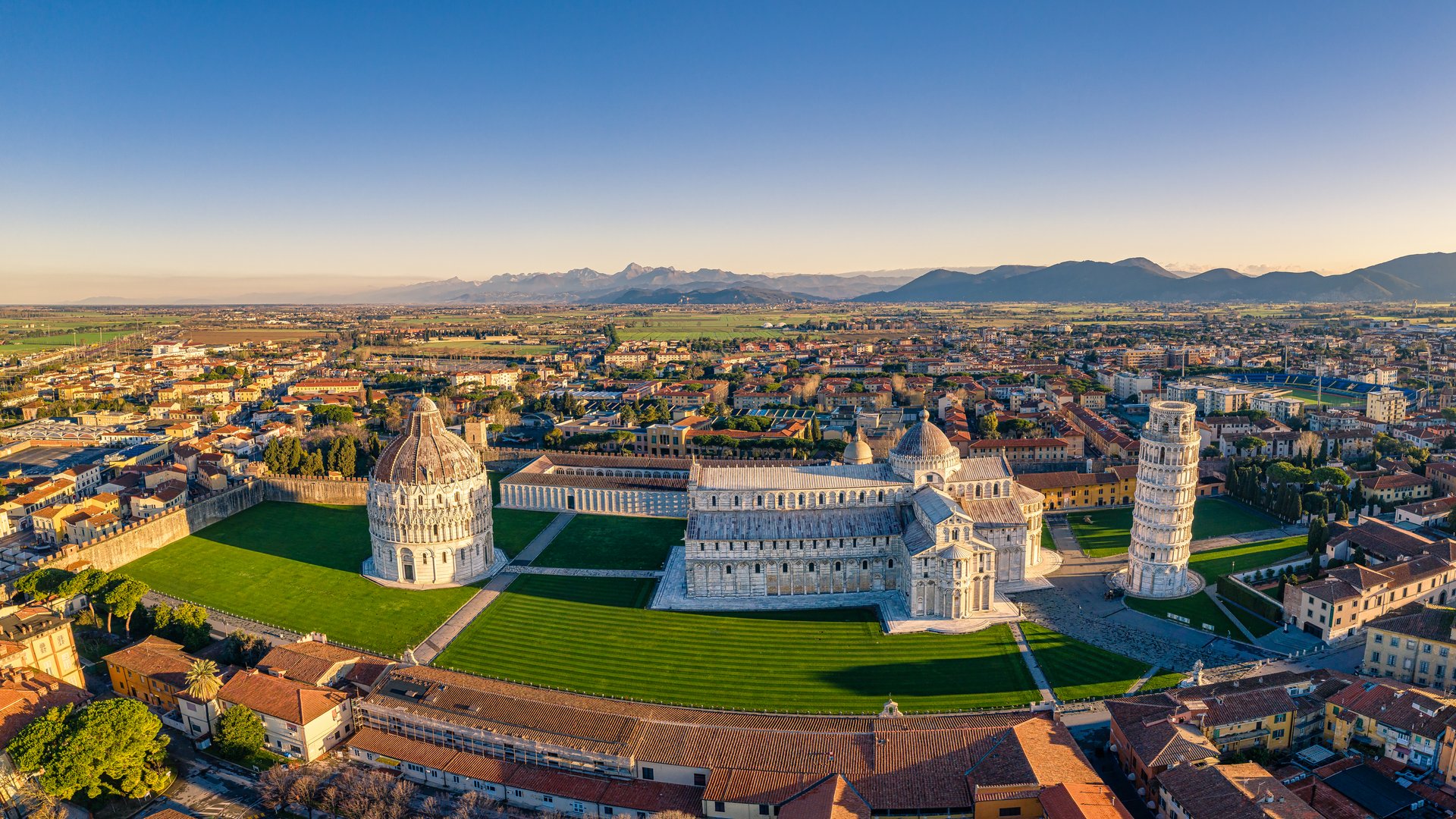
Piazza dei Miracoli
The poet Gabriele D'Annunzio called it the prato dei Miracoli -- the meadow of miracles -- in his 1910 novel, and the name stuck because it was exactly right. Within an 8.87-hectare walled compound in central Pisa, four buildings stand on green grass that seems almost impossibly bright against their white marble: a cathedral begun in 1064, a baptistery started in 1152, a bell tower that began to lean almost immediately after construction started in 1173, and a cemetery said to contain sacred soil shipped from Calvary during the Third Crusade. Nothing about the arrangement feels accidental, and nothing feels entirely planned either. It took four centuries and countless architects to complete, yet the result is one of the most harmonious architectural ensembles in Western civilization.
A Cathedral Born from Naval Victory
The story begins at sea. In 1063, Pisan warships captured the mosque of Palermo, and the granite Corinthian columns they hauled home still separate the nave from the aisles of Pisa Cathedral today. Construction began the following year under the architect Buscheto, whose tomb is embedded in the facade he designed. The building set the template for an entire architectural language -- Pisan Romanesque -- with its tiers of open galleries, grey and white marble banding, and the Byzantine-inflected mosaics that line the interior. Galileo is said to have watched an incense lamp swinging from the nave ceiling and formulated his theory of the pendulum, though the lamp hanging there today is not the one he observed. That simpler original now sits in the Camposanto. The cathedral's role even extended to timekeeping: for nearly eight centuries, Pisa reckoned the new year by a ray of sunlight striking an egg-shaped marble near Giovanni Pisano's pulpit at noon on March 25.
The Baptistery That Outgrew Its Architect
Diotisalvi -- his name means 'God Save You' -- signed his work and began the baptistery in 1153 in pure Romanesque style. He never saw it finished. Two hundred years later, Nicola and Giovanni Pisano completed the upper stories in Gothic style, adding the loggia and dome that give the building its distinctive layered appearance. At 54.86 meters tall, it is the largest baptistery in Italy, and with the statue of Saint John the Baptist on top, it actually edges out the Leaning Tower by a few centimeters. The dome itself is split in half: lead sheets clad the side facing the cathedral, while red terracotta tiles cover the side facing the sea, giving the building a strikingly asymmetric appearance from the south. Inside, the acoustics are extraordinary -- a single note sung at the center resonates through the circular space in haunting, overlapping harmonics. Nicola Pisano's pulpit, dated 1260, is often cited as the starting point of the Italian Renaissance in sculpture, its classical nude Hercules a radical departure from medieval convention.
The Tower That Would Not Stand Straight
Construction began in 1173 and the problems started almost immediately. By the time the third floor was complete, five years in, the weak subsoil had already tipped the structure to the south. The builders simply walked away for a century, which may have saved the tower -- the long pause allowed the ground to compress and stabilize. When work resumed in 1272, engineers built the upper floors with one side deliberately taller than the other, giving the tower its subtle banana curve. The bell chamber was finally added in 1372, completing 177 years of intermittent construction. Seven bells hang inside, cast to the notes of the musical scale, the largest weighing 3,620 kilograms. At its worst lean, measured before 1990, the tower tilted 5.5 degrees from vertical. Engineering interventions have since reduced this to about 4 degrees -- enough to preserve the famous tilt while preventing catastrophe. The 296 steps to the top remain open to visitors, though the climb itself tilts disconcertingly underfoot.
A Cemetery of Sacred Earth and Shattered Frescoes
The Camposanto Monumentale stretches along the square's northern edge, a long Gothic cloister begun in 1278 by Giovanni di Simone -- who died six years later when Pisa lost the naval Battle of Meloria to Genoa. Legend holds that Archbishop Ubaldo de' Lanfranchi filled its central courtyard with earth from Golgotha, brought back during the Third Crusade. The walls were once covered in frescoes spanning three centuries, including Buonamico Buffalmacco's Triumph of Death and Benozzo Gozzoli's Stories of the Old Testament. On July 27, 1944, Allied incendiary bombs set the roof ablaze. Molten lead poured over the painted walls, destroying or severely damaging nearly everything. Decades of painstaking restoration followed. The frescoes that survived, or were reconstructed from their sinopie -- the original underdrawings now displayed in a museum across the square -- stand as testimony to both the fragility and the resilience of great art.
From the Air
Located at 43.723N, 10.395E in northwestern Pisa. The white marble complex is unmistakable from the air, with the tilting tower immediately identifiable. Best viewed at 2,000-4,000 feet AGL. Pisa International Airport (LIRP/PSA) is just 2 km to the south. The complex sits north of the Arno River, which winds through the city. In clear weather, the marble buildings are visible from considerable distance against the surrounding terracotta roofscape.