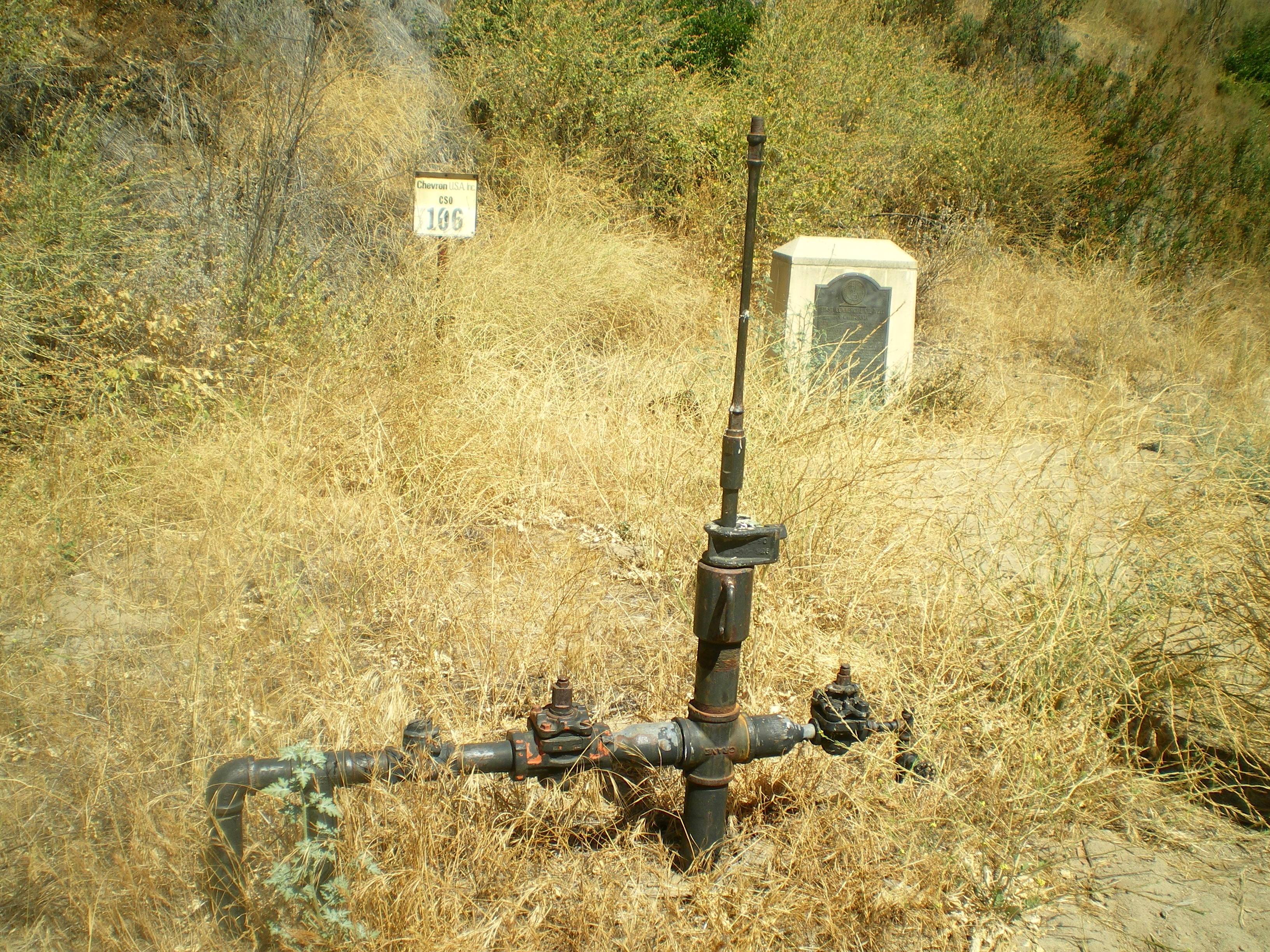
Pico Canyon Oilfield
The man who discovered oil in Pico Canyon reportedly traded his ownership stake in the resulting company for a barrel of spirits and a twenty-dollar gold piece. It was not a good trade. Well No. 4, drilled in 1876 in the Santa Susana Mountains about seven miles west of Newhall, became the first commercially successful oil well in the Western United States and the birthplace of California's petroleum industry—an industry that would, within a generation, reshape the state's economy, landscape, and culture beyond recognition.
The First Strike
California had seen oil before Well No. 4. A short-lived drilling boom had followed Pennsylvania's Drake Oil Well in 1859, but eastern oil proved cheaper and the boom collapsed in 1867, leaving 75 companies with 60 wells and virtually nothing to show for $1 million in investment. Pico Canyon changed the calculus. Charles Mentry, the superintendent of operations, improvised his tools from railroad car axles purchased from the Southern Pacific and welded together. After Well No. 4 proved successful, Mentry built the first oil pipeline in California, running from Pico Canyon to a refinery in Newhall, and later extended it fifty miles to the ocean at Ventura. When a Los Angeles Times reporter visited in 1962, the caretaker's son turned a valve on old Well No. 4 and told him: "Still producing after all these years—only about a barrel a week, but look how rich the oil is." The well ran for 114 years total, finally capped in 1990.
A Boomtown in the Canyon
The success of Well No. 4 sent California's oil production soaring: 568,000 barrels in 1879, nearly 1.8 million in 1880, more than 4 million by 1881. A town called Mentryville grew up near the well, named after the superintendent who treated his workers with enough dignity that the operation never suffered a strike. When Mentry died in 1900, the entire town of more than 200 people—all but three individuals—traveled to Los Angeles for his funeral, carrying a floral arrangement in the shape of an oil derrick. By 1895, the Pacific Coast Oil Company was operating 40 wells in Pico Canyon, producing 500 barrels a day. The Los Angeles Times editor who rode out on horseback in 1882 found his horse refusing to drink from the canyon stream, which was "about half crude oil and half water."
What Remains in the Hills
Mentryville today is a ghost town and a historic park, open to the public through the efforts of a preservation group called the Friends of Mentryville. The buildings that housed the workers and their families still stand—weathered wood and corrugated metal against the brown hills, preserved because they are the only surviving example of an early California oil company town. Well No. 4 itself was designated a National Historic Landmark in 1966, one of the first sites in Los Angeles County to be listed on the National Register of Historic Places. Hikers now walk the same canyon where men once hauled massive boilers up nearly vertical roads to keep the drills turning.
California's Oil Beginning
The oil that came out of Pico Canyon in the 1870s and 1880s helped build Los Angeles. It fueled the refinery at Newhall, created jobs across the region, and established the supply chains that would eventually make California one of the world's leading petroleum producers. The Pacific Coast Oil Company that dominated Pico Canyon later became part of Standard Oil of California, which became Chevron—a direct lineage from this canyon in the Santa Susana Mountains to one of the world's largest corporations. Chevron, after 145 years in California, relocated its headquarters to Texas in 2024, a quiet closing of a circle that began with an improvised drill and a man who refused to overpay for supplies.
From the Air
Located at 34.37°N, 118.63°W in the Santa Susana Mountains, approximately 7 miles west of Newhall, California. The canyon terrain is visible from the air at 3,000–5,000 feet MSL. Look for the narrow canyon cutting through the chaparral hills northeast of Simi Valley. Nearest airports: KWHP (Whiteman Airport, ~15 miles east), KVNY (Van Nuys, ~18 miles east). The ghost town of Mentryville sits near the canyon floor and is accessible via a hiking trail.