Pidurangala Rock
Everyone photographs Sigiriya. The people who climb Pidurangala photograph Sigiriya too, but from the one vantage point that reveals the Lion Rock as its builders might have seen it: a solitary red column rising from green plains, surrounded by the geometric traces of ancient gardens and moats. Pidurangala Rock sits barely a kilometer to the north, a granite outcrop of similar geological origin but entirely different character. Where Sigiriya became a fortress and a symbol, Pidurangala remained what both rocks were before kings intervened: a monastery.
The Monks Who Were Moved
When King Kashyapa arrived at Sigiriya in the late 5th century, he found what he wanted for a fortress but not what he expected: monks. Buddhist monastic communities had occupied the caves and shelters around Sigiriya's base since at least the 3rd century BCE, and they were not about to be simply displaced. Kashyapa, whatever his other failings, understood that a king who evicted monks would lose the legitimacy he desperately needed. So he built them a new home. At Pidurangala, barely a kilometer to the north, he constructed a monastery complex spread over more than thirteen acres, complete with the five ritual structures required for a proper Buddhist establishment: a chapter house, an image house, a Bo-tree shrine, a stupa, and monks' dwellings. The monastery housed over five hundred meditating monks. Only after they were settled did Kashyapa begin transforming Sigiriya into his fortress-palace.
The Reclining Buddha
Partway up the rock, sheltered beneath an enormous overhanging boulder, lies a monumental reclining Buddha made of brick, clay, and limestone. The statue stretches approximately 48 feet long, its form following the gentle curve of the rock shelter above it. It was created during Kashyapa's reign in the 5th century, part of the image house he built for the relocated monks. Time and treasure hunters have damaged portions of the statue, but the remaining sections still convey the calm of the original composition. Near the base of the rock, a white temple marks the entrance to the monastery grounds, and Kashyapa's own stupa stands near the path. Remains of a second stupa sit at the summit. These are not tourist attractions grafted onto the landscape but the bones of a functioning monastic community that thrived here for centuries.
Volcanic Bones
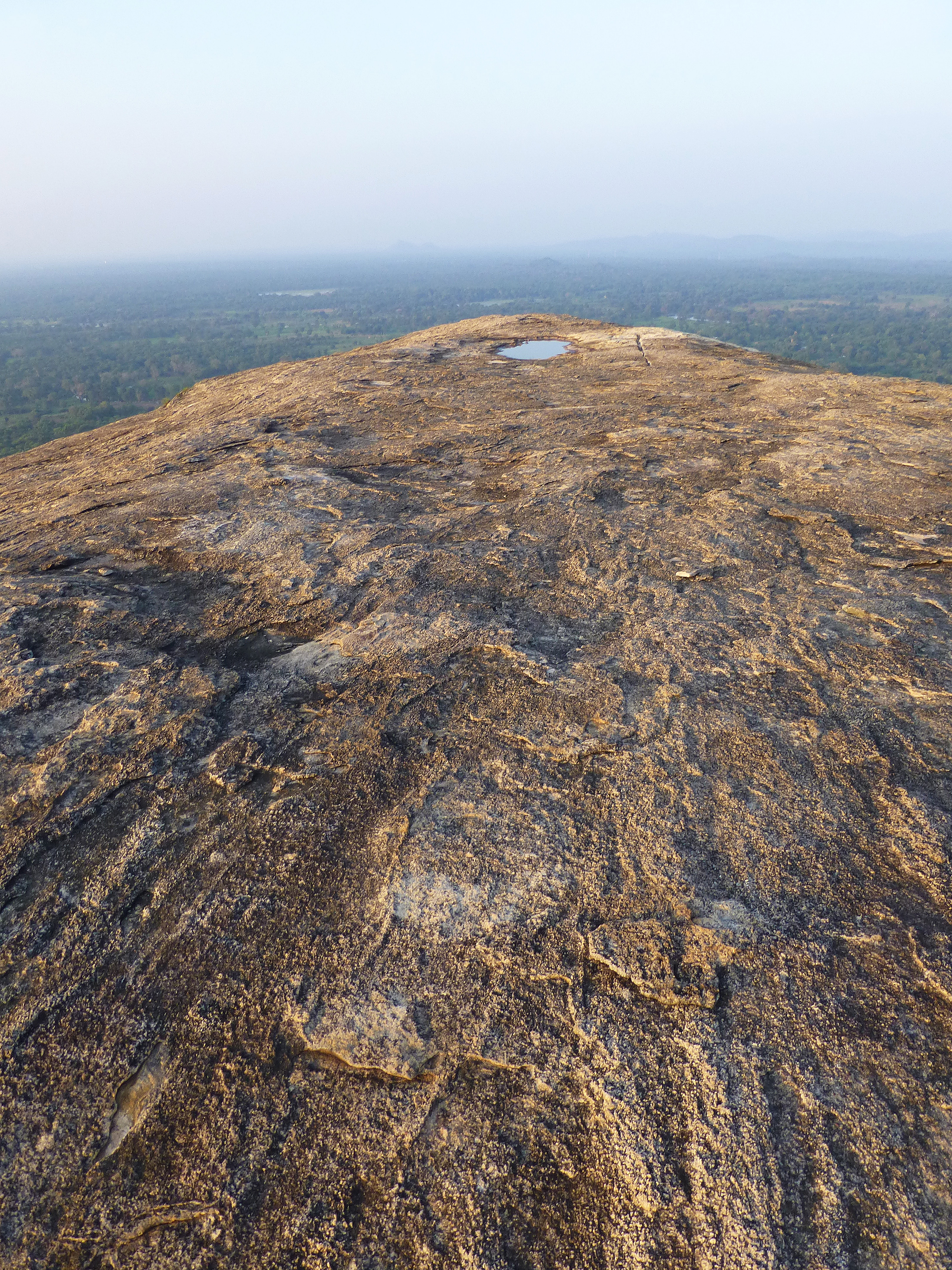
Both Pidurangala and Sigiriya are inselbergs: isolated rock formations that rise abruptly from the surrounding lowlands. They are hardened granite outcrops, the solidified magma plugs of ancient volcanoes whose softer surrounding rock eroded away over millions of years, leaving only these resistant cores standing. The flat plains of central Sri Lanka extend from the island's central mountain range, and the inselbergs punctuate them like geological exclamation marks. From the air, the pair looks like two teeth protruding from a green jaw. NASA's Earth Observatory has featured satellite imagery of the Sigiriya-Pidurangala formation, noting how dramatically the bare rock contrasts with the surrounding vegetation. The geological kinship between the two rocks gives them a visual family resemblance, but Pidurangala is broader and less sheer than its famous neighbor, making the climb more of a scramble over boulders than a staircase ascent.
In Sigiriya's Shadow, On Its Own Terms
Pidurangala has long been described as existing in the shadow of Sigiriya, and for most visitors that is literally true: they climb it for the photograph, the postcard-perfect view of the Lion Rock at sunrise. But the monastery predates Kashyapa's fortress, and the religious significance of Pidurangala extends beyond its usefulness as a viewpoint. Archaeological excavations by Klaus Kilian and Hans-Joachim Weishaar in the upper rock shelter have revealed layers of habitation reaching deep into Sri Lanka's past. The site's connection to the broader Sigiriya-Dambulla religious and archaeological region makes it part of one of the densest concentrations of ancient Buddhist sites in the world. The climb itself passes through forest, over exposed rock, and between boulders that require hands and feet to navigate. At the summit, the panoramic view extends in every direction across the Sri Lankan plains. Sigiriya dominates the southern horizon, of course. But standing on Pidurangala, surrounded by ancient stupa remains and wind, you are not looking at Sigiriya from outside. You are looking at it from the place where its displaced monks built their new lives.
From the Air
Pidurangala Rock is at 7.966N, 80.762E, approximately 1 km north of Sigiriya. It is a broad granite inselberg, less dramatic in profile than Sigiriya but clearly visible as a bare rock outcrop amid green terrain. The two rocks form a distinctive pair when viewed from altitude. Nearest airport: Sigiriya (VCCS/GIU), approximately 5 km away. Bandaranaike International (VCBI/CMB) is the nearest international airport, about 170 km west. Best viewed at 2,000-5,000 feet AGL. The white temple at the base of the rock may be visible as a bright spot against the green forest.