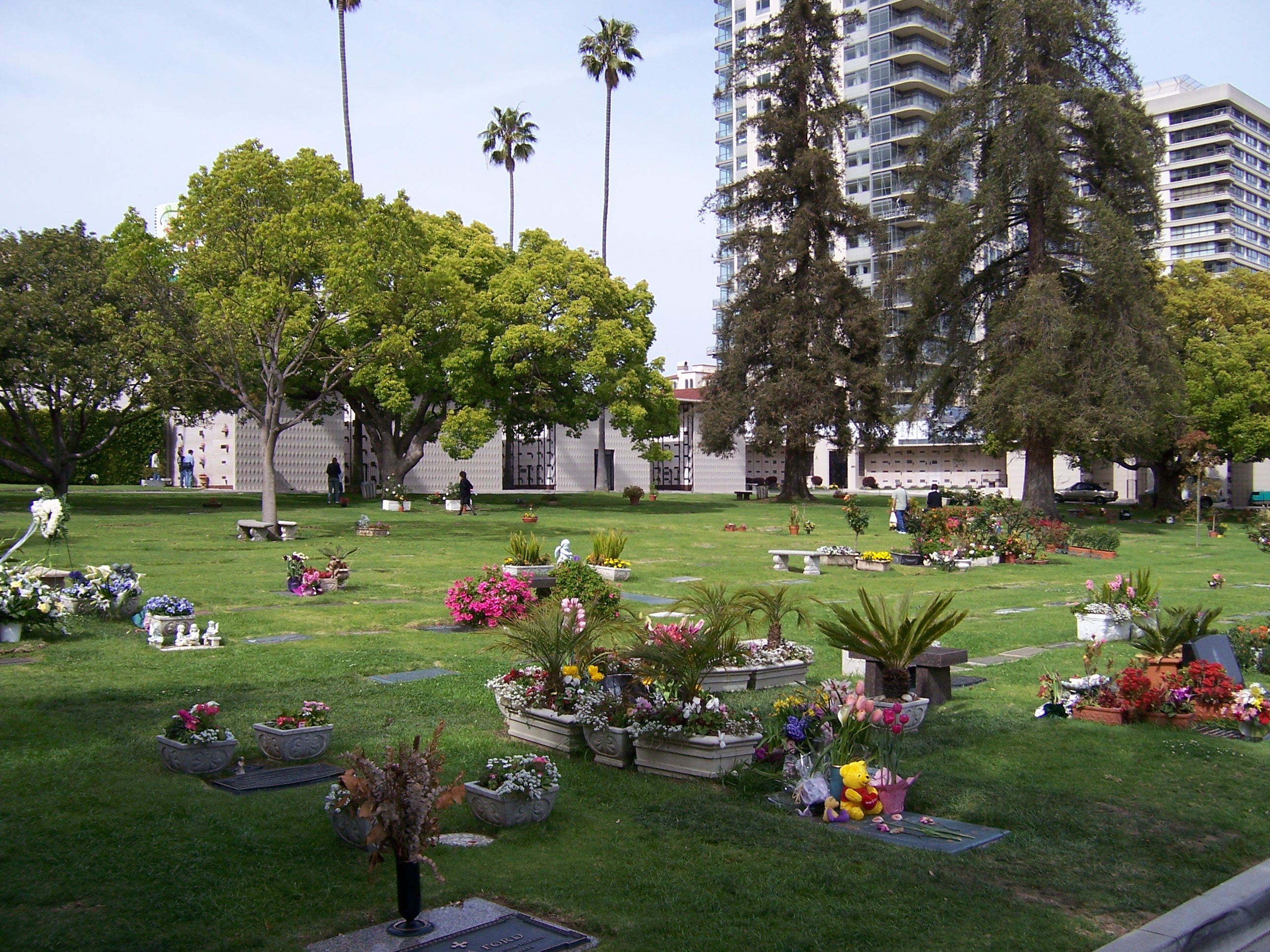
Pierce Brothers Westwood Village Memorial Park
The cemetery is easy to miss. It occupies less than two acres behind a strip of Westwood Village shops, its entrance on Glendon Avenue understated for a place that holds so much. But the people buried here — Marilyn Monroe, Natalie Wood, Dean Martin, Truman Capote, Frank Zappa, Roy Orbison, Burt Lancaster, Walter Matthau, Jack Lemmon — make this small, quiet space one of the most visited cemeteries in the world.
A Small Place with a Long History
The land had been used for burials since the 1880s, when Westwood was still open country on the western edge of a city that had not yet imagined the scale it would achieve. The cemetery was formally established as Sunset Cemetery in 1905, then renamed Westwood Memorial Park in 1926, and eventually acquired its current mouthful of a name through later ownership.
Its size — just under two acres — is what makes it distinctive among Los Angeles cemeteries and, in a way, what makes it moving. The great forest cemeteries of the East, the sprawling memorial parks of Forest Lawn, accommodate the famous and the unknown in equal anonymity over hundreds of acres. Westwood Memorial is small enough that you can walk from one end to the other in minutes, that the graves of the famous sit close together, that the scale of celebrity is compressed into something almost domestic.
Marilyn Monroe has been here since August 8, 1962, three days after her death. Hugh Hefner, who reportedly paid $75,000 for the crypt beside hers so he could spend eternity next to the woman whose photograph had launched his magazine, was interred alongside her in 2017.
The Names on the Stones
The range of the famous buried here traces the contours of 20th-century entertainment. Dean Martin, whose career spanned from the Rat Pack to the celebrity roasts, lies here. So does Roy Orbison, whose grave is unmarked — a choice that reflects either humility or privacy, depending on how you read it. Frank Zappa, musician and satirist, is also unmarked, his resting place known mainly to fans who have looked it up.
Carroll O'Connor, who played Archie Bunker. Jack Lemmon, who left instructions that his grave marker read simply 'Jack Lemmon in:' — as if death were the credit for his next role. Walter Matthau, who lies nearby, having made audiences laugh alongside Lemmon for thirty years. Burt Lancaster, who spent his career alternating between Hollywood spectacle and serious dramatic work and did both well.
Natalie Wood, the actress who drowned off Catalina Island in November 1981, is buried here. Truman Capote, who wrote Breakfast at Tiffany's and In Cold Blood and spent his last decade destroying himself in public, arrived in 1984. Armand Hammer, oil tycoon and art collector who spent a lifetime navigating the space between capitalism and Soviet diplomacy, came in 1990.
Domingo Ghirardelli, whose chocolate bears his name, was buried here in 1894, before the famous dead began to accumulate.
The Weight of a Small Place
Every cemetery is an argument about how the living remember the dead. Westwood Memorial makes a particular argument: that some deaths deserve to be remembered in proximity to other significant deaths, that the famous and the influential benefit from being interred in a community of the famous and the influential, even after the fact of their fame can no longer matter to them.
The visitors who come here — and they come in significant numbers, many of them traveling specifically to see Monroe's crypt or find the unmarked graves of their favorite musicians — are doing something that involves both grief and celebrity culture in proportions that vary by visitor. Some are fans paying tribute to artists whose work shaped them. Others are tourists completing a checklist.
But the small cemetery, with its two acres and its decades of arriving famous dead, does something that larger, more famous memorial parks do not quite manage: it makes the mortality of the famous feel close. The stones here are close together, the names legible from nearby, the evidence of endings arranged in a space that cannot be easily abstracted into landscape.