Pierre Charles L'Enfant
He changed his name from Pierre to Peter the moment he set foot on American soil in 1777, a 23-year-old Parisian artist so swept up in the cause of revolution that he would carry a musket and a sketchpad into battle. Peter Charles L'Enfant had trained at the Royal Academy in the shadow of the Louvre, absorbing the grandeur of the Tuileries Garden and the Champs-Elysees, studying baroque city plans for Rome and London. He could not have known that those lessons in beauty and ambition would one day shape the capital of the nation he had crossed an ocean to defend.
The Soldier Who Sketched Generals
L'Enfant arrived in America recruited by none other than Beaumarchais, the playwright-turned-arms-dealer, and threw himself into the Continental Army as an engineer under Lafayette. He served on George Washington's staff at Valley Forge, where Lafayette commissioned him to paint the general's portrait. During the war he produced pencil portraits of officers and panoramic paintings of encampments -- including a seven-and-a-half-foot canvas of Washington's tent at Verplanck's Point, believed to be the only wartime depiction of that tent by an eyewitness. He illustrated the military's "Blue Book" of troop formations, the only trained artist available for the job. But L'Enfant was no mere observer. He was wounded at the Siege of Savannah in 1779 and captured at the fall of Charleston in 1780. Congress promoted him to major by brevet in 1783, recognizing a man who had bled for liberty while documenting it in ink and paint.
A Vision Five Times Too Grand
When Congress authorized a new federal district on the Potomac in 1790, L'Enfant lobbied Washington directly for the commission to plan it. He arrived in Georgetown on March 9, 1791, set up at Suter's Fountain Inn, and began envisioning a city as large as New York, Boston, and Philadelphia combined -- built for a million residents. His plan placed the "Congress House" atop Jenkins Hill, with a sunburst of diagonal avenues radiating outward, and connected it to the "President's House" by a narrower road he never lived to see named Pennsylvania Avenue. The Mall would be a democratic space, deliberately the opposite of Versailles, open to all citizens rather than reserved for royalty. He envisioned the President's House at five times the size of what was actually built. Thomas Jefferson wanted something modest; L'Enfant dreamed on the scale of empires.
Fired for Brilliance and Stubbornness
L'Enfant's temperament matched his ambitions. When a wealthy landowner named Daniel Carroll of Duddington built a house directly in the path of planned New Jersey Avenue, L'Enfant ordered it torn down. He refused to hand over his original plans to the surveyor Andrew Ellicott, hinted at secret designs for the Capitol and President's House, and insisted the entire city be built as a unified whole rather than piecemeal. When Washington sent his private secretary Tobias Lear to talk L'Enfant off the ledge, L'Enfant told him he had "already heard enough of the matter" and slammed the door. Washington, who had championed and defended L'Enfant, dismissed him for insubordination. Ellicott revised the plan -- straightening Massachusetts Avenue, reshaping what would become Dupont Circle and Logan Circle -- and carried on. L'Enfant went on to design the city of Paterson, New Jersey, only to be fired from that project too.
Genius, Pauper, Legend
L'Enfant operated on what he considered a gentleman's code: do the work, and compensation will follow. It rarely did. He accepted honorary citizenship from New York after redesigning Federal Hall for Washington's inauguration but turned down a valuable plot of land. A friend and housemate named Richard Soderstrom sued him for a decade of unpaid rent, meals, and firewood -- a lawsuit that stripped L'Enfant of what little money Congress eventually paid him. In his final years, he lived as a permanent guest at a Maryland estate, tending flowers and nursing old ailments. He died on June 14, 1825, and was buried at a farm in Chillum, Prince George's County. For decades, his city languished. Charles Dickens visited in 1842 and called Washington "the City of Magnificent Intentions" -- animals grazed around an unfinished Monument, crime plagued neighborhoods called Murder Bay and Swampoodle, and the Mall was a muddy wasteland.
The View He Was Owed
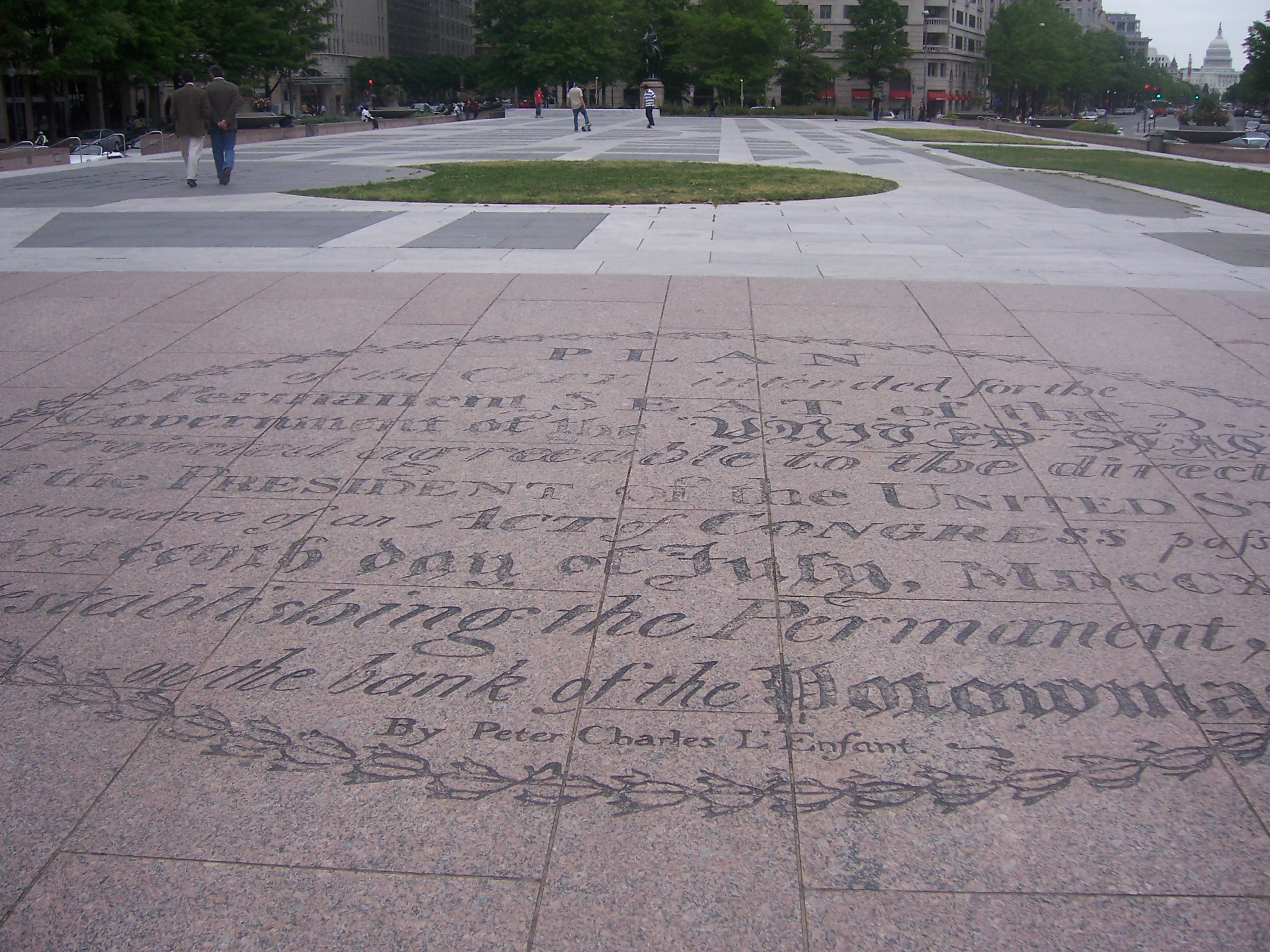
It took the Civil War, Ulysses Grant's infrastructure push, and the McMillan Commission at the turn of the 20th century to finally realize the grandeur L'Enfant had imagined. In 1909, his remains were exhumed and re-interred at Arlington National Cemetery, on a slope in front of Arlington House overlooking the Potomac and the city he had designed. President Taft spoke at the 1911 dedication, where a monument engraved with L'Enfant's original plan was placed on his grave. Today, L'Enfant Plaza bears his name in southwest Washington, Freedom Plaza displays his 1791 plan in marble, and a statue of him stands in the U.S. Capitol. His vision inspired the layouts of Brasilia, New Delhi, and Canberra. The man who was too stubborn to compromise and too proud to demand payment left behind something more durable than either fortune or fame: the bones of a capital city that three centuries of politics have never fully overruled.
From the Air
L'Enfant's gravesite is at Arlington National Cemetery (38.88N, 77.07W), overlooking the Potomac and the city he planned. From the air, the radiating diagonal avenues of his plan are unmistakable -- Pennsylvania Avenue connecting the Capitol to the White House, the long axis of the National Mall, the circles at Dupont and Logan. Nearest airports: KDCA (Ronald Reagan Washington National, 2nm south), KIAD (Dulles International, 25nm west). Best viewed at 3,000-5,000 feet AGL for the full geometric layout of the city.