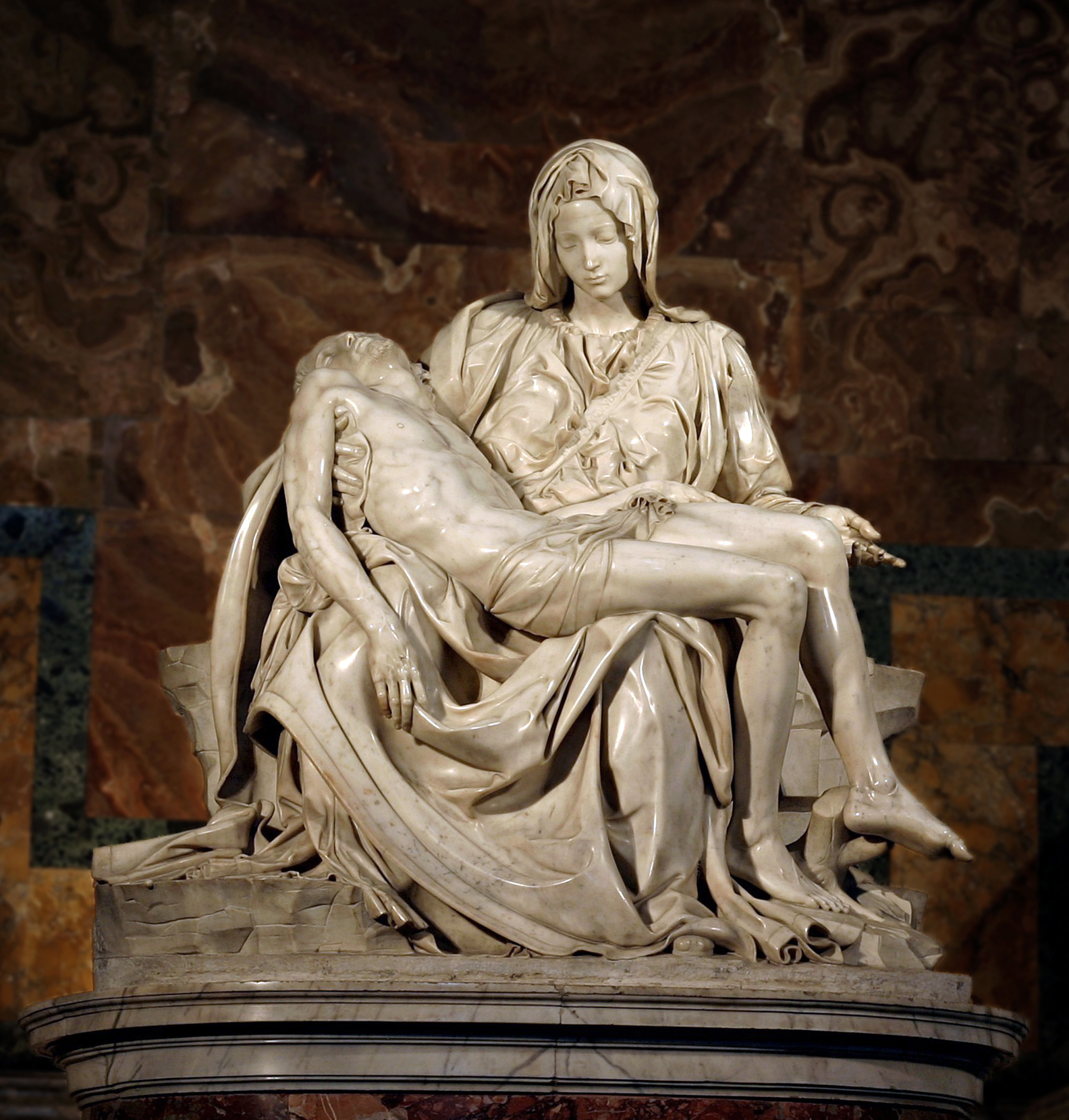
Pieta (Michelangelo)
Michelangelo was 24 years old when he finished carving the Pieta in 1499. He had shaped a mother and her dead son from a single block of Carrara marble, and the result was so astonishing that visitors refused to believe it was his work. According to Giorgio Vasari, the young sculptor overheard someone attribute the piece to Cristoforo Solari. Furious, he returned to the chapel and carved his name across the sash on Mary's chest: MICHAELANGELVS BONAROTVS FLORENTINVS FACIEBAT. He immediately regretted the act of pride and swore he would never sign another work. He kept that promise for the remaining 65 years of his life.
The Commission
A French cardinal named Jean de Villiers de Lagraulas, the Bishop of Condom and French ambassador to the Holy See, commissioned the sculpture as an altarpiece for his own funeral chapel within Old Saint Peter's Basilica. The chapel of Saint Petronilla, where the Pieta first stood, was a circular Roman mausoleum attached to the south transept of the old basilica, with several radiating sub-chapels estimated at about 4.5 meters wide by 2 meters deep. When Donato Bramante demolished the chapel during his rebuilding of the basilica, the sculpture was preserved and eventually moved to its current location: the first chapel on the north side after the entrance of the new Saint Peter's. What began as a private memorial for a French cardinal became one of the most visited works of art in the world.
Virgin Mother, Daughter of Your Son
The Pieta's most striking feature is Mary's youth. She appears younger than her 33-year-old son, a deliberate choice that startled contemporaries. Michelangelo explained to his biographer Ascanio Condivi that her youth symbolized incorruptible purity. But scholars have long suspected another influence: Dante's Divine Comedy, a work Michelangelo knew so thoroughly that he once paid for lodging in Bologna by reciting its verses. In Canto XXXIII of Paradiso, Saint Bernard of Clairvaux addresses Mary as "Vergine madre, figlia del tuo figlio" -- Virgin mother, daughter of your son. That paradox, where the mother is both older and younger than her child, is precisely what the sculpture embodies. The composition is pyramidal, widening from Mary's bowed head through the cascading drapery that conceals the impossible proportions needed to cradle a full-grown man in a woman's lap.
Across the Atlantic and Back
In 1964, Cardinal Francis Spellman's earlier request to Pope John XXIII had secured permission to lend the Pieta to the New York World's Fair -- a loan confirmed by Pope Paul VI after John XXIII's death in 1963. The logistics were extraordinary. The marble sculpture was placed in a wooden crate with walls 2.5 inches thick and an 8-inch base, then secured to the deck of the ocean liner Cristoforo Colombo. The crate's cushioning was designed to float in case of shipwreck, with an emergency locator beacon and marker buoy attached. At the fair, visitors stood in line for hours to catch a glimpse from a conveyor belt moving past the sculpture. When the Pieta returned to Saint Peter's in November 1965, the weight of the marble broke a metal ventilation cover in the floor, tilting the crate and terrifying its handlers. The statue survived unscathed. The New York Times reported Pope Paul VI's decree: it would never travel again.
Fifteen Blows
On Pentecost Sunday, May 21, 1972, a Hungarian-born Australian geologist named Laszlo Toth walked into the chapel and attacked the Pieta with a geologist's hammer, shouting, "I am Jesus Christ; I have risen from the dead!" In 15 blows, he severed Mary's arm at the elbow, knocked off a chunk of her nose, and chipped one of her eyelids. Onlookers scrambled to collect the fragments of marble that flew off. Some were returned, but many were not, including Mary's nose, which had to be reconstructed from a block cut from the sculpture's own back. An American named Bob Cassilly from St. Louis was among the first to pull Toth away from the statue. The restoration took months of painstaking work. During the process, restorers discovered an initial M carved into Mary's palm, making the Pieta doubly signed, as if Michelangelo had left a secret mark alongside his public one.
Behind the Glass
Since the 1972 attack, the Pieta has stood behind a bulletproof acrylic glass panel. The barrier was replaced and modernized in November 2024 in preparation for the 2025 Jubilee. Visitors now view the sculpture at a remove, unable to approach the marble the way pilgrims once could. Yet the distance changes nothing essential. The sculpture still depicts the moment after the Crucifixion when Jesus is returned to his mother, and Michelangelo's restraint makes the scene more devastating: the nail marks are tiny, the wound in Christ's side is a suggestion, his face shows no trace of suffering. Michelangelo called it "the heart's image." The Pieta was the work that launched a career spanning the Sistine Chapel ceiling, the Last Judgment, and the dome of Saint Peter's itself. He returned to the subject of the Pieta twice more later in life, but completed neither. He was still working on the Rondanini Pieta six days before his death in 1564.
From the Air
The Pieta is housed in Saint Peter's Basilica (41.90N, 12.45E) in Vatican City. The basilica's enormous dome, designed in part by Michelangelo himself, is one of the most recognizable landmarks from the air over Rome. Rome Fiumicino (LIRF) is 25km southwest; Ciampino (LIRA) is 20km southeast. Saint Peter's Square and the Vatican Gardens are immediately visible from altitude. The Tiber River curves just east of the site.