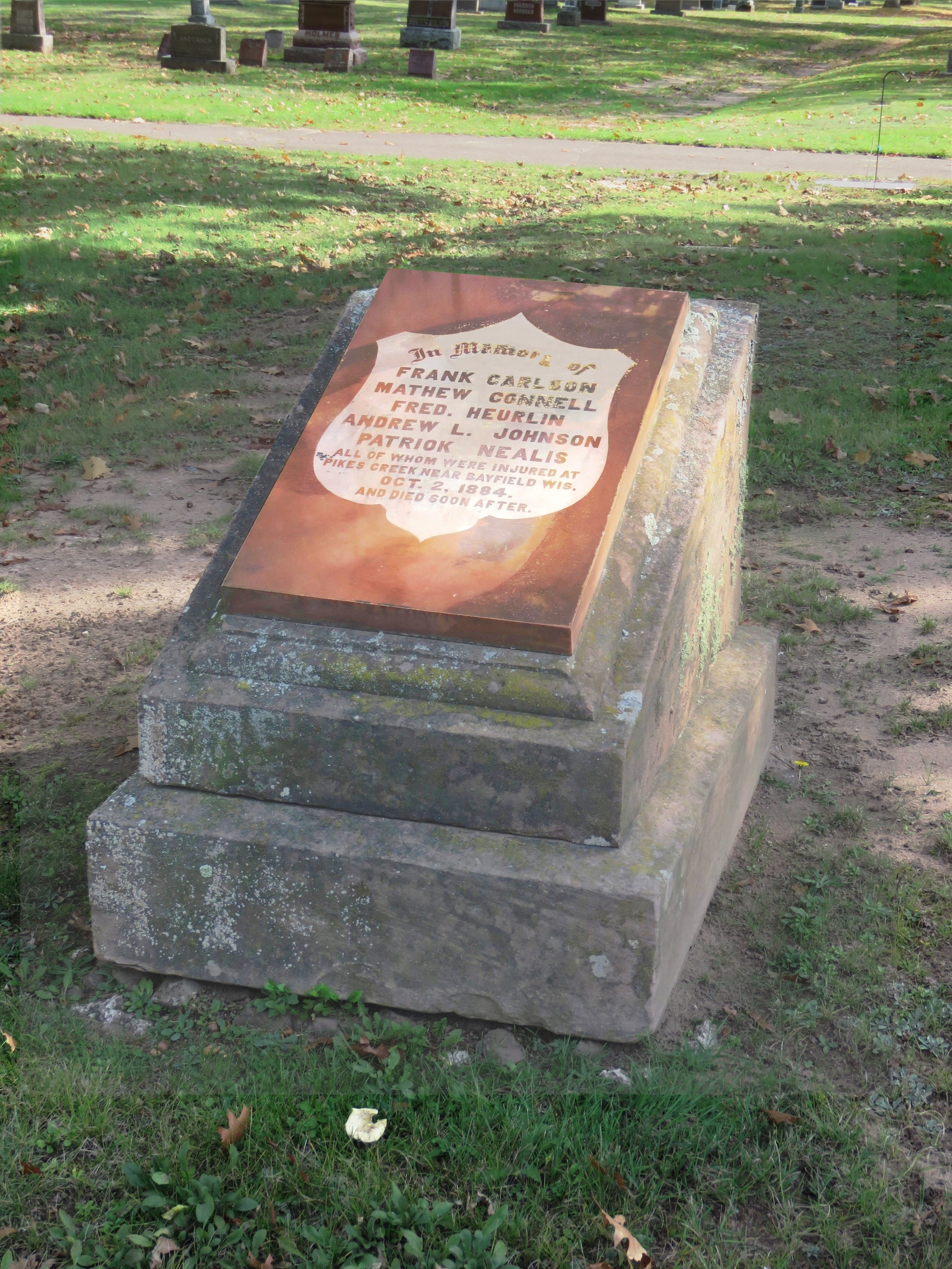
Pikes Creek Tragedy
The men who climbed aboard the work train on October 2, 1884 were heading toward a problem, not away from one. Nearly a week of relentless rain had swollen Pikes Creek from its usual meandering trickle into something unrecognizable, and a quarter-mile south of Bayfield, Wisconsin, the creek had torn out a section of the Chicago, St. Paul, Minneapolis and Omaha Railway's Bayfield branch. The line was less than a year old. When word of the washout reached Washburn, the next station south, the railroad dispatched a repair crew -- twenty-two men loaded onto three flatcars with logs and supplies, hauled by a single locomotive. There was no caboose, no crew car. The men rode wherever they could find space: perched on the flatcars, packed into the locomotive cab, and two of them sitting on the cowcatcher at the very front of the engine.
A Creek That Became a Killer
Pikes Creek drains the hills between Bayfield and Washburn along the south shore of Lake Superior. In ordinary weather, it is a modest stream, the kind of waterway that railroad engineers would have crossed without much thought when they laid the Bayfield branch in 1883. But October 1884 was not ordinary weather. Days of sustained rainfall had saturated the soil and filled every drainage in the region beyond capacity. The creek did not just rise -- it undermined the very ground the railroad sat on. Somewhere between the two towns, the train met the gap. The locomotive and its three flatcars plunged into the swollen creek. The weight of the logs, the force of the water, the sudden collapse of the railbed -- it all happened in moments. Men who had been sitting in the open were thrown into churning water and wreckage.
The Toll in a Small Community
Ten men died. The engineer who was running the train. The conductor overseeing the crew. The brakeman. Seven members of the track gang. Some were killed instantly in the derailment. Others lingered for a day or more, their injuries beyond what the small hospitals in nearby Ashland could properly treat. Those hospitals were overwhelmed -- two small facilities suddenly tasked with the aftermath of a major disaster. The community mobilized in the way small communities do when catastrophe strikes close to home. A local dentist organized a house-to-house collection, going door to door gathering bedding, bandages, and supplies for the injured. Women in the area formed sewing bees, stitching quilts and bedding to replace what the hospitals lacked. In a region where everyone knew everyone, each of the ten dead men had a name that meant something to the people sewing those quilts.
Coast-to-Coast Headlines, Then Silence
News of the wreck traveled fast. The accident was quickly dubbed the Pikes Creek Tragedy, and newspapers from coast to coast carried the story -- though, as one later account noted, the coverage varied considerably in sensationalism and accuracy. The remoteness of the Bayfield Peninsula, the drama of a train swallowed by floodwaters, the round number of ten dead -- it was the kind of story that lent itself to embellishment. A local history published in 1929 by Weber and Sons described the event in careful detail, quoting a writer who declared, 'It is doubtful if a worse tragedy ever occurred in this vicinity than that of October 2, 1884.' But memory is fragile, especially in places where the landscape itself changes. Highway construction eventually obscured the exact location of the wreck. By 2023, according to one local historian, the Pikes Creek Tragedy had become all but forgotten.
A Marker Against Forgetting
In 2023, nearly 140 years after ten men died on a rain-soaked afternoon along the Lake Superior shore, an ad hoc citizens group raised funds to place a marker near the site of the derailment. It was a small act of recovery -- pulling a name and a date back from the edge of erasure. The Bayfield branch of the Omaha Railway is itself long gone, its right-of-way absorbed into roads and overgrowth. Pikes Creek still flows between Bayfield and Washburn, still rises when the rains come heavy in autumn. The marker stands as a reminder that the infrastructure we take for granted -- the railroads, the bridges, the drainage culverts -- was built by specific men who sometimes died in the building. Ten of them, on one October afternoon, riding a work train toward a washout they never reached.
From the Air
Located at 46.7853°N, 90.8635°W along the Lake Superior shoreline between Bayfield and Washburn, Wisconsin, on the Bayfield Peninsula. The wreck site sits roughly midway between the two towns along what was once the Omaha Railway's Bayfield branch. From altitude, the Bayfield Peninsula extends northward into Lake Superior with the Apostle Islands visible to the northeast. Pikes Creek is a small drainage running to the lake, difficult to spot from altitude but the general area is identifiable by the coastline between the two harbor towns. Nearest airport is John F. Kennedy Memorial Airport (KBFW) in Ashland, approximately 15 nm southwest. The terrain is hilly and forested, with the Lake Superior shoreline providing the primary visual reference. Best viewed from 2,000-4,000 feet to appreciate the coastal geography and the narrow corridor between Bayfield and Washburn where the railroad once ran.