Pikes Peak
The Pawnee called it Tus Peh - Where the Heavens Touch the Earth. The Ute people named it Tava-Kaavi, Sun Mountain, and their oral history says they were created on its slopes. Zebulon Pike, the Army officer who gave the peak its European name, never actually reached the top. Standing in waist-deep snow in November 1806, his soldiers wearing only light overalls and no stockings, Pike stared at the summit still miles away and wrote in his journal that he believed no human being could ascend to its pinnacle. Fourteen years later, a young botanist named Edwin James proved him wrong, climbing to 14,115 feet in two days and discovering Colorado's state flower, the blue columbine, along the way.
The Mountain of Many Names
Before it was Pikes Peak, the mountain carried a catalog of identities. The Tabeguache band of the Ute people - whose name means 'People of Sun Mountain' - considered it sacred, a place of creation. The Arapaho knew it as Long Mountain. European explorers called it El Capitan, Grand Peak, Great Peak, and James Peak, after the botanist who first climbed it. The name Pikes Peak stuck not because of any particular achievement by Zebulon Pike - who failed to summit and moved on - but because the 1858 gold rush turned the mountain into America's most famous landmark west of the Mississippi. 'Pikes Peak or Bust' became the rallying cry of prospectors heading to Colorado, even though the actual gold deposits were nowhere near the mountain. The peak's real value to the gold rushers was visibility: it was the first landmark they could see rising above the Great Plains, a massive granite beacon marking the edge of the frontier.
The Song at the Summit
In July 1893, Katharine Lee Bates, an English professor from Wellesley College who had been suffering from depression, traveled to Colorado Springs to teach a summer course. She made the trip to the summit by wagon and mule, and the panoramic view from 14,115 feet unlocked something. The poem she wrote that afternoon - originally titled simply 'Pikes Peak' - became 'America the Beautiful,' first published on July 4, 1895, in The Congregationalist. A plaque at the summit still commemorates the words. Thirty-five years before Bates, Julia Archibald Holmes had stood in the same spot - the first European-American woman to climb Pikes Peak. From the top, she wrote to her mother: 'Nearly everyone tried to discourage me from attempting it, but I believed that I should succeed; and now here I am, and I feel that I would not have missed this glorious sight for anything at all.'
Race to the Clouds
The Pikes Peak Highway winds its way from Cascade to the summit along a series of switchbacks so treacherous at speed they are called 'The W's.' Since 1916, the road has hosted the Pikes Peak International Hill Climb, one of the oldest motor races in America. In 1913, William Wayne Brown drove his car, the Bear Cat, to the summit in five hours and 28 minutes - the first recorded automobile ascent. Today, professional drivers cover the same route in under ten minutes. The iconic short film Climb Dance captured rally legend Ari Vatanen attacking the mountain's gravel switchbacks in a Peugeot 405 T16, a piece of motorsport cinema that became a sensation. The highway is also home to cycling hill climb events, including the USA Cycling Hill Climb National Championships, first held in 2016. The road itself was fully paved only in 2011, after a Sierra Club lawsuit over sediment damage to the alpine environment.
Thin Air and High Doughnuts
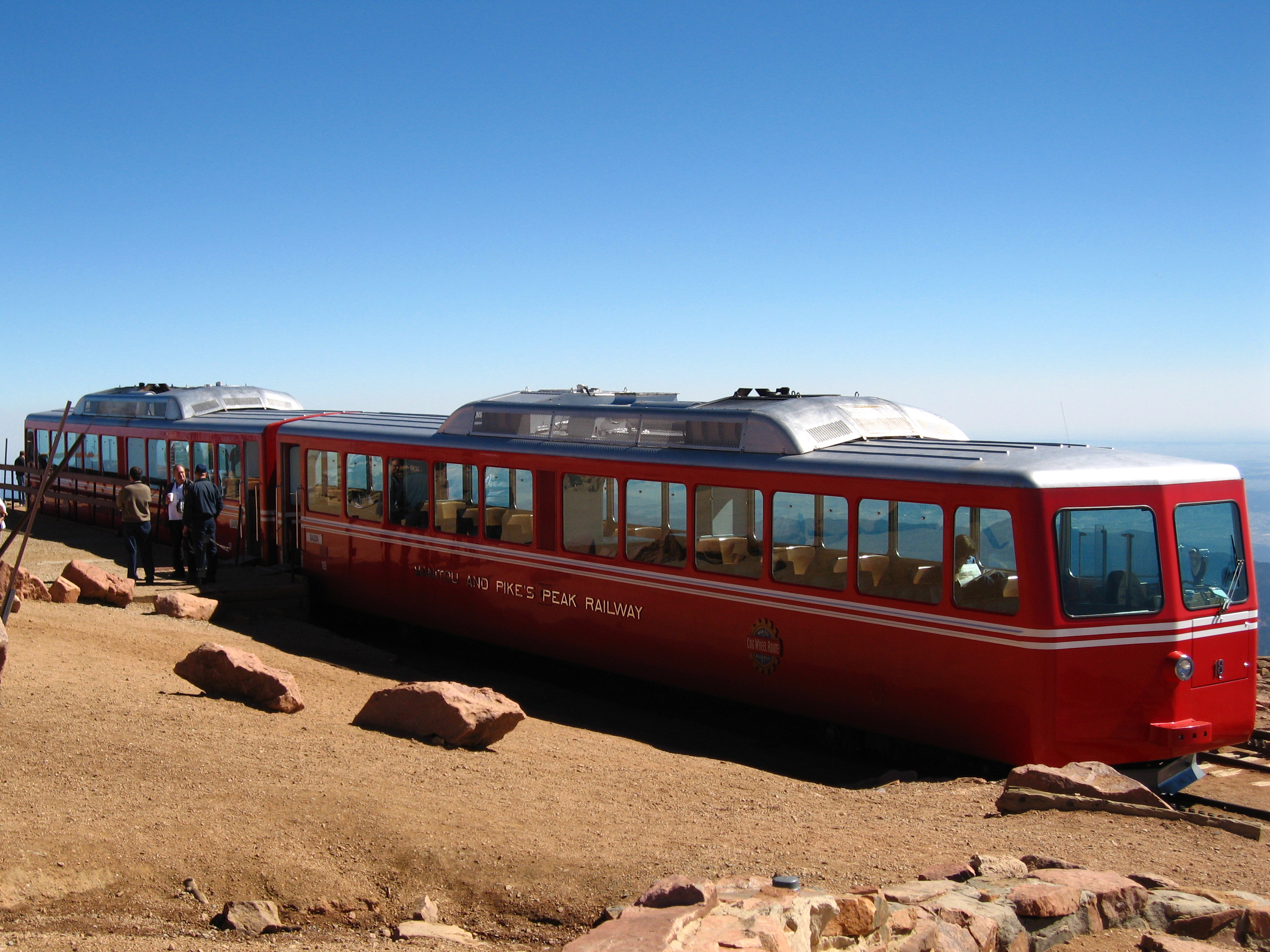
At the summit, the partial pressure of oxygen drops to about 60 percent of sea level. Water boils at a lower temperature, altitude sickness lurks for the unacclimated, and the Summit House sells what may be America's most unusual baked goods: high-altitude doughnuts, fried at a rate of up to 700 per hour, that collapse into mush if carried to lower elevations. The world's highest cog railroad, the Manitou and Pikes Peak Railway, has been hauling passengers from Manitou Springs to the summit since the late 1800s, resuming service in May 2021 after a three-year closure for repairs. Hikers tackle the Barr Trail, a demanding route with nearly 8,000 feet of elevation gain, and the Pikes Peak Marathon has tested runners on this path since 1956. Each New Year's Eve, members of the AdAmAn Club climb through the night to ignite a fireworks display from the summit at midnight - a tradition dating to 1922.
A Summit Above the Permafrost
The uppermost portion of Pikes Peak, above 14,000 feet, was declared a National Historic Landmark in 1961. The summit has a polar climate classification - snow can fall in any month, and afternoon thunderstorms bring winds that gust to hurricane force. Since 1969, the U.S. Army has operated the Pikes Peak Research Laboratory at the summit, studying the effects of extreme altitude on human physiology. A $50 million Summit Complex, groundbreaking in 2018, required contractors to work limited hours in the thin air during a short season of April to October. Building components were prefabricated at lower elevations and trucked up the highway at night. Excavation proved difficult because the summit sits atop alpine permafrost - soil and fractured granite frozen year-round to depths of many feet - that absorbs blasting energy rather than yielding to it. On July 20, 2023, an EF1 tornado touched down on the mountain, a rare event at that altitude, snapping trees along the highway. The peak endures.
From the Air
Located at 38.84°N, 105.04°W in the Front Range of the Rocky Mountains, approximately 10 miles west of Colorado Springs. At 14,115 feet, Pikes Peak is the highest summit east of its longitude in the contiguous United States and a prominent visual landmark from the plains. The Pikes Peak Highway switchbacks are visible on the northwest face. Colorado Springs Airport (COS) lies 15 miles to the southeast. Peterson Space Force Base is nearby. The summit features the Summit House complex and communication towers. Garden of the Gods red rock formations are visible to the east at the mountain's base.