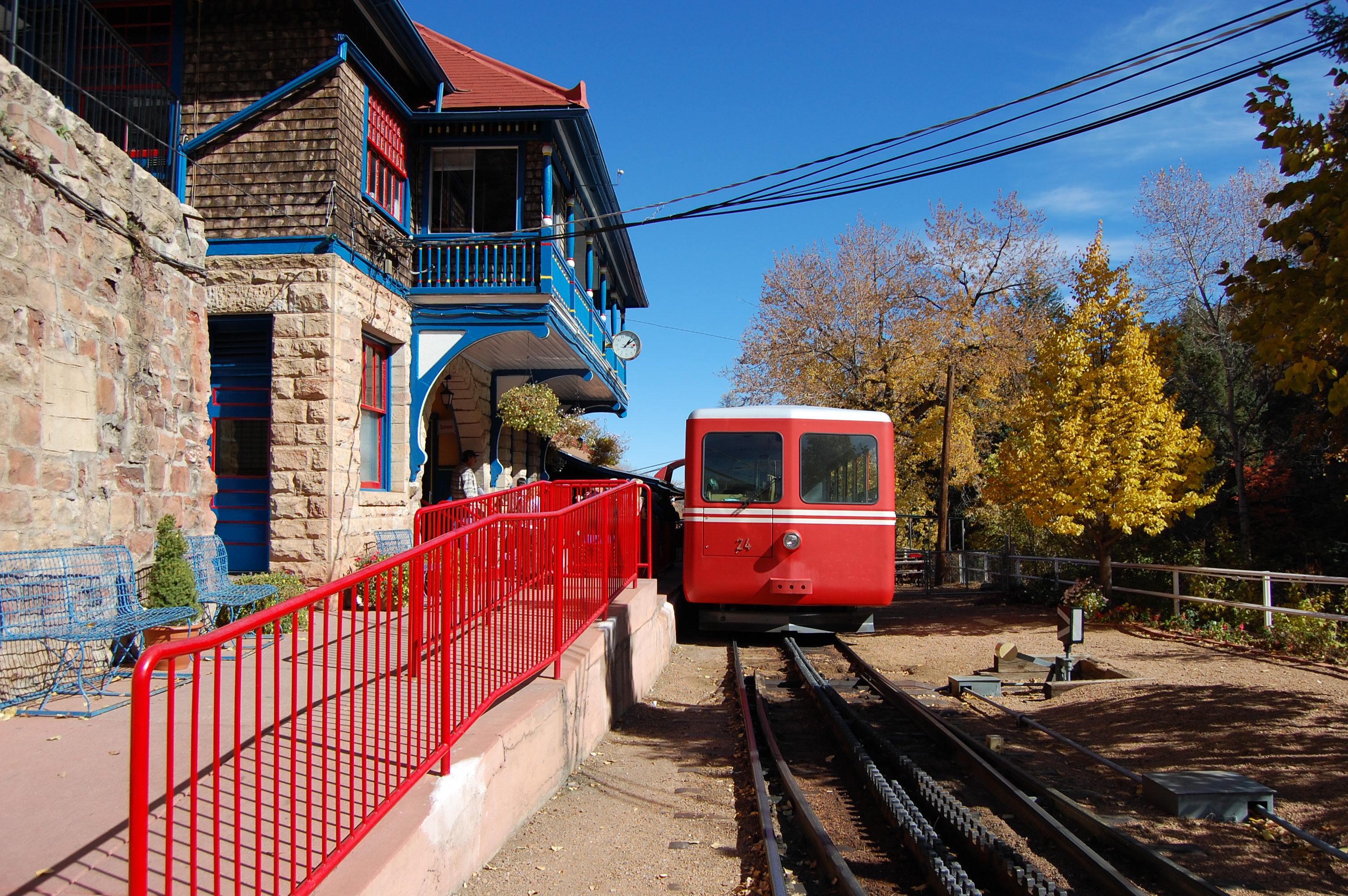
Pikes Peak Cog Railway
It started with a bad day on a mule. In 1888, Zalmon G. Simmons -- inventor, mattress magnate, and board member at Western Union -- endured a miserable two-day ride to the summit of Pikes Peak while surveying Englemann Canyon for telegraph lines. When he finally dismounted, Simmons was convinced of one thing: there had to be a more civilized way to reach the top. He decided to fund a railway. Construction began in 1889, Italian laborers hacking at the mountainside with pickaxes, assisted by donkeys. On June 30, 1891, the first train reached the summit. More than 130 years later, the Broadmoor Manitou and Pikes Peak Cog Railway remains one of only three cog railways operating in the United States.
Tilted Boilers and Runaway Prevention
The engineering challenges of climbing Pikes Peak were formidable. The line starts at a depot in Manitou Springs and ascends to the summit at 14,115 feet, with an average grade of 12% that maxes out at 25%. Normal trains lose traction on anything steeper than 10%, so the railway required a cog and rack system -- toothed gears meshing with a toothed rail between the tracks -- to pull trains up and control the descent. The first three steam locomotives, built by Baldwin Locomotive Works, featured boilers offset by 16 degrees to keep them level on the steep incline. Unlike conventional trains, these engines pushed passenger cars up the mountain rather than pulling them, reducing the risk of runaway cars breaking free on the descent. A fourth locomotive arrived in 1892 as a Vauclain compound, which proved more efficient and led to all the originals being rebuilt to the same design in 1893.
From Coal Smoke to Swiss Precision
Steam ruled the mountain for decades, with each locomotive burning just under one ton of coal per round trip. Diesel locomotives gradually replaced them, though steam engines hung on into the 1960s as backup power and for snow-clearing duty, where their greater weight made derailment less likely. In 1964, the railroad purchased its first self-propelled railcars from Swiss Locomotive and Machine Works, bringing Alpine engineering to the Colorado Rockies. The air-cooled diesel engines in these first Swiss units struggled above the tree line and had to be swapped for water-cooled versions, but the railcars proved their worth. Two more units followed in 1968. The Swiss connection would deepen further in the 21st century, when the railway's massive overhaul brought brand-new trainsets from Stadler Rail of Switzerland.
The Hundred-Million-Dollar Rebuild
On October 29, 2017, the railway closed for its most ambitious project yet: a complete refurbishment estimated at 00 million. The Anschutz Corporation, which owned the railway, negotiated 6 million in tax breaks from Manitou Springs over a 50-year period in exchange for completing the upgrades. Starting in March 2019, crews ripped up the original rails, Abt rack system, and wooden ties -- some in place since 1889 -- working from the depot to the summit. New metal ties, custom rails from Poland, and a more robust Strub rack system were laid from the top down. Manual track switches gave way to radio-controlled versions. Four vintage Swiss railcars were rebuilt with new transmissions, dynamic braking retarders, and fresh diesel engines. Three new diesel-electric trainsets and a snowblower arrived from Stadler Rail in early 2021. The line reopened on May 20, 2021, with a new summit visitor center and a second boarding platform at the Manitou Springs depot.
The Incline Next Door
Adjacent to the cog railway's base station stands the remnant of another remarkable piece of engineering: the Manitou Incline. Originally built in 1907 to support construction of city water lines and a hydroelectric plant, this funicular averaged nearly a 40% grade with a maximum of 68%, making it one of the steepest inclines anywhere. The Manitou and Pike's Peak Railway operated it as a tourist attraction after construction ended, until a rockslide shut it down in 1990. For over two decades the defunct Incline existed in a legal gray zone -- officially off-limits but heavily used by hikers and fitness enthusiasts who ignored the trespassing signs. On February 1, 2013, it finally became legal to climb. Today Colorado Springs Parks and Recreation manages the trail, and the old railway bed has become one of the most popular -- and punishing -- hikes in the state.
The View from the Cockpit
The Pikes Peak Cog Railway base station sits at approximately 38.856 degrees north, 104.931 degrees west, in Manitou Springs at the foot of Pikes Peak. From the air, the railway's corridor is visible as a thin line climbing the eastern face of the mountain, switchbacking through alpine terrain. Colorado Springs Airport (KCOS) is about 15 nautical miles to the southeast. Pikes Peak itself, at 14,115 feet, is the dominant feature of the southern Front Range and visible from well over 100 miles on a clear day. The summit visitor center and the railway terminus are identifiable at the peak. Below, the tight grid of Manitou Springs contrasts sharply with the steep slopes above, and the Incline's straight scar up the mountainside is unmistakable even from several thousand feet up.
From the Air
Located at 38.856N, 104.931W in Manitou Springs. Nearest airport: Colorado Springs (KCOS), approximately 15 nm southeast. The cog railway line is visible climbing the eastern face of Pikes Peak (14,115 ft MSL). The Manitou Incline appears as a steep linear scar on the adjacent slope. Best observed at 8,000-10,000 ft MSL to appreciate the railway corridor against the mountain. Caution: mountain wave turbulence common along the Front Range; Pikes Peak generates significant rotor activity in westerly winds.