Pilar, Paraguay
When the last Brazilian soldiers departed Paraguay in 1876, the bell tower of the Minor Basilica of Nuestra Senora del Pilar rang without stopping. Hours passed, and still the bells sounded over the rooftops and the slow-moving Paraguay River below. The town had endured war, occupation, and the destruction that comes with being strategically important in a place where strategy means suffering. Pilar had survived. The bells were its way of saying so.
A Virgin, a Priest, and a River Fortress
Pilar began as a military calculation. In 1779, Governor-Intendant Pedro Melo de Portugal ordered settlers from Asuncion to establish Villa del Neembucu on the Paraguay River, 258 kilometers downstream from the capital. The purpose was blunt: station troops to control river traffic. Four years later, a Spanish priest named Marcial Antonio Uliambre, originally from Zaragoza, renamed the settlement Villa del Pilar after the Virgin of the Pillar venerated in his hometown. By 1783, a census counted 2,355 inhabitants. The town was young, remote, and already tangled in the politics of empire. When Paraguay moved toward independence, Captain Blas Jose Roxas de Aranda positioned himself in Pilar with soldiers to prevent the Spanish governor Bernardo de Velasco from fleeing the country by ship. Under the dictatorship of Gaspar Rodriguez de Francia that followed, the Port of Pilar became the only port in all of Paraguay authorized for foreign trade -- primarily the export of yerba mate.
Battleground on the River
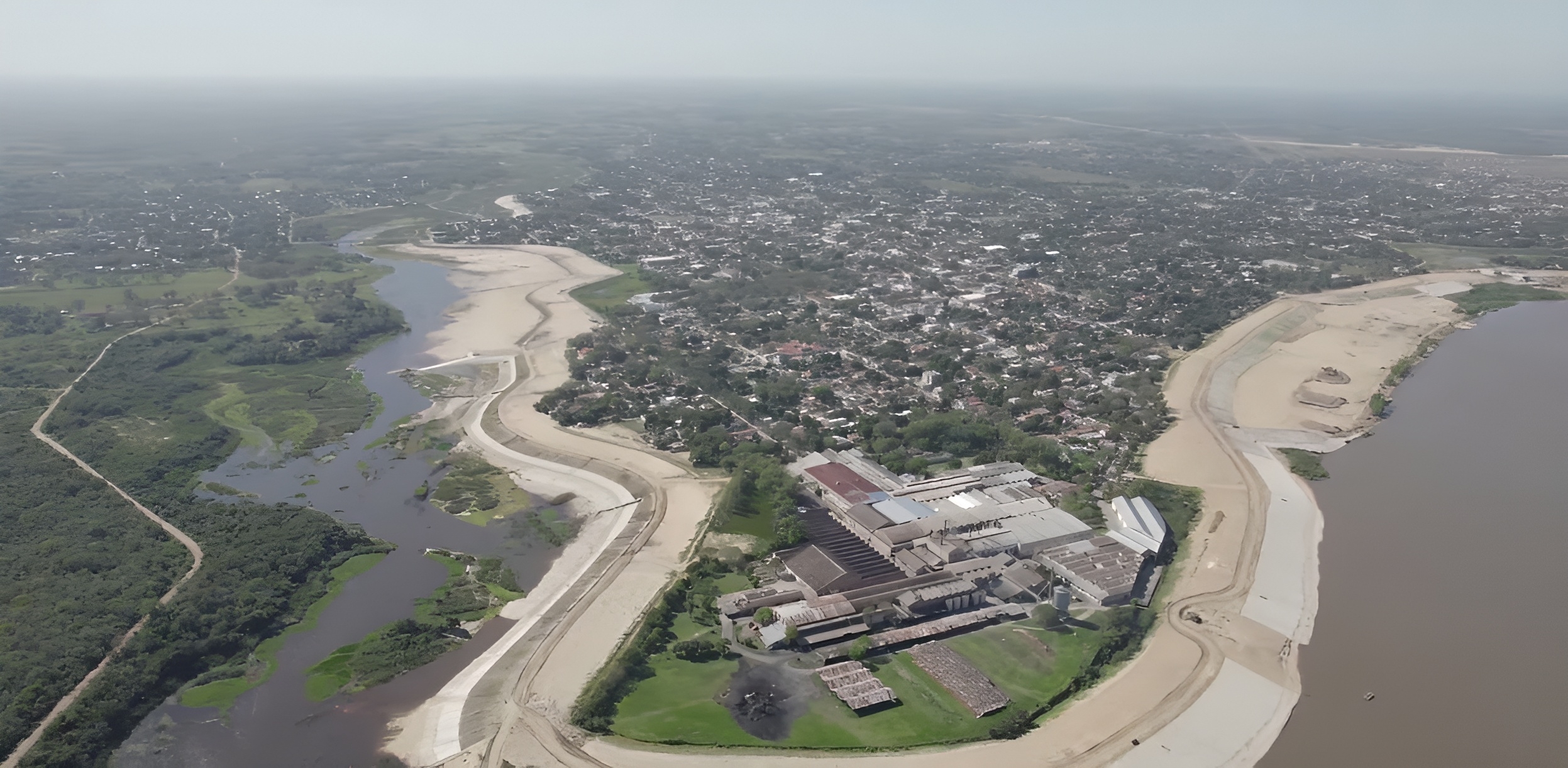
The Paraguayan War brought devastation directly into Pilar's streets. On September 20, 1867, Brazilian forces attacked the small Paraguayan garrison in what became known as the Battle of Pilar. Marshal Solano Lopez dispatched his personal guard under Felipe Toledo to reinforce the defenders, but the town was outmatched. A second engagement on October 27 of that year -- a skirmish fought in the middle of town itself -- ended with Brazilian occupation. The soldiers stayed for nearly a decade. When they finally withdrew in 1876, the community marked the moment with those hours of ceaseless bell-ringing, a celebration born from exhaustion as much as joy. In 1908, Villa del Pilar was elevated to the status of city. Two decades later, Italian industrialist Paolo Federico Alberzoni built a textile complex that still operates today as Manufactura de Pilar SA. He later expanded his plant to provide electricity to the entire city -- a factory owner who became, by default, the town's power company.
Where Motorcycles Outnumber Cars
Modern Pilar, with roughly 34,700 inhabitants, runs on a mixture of commerce, fishing, dairy production, and a kind of laid-back self-sufficiency that reflects its distance from the capital. Motorcycles and mopeds dominate the streets, with bicycles close behind. Horse-drawn carts share the road with the occasional car or truck. The city's location on the Paraguay River makes it a natural hub for boating and fishing, and during Semana Santa each year, a massive fishing tournament draws competitors and spectators from across Paraguay and northern Argentina. Every January 2, the Fiesta Hawaiana along the Neembucu stream attracts 20,000 to 30,000 people from Paraguay, Argentina, and Uruguay. Basketball, surprisingly, rivals soccer as the most popular sport -- every school has at least one court, and the Pilarense Basketball Association fields teams that compete nationally.
Colonial Walls and Italian Towers
The Basilica of Our Lady of Pilar, built by Italian missionaries, anchors the city center with its colonial architecture and its October 12 feast day celebrations. Nearby, the Town Council Museum occupies a building constructed in 1817 during the government of Gaspar Rodriguez de Francia. It is the only structure of its kind still preserved in Paraguay, housing photographs, trophies, and medals that belonged to Marshal Lopez, alongside weapons, ammunition, lances, and shields from the war years. The historical center preserves a large number of buildings dating to the town's founding era. In December 2022, the presidents of Argentina and Paraguay announced plans to build a bridge over the Paraguay River connecting Pilar directly to Argentina -- a project that would transform the town's relationship with its nearest international neighbor and reshape the economy of the entire Neembucu region.
From the Air
Located at 26.86S, 58.30W on the west bank of the Paraguay River in southwestern Paraguay. Best viewed from 2,000-3,000 feet AGL approaching from the east, where the river and town layout are clearly visible. The Paraguay River forms a wide, slow curve here. No major airports nearby; the closest significant airfield is Asuncion's Silvio Pettirossi International Airport (SGAS), approximately 258 km to the northeast.