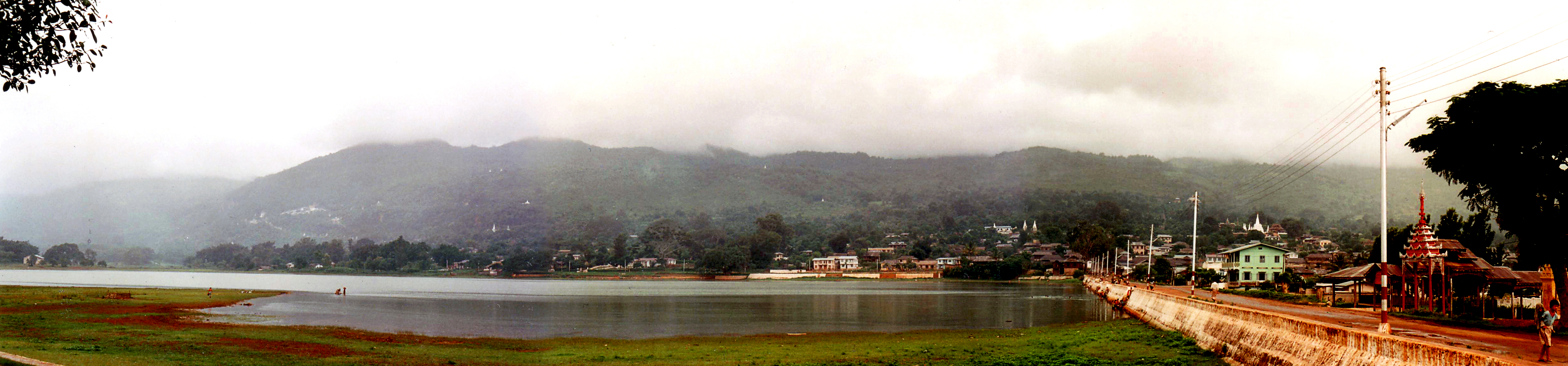
Pindaya Caves
Seven princesses, a giant spider, and a prince with a bow. That is the legend the Danu people tell about the limestone caves on the ridge above Pindaya, a small town in the Myelat region of Shan State, Myanmar. Sculptures of the spider and the prince now guard the entrance to the covered stairway, but the real story inside is stranger than any folktale. Walk 490 feet into the southernmost cave and you will find yourself surrounded by more than 8,000 images of the Buddha -- a golden forest of statues accumulated over nearly three centuries by donors ranging from local farmers to Burmese kings.
A Golden Labyrinth Underground
Three caves punctuate the limestone ridge that runs north to south above Pindaya, but only the southernmost can be entered. The other two remain unexplored, their depths unknown. Inside the accessible cave, a well-worn path extends roughly 490 feet through chambers packed with Buddha images in every conceivable size and posture. The oldest inscribed statue dates to 1773, placing it in the early Konbaung period, though historian Than Tun believed some uninscribed images may date to around 1750 based on their style. What makes the collection extraordinary is not just its scale but its range. Statues from the late 18th century stand alongside images donated in the 21st, creating an unbroken visual record of Burmese Buddhist art spanning the Konbaung era to the modern day. No other site in Myanmar displays such stylistic breadth -- not only in the images themselves but in the ornamental thrones and reredos that frame them.
The Bhisakkaguru Mystery
Among the thousands of figures, roughly seventy stand apart. Dating to the late 18th century, these images belong to the Bhisakkaguru tradition -- the Medicine Buddha. Their styling is distinctive: the hair, eyes, nose, ears, and robes differ markedly from conventional Burmese Buddhist sculpture. Most telling is the posture. Each figure holds a seed in its upturned right palm, a gesture found nowhere else in Myanmar. Than Tun concluded that these images come from the Mahayana tradition rather than the Theravada Buddhism that has dominated Burma for centuries. The implication is remarkable: at some point in its history, the Pindaya cave served a Mahayana Bhisakkaguru cult, a religious community that left its mark in stone and then vanished. How a Mahayana practice took root in this remote corner of Shan State, and why it disappeared, remains an open question.
Explosives, Bells, and a Lost Pagoda
A 15-meter pagoda called Shwe U Min -- the Golden Cave Pagoda -- stands at the entrance to the southernmost cave. Local tradition credits King Asoka with its construction and King Alaungsithu with its 12th-century repair, though no historical evidence supports either claim. In its current form, the pagoda is clearly of recent origin. Nearby hangs a large bronze bell cast in 1842, weighing 400 viss -- about 654 kilograms. Its inscription is barely readable now, the characters worn smooth by time and the humid cave air. The modern entrance dates to 1925, when workers used explosives to widen the cave mouth to accommodate growing numbers of pilgrims. The blast destroyed valuable images and epigraphs that can never be recovered. A steel framework was erected to support the enlarged opening, and dedication inscriptions from the renovation reveal an unexpectedly diverse group of donors -- not only Theravada Buddhists, but Hindus, Chinese, and Muslims as well.
What War and Time Have Taken
During the 1925 renovation, some of the cave's most unique images were removed to a nearby monastery for safekeeping. They did not survive. A World War II bombing raid destroyed the monastery and the irreplaceable statues along with it. The loss underscores a tension that runs through Pindaya's history: the impulse to preserve and the damage that well-meaning intervention can cause. The 1925 blasting opened the cave to thousands more visitors but obliterated the very artifacts those visitors came to see. Today, scholars advocate for the caves' inclusion on the UNESCO World Heritage List, arguing that the site's combination of natural geology and centuries of devotional art makes it unique. Whether that recognition comes or not, the caves continue to evolve. New images are still being placed alongside centuries-old ones, each donor adding their small act of faith to a tradition that has persisted since at least the reign of the Konbaung kings.
Legends at the Gate
The Danu people, whose ancestral homeland encompasses the Myelat region around Pindaya, have layered the caves with stories. One legend holds that a blocked passage at the far end of the cave leads all the way to the ancient city of Bagan, more than 200 miles to the west. Another tells of seven princesses who were bathing in the lake below the ridge when a giant spider captured them and imprisoned them inside the cave. Prince Kummabhaya of Yawnghwe arrived to rescue them, killing the spider with his bow. The word Pindaya, some say, derives from the prince's exclamation as he loosed his arrow. Whether or not the etymology holds, the sculptures at the stairway entrance -- the spider, the prince drawing his bow -- give pilgrims and tourists alike the sense that they are entering a place where the boundary between history and myth has long been negotiable.
From the Air
Located at 20.925N, 96.651E on a limestone ridge in the Myelat region of Shan State, Myanmar. The caves sit at approximately 4,000 feet elevation in hilly terrain east of Inle Lake. The nearest significant airfield is Heho Airport (VYHH), about 40 km to the northeast. The town of Pindaya is visible below the ridge, with a lake on its western edge. Best viewed from medium altitude -- the ridge formation and pagoda at the cave entrance are identifiable landmarks. Visibility can be reduced by mountain haze, especially during the monsoon season.