Pine Creek, Northern Territory
Gold was found at Pine Creek because someone was digging holes for a telegraph line. In 1872, construction of the Overland Telegraph Line was underway through country that no European had mapped — and when workers dug near a creek lined with pine trees, they found gold at the Eleanour Reef. The government tried to suppress the discovery, worried about the 'distraction' of a gold rush. It didn't work. By January 1873, twenty-three mining claims had been staked. Within a few years, the town's population was rocketing toward three thousand people.
The Gold Rush
The Northern Territory's first stamp battery — the heavy machinery used to crush ore and extract gold — was constructed at Pine Creek in July 1873, a marker of how quickly the industry had scaled. Chinese miners began arriving in 1874, most from Guangdong Province. The South Australian government indentured 176 of them. By 1877, the discovery of substantial alluvial deposits brought a much larger wave. In 1879 a Chinatown was established and the population reached its peak of 900 people — with Chinese residents vastly outnumbering European ones.
Then it ended. By 1882, only 80 miners remained. By 1886, the mines were virtually inactive. The population of the town in 1894 was 753 Chinese people and just 39 'Europeans' — a demographic snapshot that challenges easy assumptions about who built the Northern Territory's early infrastructure. Gold mining continued in cycles through the twentieth century. By 1915, approximately 75,000 ounces — more than 2,000 kilograms — had been extracted from the area. The 1985 open-cut mine run by Pine Creek Goldfields Limited yielded 764,000 ounces over a decade before closing.
The old mine pit, rather than being left open, was filled with water to prevent acid buildup. It sits there now, a lake where there was a hole.
The Railway That Made the Town
Gold brought the miners, but the railway kept Pine Creek alive long after the easy gold was gone. The narrow-gauge line from Palmerston (now Darwin) reached Pine Creek in 1889, connecting the goldfields to Port Darwin and making it possible to move people and heavy machinery through country that would otherwise require months of overland travel. Pine Creek became the southern terminus of the line, and the station yard was designed with two sidings, each capable of handling forty-two goods wagons.
The railway shaped the town's economy for nearly a century, passing through wartime service — by 1944, 147 weekly trains were stopping here — before declining passenger numbers led to closure in 1976. The old station building from 1888 survived, along with a 1877 Commonwealth Railways steam locomotive called NF5 that was restored to operational condition in 2001. The station is now the Pine Creek Railway Precinct, a museum where the rolling stock includes a steam locomotive that is still operable. Few heritage sites anywhere in Australia can make that claim.
The modern standard-gauge Adelaide–Darwin railway, completed in 2004, passes just 400 meters east of town. The Ghan — the legendary tourist train between Adelaide and Darwin — rolls by without stopping, which seems like an oversight.
War and Survival
During World War II, Pine Creek quietly became a strategic asset. The Australian Army established the 65th Australian Camp Hospital here. The US Army's 808th Engineer Aviation Battalion extended the civilian airfield between May and July 1942 to serve as an emergency landing ground, and the 43rd Engineer Regiment constructed MacDonald Airfield nearby. Unlike Darwin and many other Top End towns, Pine Creek was never bombed by Japan — Japanese reconnaissance aircraft overflew it at least once, according to reports, but no attack came.
The Stuart Highway sections through Pine Creek were sealed during the war years, when the military needed reliable all-weather roads between bases. Finished in this area by 1944, the work that army engineers did to connect the Top End became the permanent infrastructure civilians would use for decades after.
The Wagiman, Jawoyn Bolmo, Matjba, and Wurrkbarbar groups are the traditional owners of the Pine Creek area. In 2019, after a twenty-year legal process, they were formally awarded exclusive native title rights over the land. In 2005, prominent resident Edward Ah Toy was recognized as the Northern Territorian of the Year. The town remains, as it has been for a century and a half, the fourth largest settlement between Darwin and Alice Springs.
From the Air
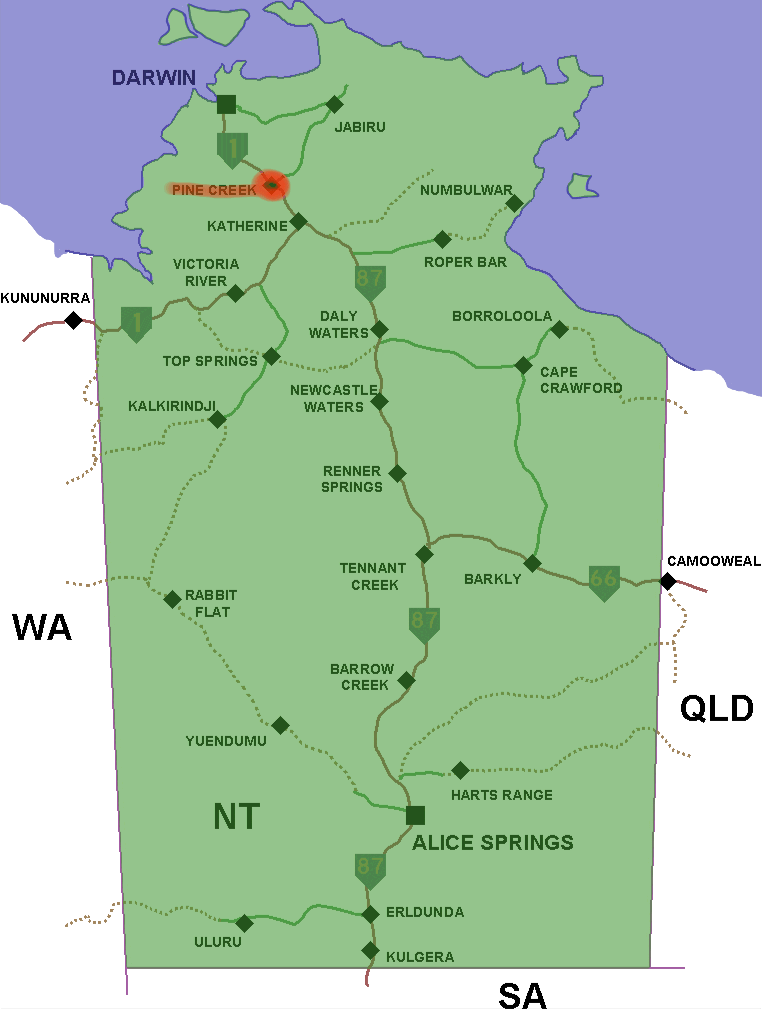
Pine Creek lies at approximately 13.82°S, 131.83°E, just off the Stuart Highway about 90 km north of Katherine and 240 km southeast of Darwin. From the air, the township appears as a small cluster in open savanna country between Katherine and Darwin. The old mine pit, now a water-filled lake, is visible adjacent to the town. Recommended viewing altitude: 1,500–2,500 feet AGL. Nearest airport: Pine Creek Airfield (YPCT), a small unsealed strip adjacent to the town. Katherine Airport (YKTR) is the nearest regularly used airfield, 90 km to the south. The modern Adelaide–Darwin railway line is visible 400 m east of town.