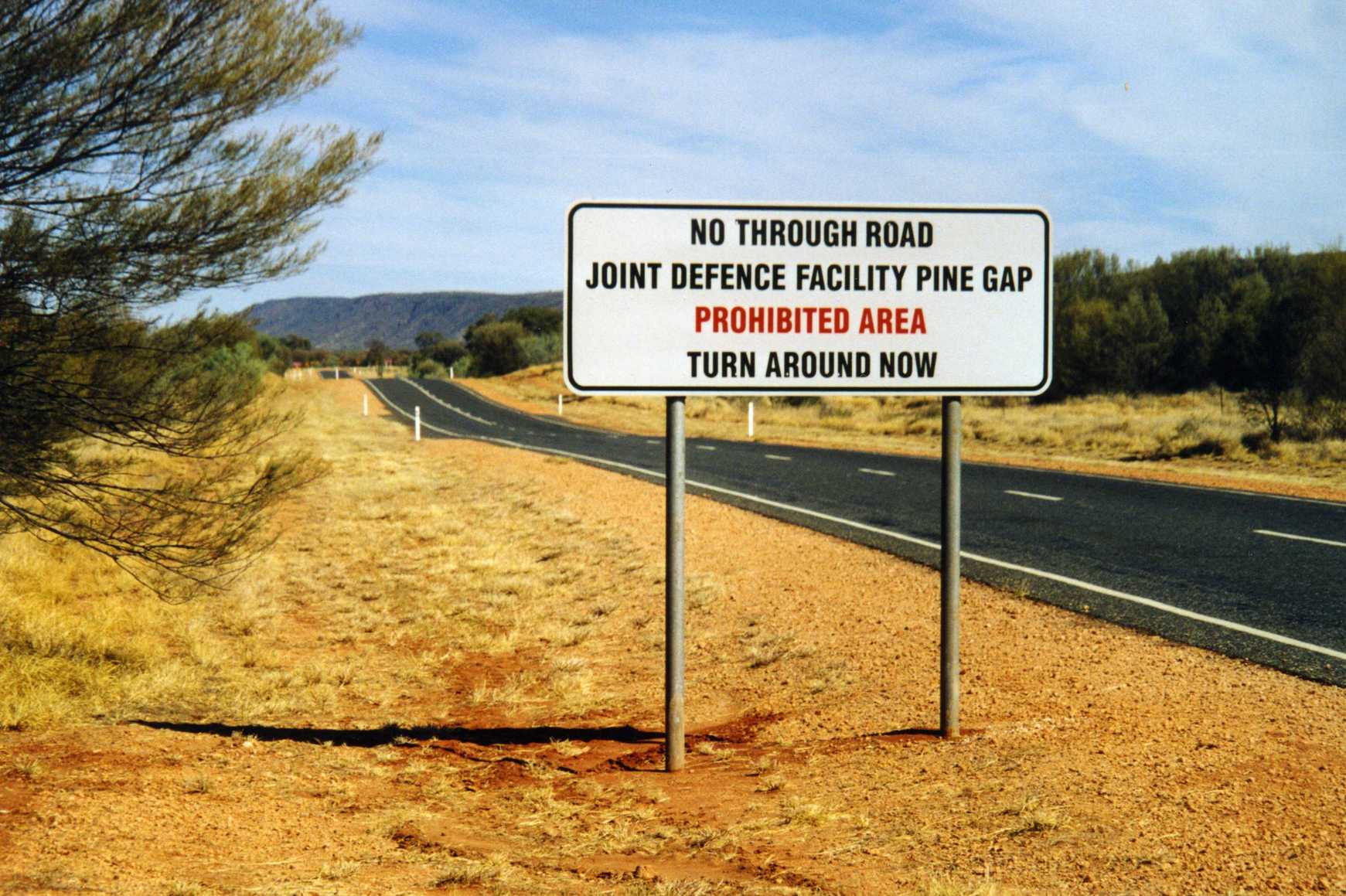
Pine Gap
Drive southwest from Alice Springs for about 18 kilometres and you will hit a fence. Behind it, 38 white radomes rise from the red desert like oversized golf balls, sheltering satellite dishes that listen to a third of the planet. This is Pine Gap -- officially the Joint Defence Facility Pine Gap -- and it is the only place in Australia where the airspace above is permanently prohibited. Operated jointly by the Australian Defence Force, the CIA, the NSA, and the National Reconnaissance Office, the facility has been collecting signals intelligence since 1970, when 400 American families moved to Central Australia and the cover story was "space research."
Eyes Over One-Third of the Globe
Pine Gap's location is not accidental. Situated deep in the Australian interior, it is shielded from electronic interference by thousands of kilometres of empty desert. Its satellites cover a swath of the Earth stretching from China and North Korea through the Asian portions of Russia to the Middle East -- roughly one-third of the globe. The facility intercepts four categories of signals: telemetry from ballistic missile tests, emissions from anti-missile and anti-aircraft radar systems, transmissions routed through communications satellites, and microwave signals including long-distance telephone calls. Each morning, a committee meets to determine what the satellites will monitor over the next 24 hours. Over 800 people now work at the base, the largest staffing expansion since the end of the Cold War. Australian personnel have access to all areas except the NSA's cryptology room. American personnel, in turn, are barred from the Australian Signals Directorate's equivalent space. Each ally keeps certain secrets from the other, even here.
The Base That May Have Toppled a Government
In the early 1970s, Australian Prime Minister Gough Whitlam began asking uncomfortable questions about Pine Gap and considered closing the facility. Victor Marchetti, a former CIA officer who had helped establish the base, later said this "caused apoplexy in the White House" and that "a kind of Chile was set in motion" -- a reference to the CIA-backed coup against Salvador Allende. Whether the CIA actually played a role in Whitlam's dismissal by Governor-General John Kerr in November 1975 remains one of Australia's most contested political questions. Christopher Boyce, a US defense industry employee convicted of espionage, testified during his trial that the CIA referred to Kerr as "our man Kerr" and that Pine Gap was monitoring Australian political communications -- telephone calls and telex messages of a political nature flowing in and out of the country.
Protest in the Red Desert
Pine Gap has drawn protesters since the Cold War's height. On 11 November 1983, Aboriginal women led 700 women to the facility's gates, where they fell silent for 11 minutes to mark Remembrance Day and echo the Greenham Common peace camp in Britain. The two-week women-only encampment that followed was nonviolent, but 111 women were arrested on a single day -- each giving her name as Karen Silkwood, the American nuclear safety activist. In October 2002, Quakers and student groups protested the base's anticipated role in the impending Iraq war. In December 2005, four members of Christians Against All Terrorism broke into the facility and were arrested under Australia's Defence Special Undertakings Act of 1952, a law that had never before been invoked. They were convicted, then acquitted on appeal in 2008. More recently, pro-Palestinian demonstrators have blockaded Hatt Road, the base's main access route, arguing that intelligence collected at Pine Gap is being shared with the Israeli Defence Forces.
An Open Secret in the Outback
The treaty establishing Pine Gap was signed on 9 December 1966 and stated that after an initial nine years, either nation could cancel the agreement with one year's notice. Neither has. The base was placed on nuclear alert during the 1973 Yom Kippur War when Henry Kissinger issued a DEFCON 3 force-wide alert -- and Australian personnel at the facility, along with the Australian government and Prime Minister Whitlam, were not informed. Leaked NSA documents have since confirmed that Pine Gap provides geolocation data used in drone strikes against al-Qaeda and Taliban targets, and that the facility controlled satellites used during the Vietnam War to pinpoint bombing targets in Cambodia. The 2018 Australian television series Pine Gap dramatized life inside the installation. Midnight Oil referenced it in their 1982 song "Power and the Passion." The base is simultaneously one of the worst-kept secrets in intelligence and one of the most consequential -- a place where the alliance between two democracies operates in permanent, deliberate shadow.
From the Air
Located at 23.80S, 133.74E, approximately 18 km southwest of Alice Springs. Pine Gap has permanently prohibited airspace -- aircraft must not overfly the facility. Alice Springs Airport (YBAS) is the nearest field, 20 km to the east. The 38 radomes are visible from a distance but overflight is illegal. Approach Alice Springs from the east or north to avoid the restricted zone. Nearest alternate airports include Tennant Creek (YTNK) and Yulara (YAYE).