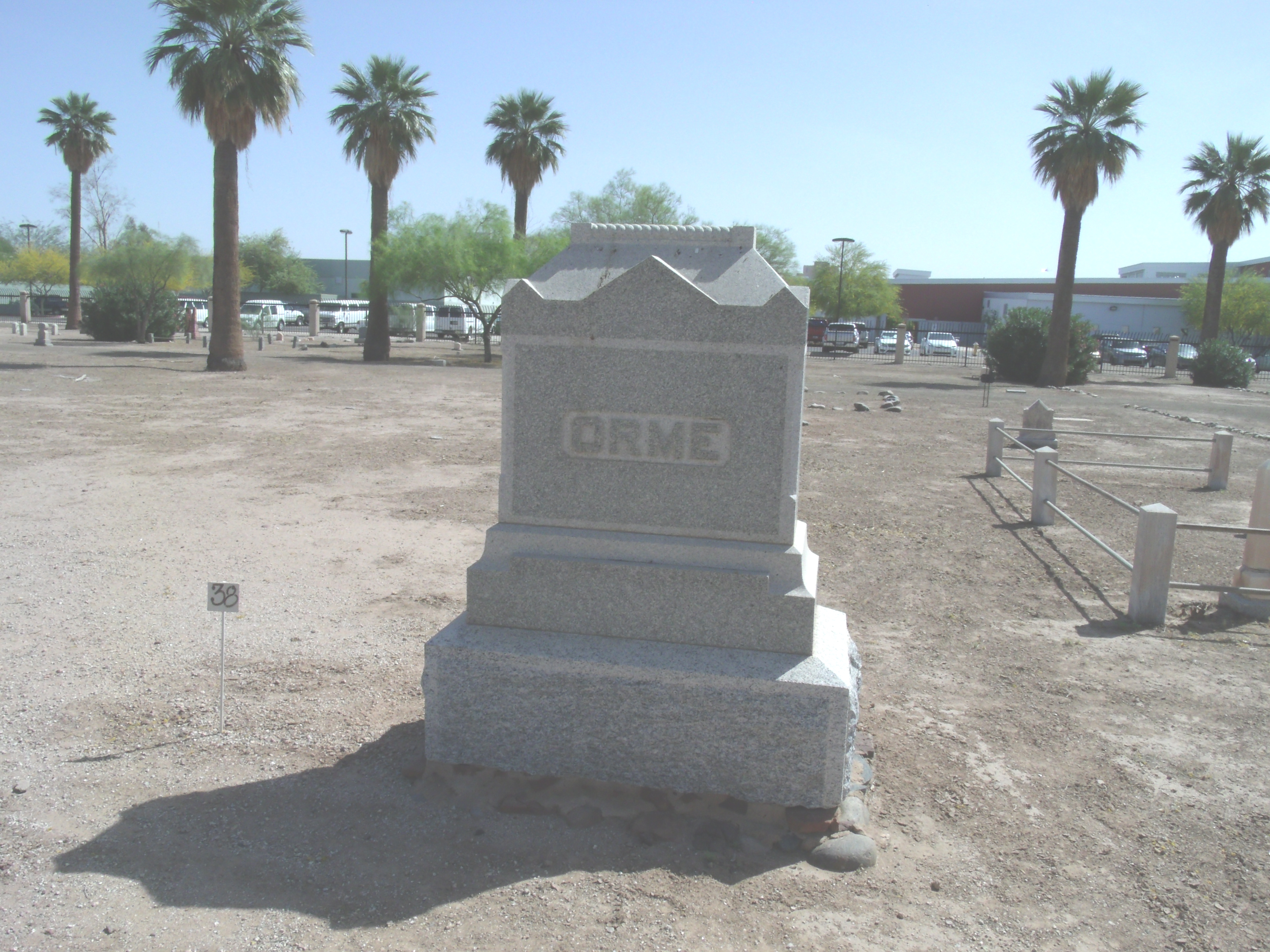
Pioneer and Military Memorial Park
Jacob Waltz took his secret to the grave here in 1891. The German immigrant who discovered what became known as the Lost Dutchman's Mine lies in Pioneer and Military Memorial Park, his legendary gold deposit still unfound in the Superstition Mountains to the east. But Waltz is just one among hundreds of Phoenix founders, territorial governors, Civil War veterans, Buffalo Soldiers, and Rough Riders resting beneath the desert soil of Block 32, seven historic cemeteries built unwittingly atop the ruins of a pre-Columbian Hohokam village that archaeologists would later name La Villa.
Birth of a Burial Ground
In the 1880s, Phoenix was a raw frontier town with railroad ambitions. The city's old cemetery, wedged between 5th and 7th Avenues near a new train station, struck officials as an unseemly welcome for arriving passengers. In 1884, they purchased Block 32 on the city's edge, unknowingly selecting ground where ancient Hohokam people had lived centuries before. Families exhumed their loved ones from the old site and reburied them here. Unclaimed bodies went into a common grave. Seven distinct cemeteries emerged, each affiliated with different organizations: the Ancient Order of United Workmen, Independent Order of Odd Fellows, Knights of Pythias, Masons, and three others. When a 1914 law prohibited burials within city limits, all seven closed. Decades of abandonment followed.
The Man Who Named Phoenix
Phillip "Lord" Darrell Duppa, an educated Englishman with aristocratic pretensions, arrived in the Salt River Valley and saw something others missed. Looking at the ancient canal systems built by the vanished Hohokam, he proposed naming the new settlement Phoenix, the mythological bird that rises from its own ashes. The city would rise from the ashes of an earlier civilization. Duppa also named nearby Tempe, after the Vale of Tempe in Greece, and founded the town of New River. He died January 29, 1892, and was buried among the pioneers whose city would grow into Arizona's largest. His grave remains one of the most visited in the park.
Firsts and Founders
The headstones read like a founding document. William Augustus Hancock laid out the first Phoenix town site in 1870 and earned the title "Father of Phoenix." He served as district attorney, probate judge, and first sheriff of Maricopa County before dying in 1902. John Taylor Alsap became the first Treasurer of Arizona Territory, served as both Speaker of the House and President of the Council in the territorial legislature, then became Phoenix's first mayor in 1881. Henry Garfias, a Hispanic gunfighter, became the first marshal of Phoenix and the highest-elected Mexican American official in the Valley during the nineteenth century. John Preston Osborn arrived in Prescott in 1854 and built what historians consider Arizona's first hotel. Broadway Road bears the name of Noah Broadway, Civil War veteran and Maricopa County sheriff, whose farm stretched between 7th and 23rd Avenues.
Soldiers and Seekers
Wars left their mark here. Robert Plumridge served with the California Column and fought Confederates at the Battle of Picacho Pass, the westernmost engagement of the Civil War. Millard Lee Raymond rode with Theodore Roosevelt's Rough Riders, serving in Troop F of the 1st U.S. Volunteers Cavalry through the Spanish-American War in Cuba before dying in Phoenix on January 11, 1899. Clarence Proctor, a Buffalo Soldier and sergeant in the 10th U.S. Cavalry, served with distinction in the Spanish-American War. Benjamin Joseph Franklin served in the Missouri U.S. Congress, then as U.S. Consul to China, before President Grover Cleveland appointed him Arizona's twelfth Territorial Governor. The Medal of Honor recipient Captain Trustrim Connell once owned the Smurthwaite House that now serves as the cemetery's main office.
Resurrection and Remembrance
The cemeteries lay neglected until 1930, when the Pioneers' Cemetery Association formed to preserve and restore them. World War II interrupted the work, and researcher Thomas Hayden's death further delayed progress. The present association, formed in 1983, completed what the earlier group began. On February 1, 2007, Block 32 received its official name: Pioneer and Military Memorial Park. Both the park and the historic Smurthwaite House now appear on the National Register of Historic Places. Each year, the association hosts walking tours through the grounds, introducing visitors to the territorial governors, pioneering sheriffs, and legendary prospectors who shaped Arizona. The Lost Dutchman's gold remains hidden somewhere in the Superstition Mountains, but Jacob Waltz rests here in plain sight, his headstone marking the end of a mystery that has outlived him by more than a century.
From the Air
Located at 33.4464N, 112.0903W in downtown Phoenix, Arizona. The park occupies several blocks west of the downtown core, approximately 3 miles northwest of Phoenix Sky Harbor International Airport (KPHX). From the air, look for the distinctive layout of seven cemetery sections within a green park setting, contrasting with surrounding urban development. The historic Smurthwaite House is visible as a small structure within the grounds. Best viewed at 1,500-2,500 feet AGL. Jefferson Street and 15th Avenue provide reference points.