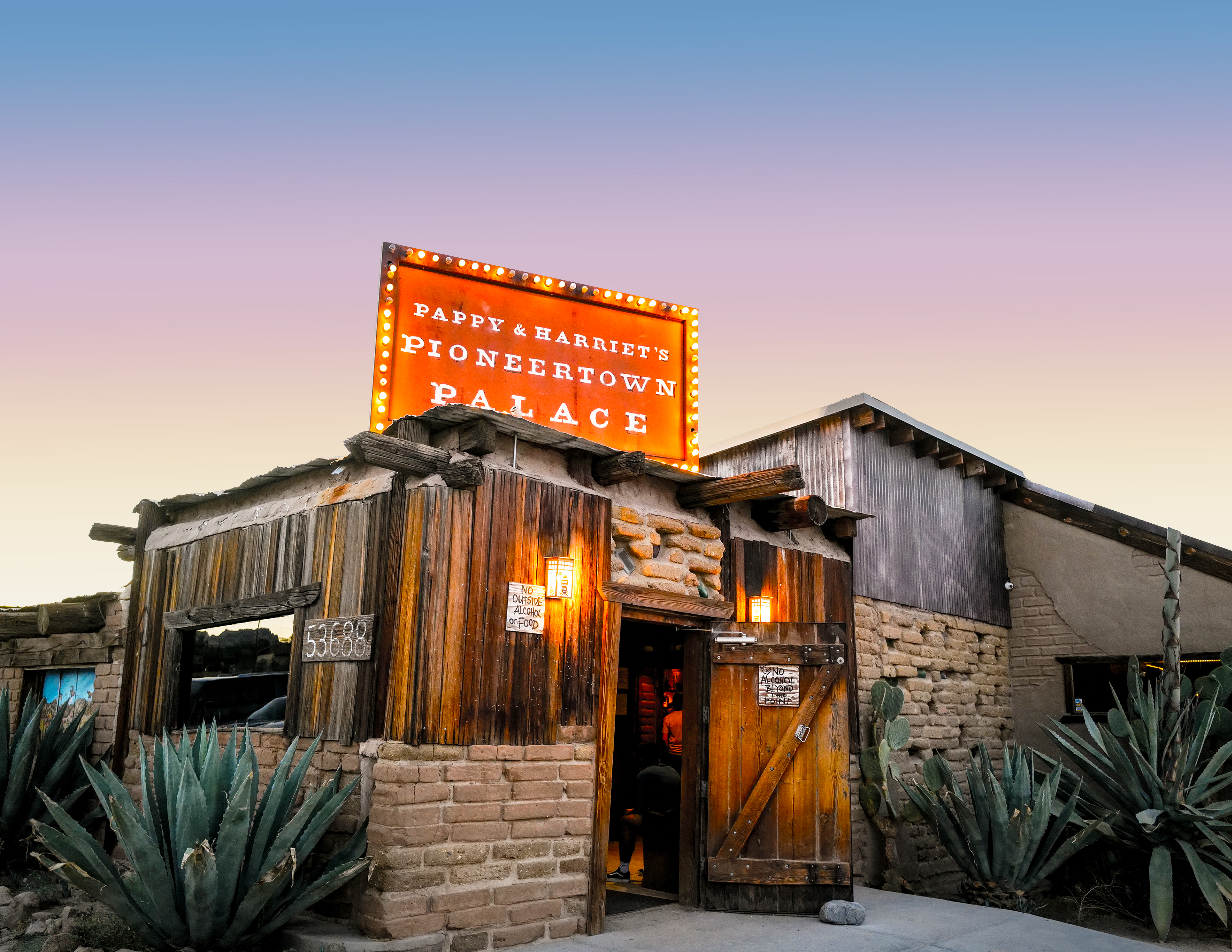
Pioneertown and Pappy & Harriet's
In the high desert north of Joshua Tree, a fake town became real. Pioneertown was built in 1946 as a permanent movie set for Western films - Roy Rogers, Gene Autry, and Russell Hayden were among the investors. The buildings were functional, not just facades; actors could live in them between shoots. Over time, the movie business moved on but the town remained, inhabited by artists, musicians, and desert eccentrics. At its heart is Pappy & Harriet's Pioneertown Palace, a former cantina turned roadhouse that has become one of America's most celebrated small music venues. Artists from Paul McCartney to Robert Plant to Arctic Monkeys have played to crowds of 200 in a room decorated with Christmas lights and taxidermy. The fake frontier became a real community, and the roadhouse became legendary.
The Movie Set
Pioneertown was conceived by Roy Rogers and a group of Hollywood investors in 1946. The idea was innovative: build a permanent Old West town where film crews could shoot exteriors while actors lived in real buildings. 'Mane Street' (named for the horses) featured a jail, a bowling alley (called the 'Bowling Barn'), a saloon, and various false-front buildings. Over 50 Western films and TV shows were shot here in the late 1940s and 1950s. The town was designed to look authentic on camera while being livable off-camera. When the Western film industry declined, the buildings remained - too solidly built to abandon, too far from anywhere to redevelop.
The Community
After the movies left, Pioneertown became a real community - population about 350 in the surrounding area. The desert attracted artists, musicians, and people seeking cheap land and solitude. The buildings that had housed movie cowboys now housed welders, painters, and retirees. The town maintained its Old West aesthetic; new construction followed the established style. The remoteness that made filming inconvenient made living affordable. Pioneertown exists in the space between ghost town and bedroom community - too occupied to die, too isolated to grow, perfectly suspended in desert time.
Pappy & Harriet's
Pappy & Harriet's Pioneertown Palace started as a 1950s cantina for film crews and evolved into one of America's most improbable music venues. The current owners, Linda and Claude 'Pappy' Allen, transformed it in the 1980s into a roadhouse serving barbecue and hosting live music. The venue's reputation grew through word of mouth until it became a bucket-list destination for touring musicians. The room holds perhaps 200 people. Paul McCartney played here in 2016. Robert Plant has performed multiple times. Arctic Monkeys recorded. Eric Burdon. Vampire Weekend. The intimacy is the point - major artists in a room where the back row is 50 feet from the stage.
The Experience
Visiting Pappy & Harriet's means entering a specific atmosphere: Christmas lights year-round, taxidermy on the walls, desert characters at the bar, and the smell of barbecue smoke. The food - ribs, brisket, Santa Maria-style tri-tip - is served on paper plates. The crowd mixes locals in cowboy hats with L.A. music industry people and European tourists who read about it somewhere. Sunday afternoon sets feature local acts; weekend nights might draw several hundred people spilling onto the patio. The desert sky is spectacular; the stars after a show are reason enough to make the drive. This is how roadhouses used to be before chains killed them.
Visiting Pioneertown
Pioneertown is located 4 miles north of Yucca Valley, California, via Pioneertown Road. Mane Street is free to walk; buildings house galleries and shops. Pappy & Harriet's (53688 Pioneertown Road) serves food daily and hosts live music most nights; check the schedule online. Reservations are difficult for announced shows; arrive early or take your chances. The bowling alley still operates. Pioneertown Mountains Preserve offers hiking. Joshua Tree National Park's north entrance is 5 miles south. Lodging in Yucca Valley, Joshua Tree, or Twentynine Palms. Palm Springs International Airport is 35 miles southwest. The drive from Los Angeles is 2.5 hours. Summer is hot; spring and fall are ideal; winter nights are cold but clear.
From the Air
Located at 34.16°N, 116.50°W in the high desert north of Joshua Tree, California. From altitude, Pioneertown appears as a small cluster of buildings in desert terrain - the planned Old West street layout is visible. Joshua Tree National Park's western boundary is south. Yucca Valley spreads across the Morongo Basin to the south. The Coachella Valley and Palm Springs are visible beyond the mountains to the southwest. The terrain is classic Mojave - Joshua trees, boulders, and desert washes. The isolation that attracted filmmakers remains apparent; Pioneertown sits alone in the desert, accessible but remote.