Piper Alpha
At ten o'clock on the evening of 6 July 1988, a gas leak ignited on the Piper Alpha oil platform in the North Sea, 120 miles northeast of Aberdeen. Within two hours, the platform was consumed by fire. Of the 226 men on board, and others on a rescue vessel nearby, 167 died. It remains the deadliest offshore oil disaster in history. The men who perished were ordinary workers -- roughnecks, welders, divers, engineers, cooks -- who had left families in Aberdeen and across Scotland to work two-week rotations on a steel structure in the middle of the sea. Their deaths exposed catastrophic failures in safety management, emergency planning, and the regulatory framework governing North Sea oil. What followed was the most comprehensive overhaul of offshore safety regulation the world had ever seen.
An Ordinary Evening
Piper Alpha began production in 1976 as a fixed platform operated by Occidental Petroleum, sitting above the Piper oilfield in 474 feet of water. By 1988, it had been converted from oil-only production to handle both oil and gas, a modification that introduced pressurized gas condensate systems into a platform not originally designed to accommodate them. On the evening of the disaster, a maintenance crew had removed a pressure safety valve from one of the condensate pumps for routine work. A permit-to-work form documenting this was filed, but the information was not effectively communicated to the night shift. When the backup condensate pump was activated later that evening, gas escaped through the opening where the safety valve had been, found an ignition source, and exploded. The initial blast was survivable. What turned an accident into a catastrophe was the cascade of failures that followed.
The Chain of Failures
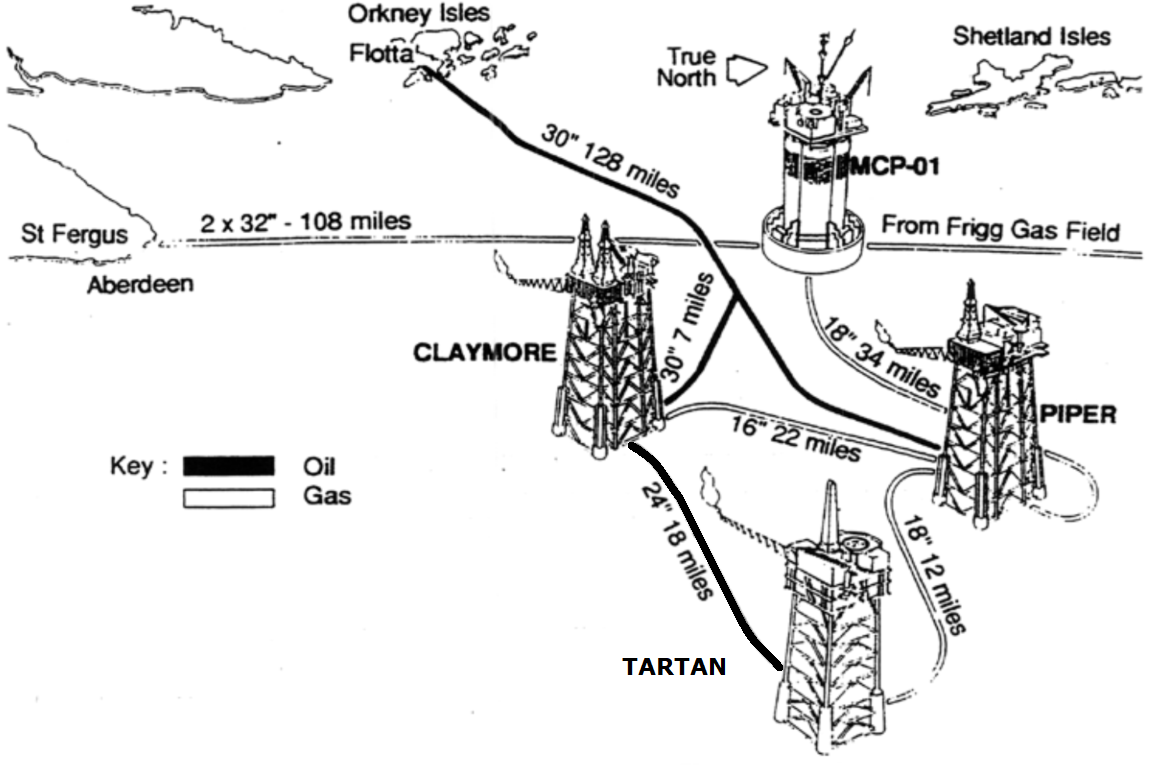
The first explosion damaged the control room and disabled the platform's fire suppression systems. Crude oil and gas pipelines connecting Piper Alpha to two neighboring platforms -- the Tartan and Claymore platforms -- continued pumping under pressure even as the fire intensified, feeding the blaze with a continuous supply of fuel. The operators of those platforms could see the fire but had no clear authority or established procedure to shut down their own operations. The resulting fireball engulfed the platform. The accommodation module, where off-duty workers had gathered as instructed by emergency procedures, was directly above the main fire. Men who followed the prescribed emergency plan -- muster in the accommodation block, await orders to evacuate via helicopter -- were trapped. Those who survived tended to be the ones who broke protocol: they made their way to the edges of the platform and jumped seventy feet into the burning sea. Rescue efforts were hampered by the intensity of the fire and the sea conditions, though the crew of the standby vessel Tharos and helicopter teams from RAF Lossiemouth performed acts of extraordinary courage.
The Cullen Inquiry
Lord Cullen's public inquiry, published in November 1990, identified a series of failures that extended far beyond a single missing safety valve. The permit-to-work system was poorly managed. Emergency training was inadequate. The platform's fire and blast walls were not designed to withstand the forces generated by a gas explosion. Most critically, the regulatory regime itself was flawed: the Department of Energy was simultaneously responsible for promoting North Sea oil production and for regulating the safety of that production -- a conflict of interest that Cullen identified as fundamentally corrosive. His 106 recommendations reshaped offshore safety worldwide. Responsibility for regulation was transferred to the Health and Safety Executive. The Safety Case approach became mandatory, requiring operators to demonstrate that they had identified all major hazards and implemented measures to reduce risk to as low as reasonably practicable. Platform design changed, with rectangular layouts replacing square ones to increase separation between vulnerable areas, and bridge-linked platforms becoming standard to isolate accommodation from production.
A City in Mourning
Aberdeen, the granite city that served as the onshore hub for North Sea oil, bore the disaster's weight. Nearly every family in the northeast of Scotland knew someone who worked offshore or knew someone who did. On 6 July 1991, the third anniversary, the Queen Mother unveiled a memorial sculpture by Sue Jane Taylor in the Rose Garden of Hazlehead Park. The bronze figures depict three oil workers, and the memorial carries the names of all 167 men who died. A stained-glass window at Ferryhill Parish Church shows discs that shift from orange and red at the base -- representing the fire -- to lighter colors as they ascend, representing the lost workers' passage from this world. Piper Alpha did not end North Sea oil production. A replacement platform, Piper Bravo, was built on the site and continues to operate. But the disaster permanently changed the relationship between the industry, its workers, and the sea. Every safety regulation, every emergency drill, every permit-to-work procedure used on offshore installations worldwide carries something of that July evening -- a reminder, purchased at an unconscionable price, that the systems designed to protect human life must never be treated as routine.
From the Air
The Piper Alpha platform was located at 58.46N, 0.25E in the North Sea, approximately 120 nm northeast of Aberdeen. The site is now occupied by the Piper Bravo platform. The memorial sculpture is located in Hazlehead Park, Aberdeen (EGPD). The North Sea oil field area contains numerous visible platforms. The original platform location is in open water with no visual landmarks other than nearby operational platforms.