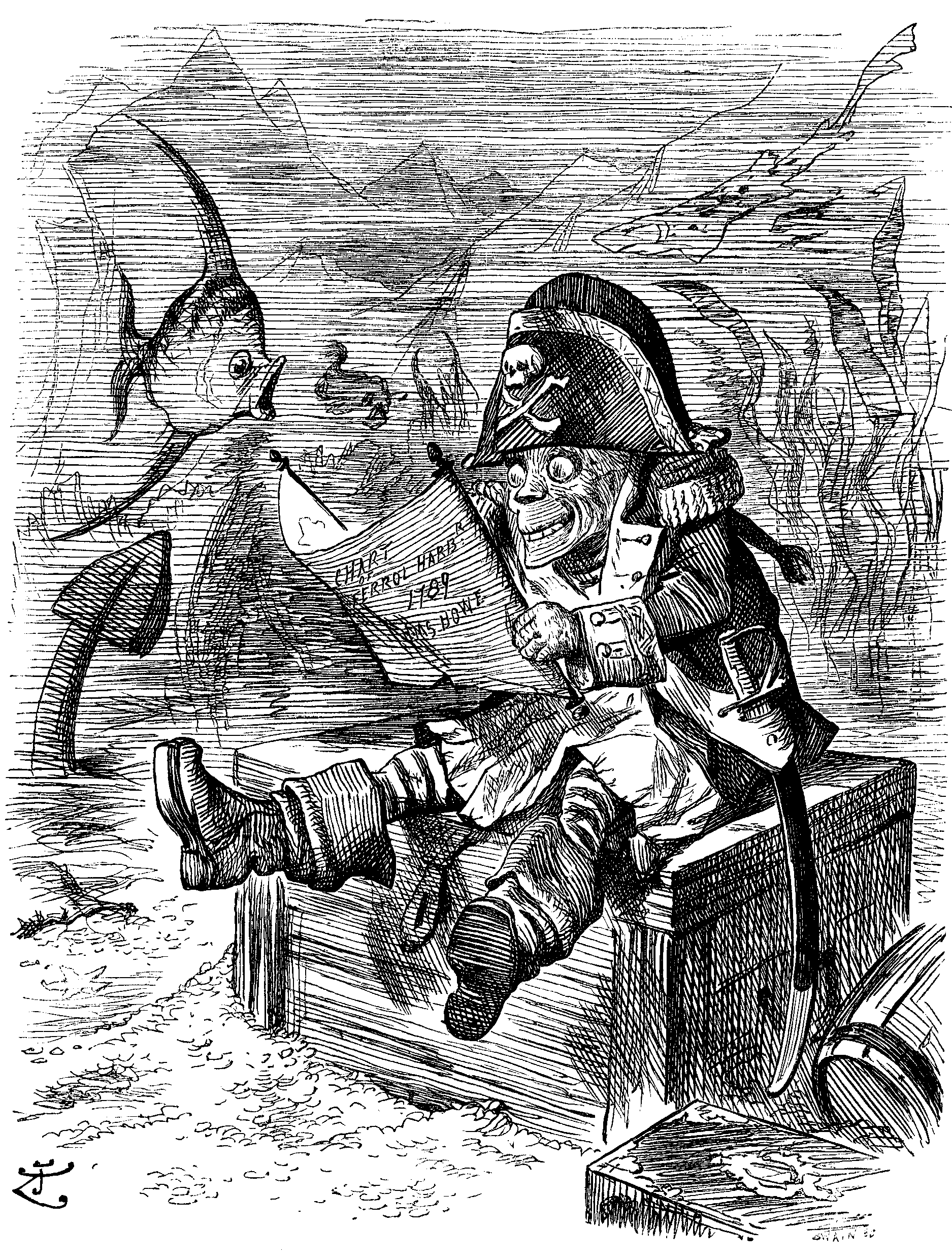
Illustration of Davy Jones sitting on his locker, wearing a pirate captain's uniform,  while viewing a 1789 chart of Ferrol Harbor, Spain, belonging to HMS Howe. The ship had run aground at the mouth of the harbor on 2 November 1892, allegedly after using a poorly prepared naval chart to navigate its waters. A Royal Navy court-martial opened an inquiry into the conduct of Vice Admiral Henry Fairfax, who was charged with negligence for ordering a hazardous course when the ship entered harbor. On 7 January 1893 the court found that the charge against Fairfax was not proven.
"Davy Jones' Locker" is an idiom for the bottom of the sea: the state of death among drowned sailors. It is used as a euphemism for death at sea (to be "sent to Davy Jones's Locker"), whereas the name Davy Jones is a nickname for what would be the devil, saint, or god of the seas. The origins of the name are unclear and many theories have been put forth, including incompetent sailors, a pub owner who kidnapped sailors, or that Davy Jones is another name for the devil—as in "Devil Jonah". This nautical superstition was popularized in the 19th century.
The imprint:


CHART
.mw-parser-output .smallcaps{font-variant:small-caps}of
FERROL HARBR
1789
HMS HOWE


The title and caption (not shown):


"DAVY JONES'S LOCKER."
Davy Jones. "AHA! SO LONG AS THEY STICK TO THEM OLD CHARTS, NO FEAR O' MY LOCKER BEIN' EMPTY!!"


The accompanying text feature (not shown):


"DAVY JONES'S LOCKER."
Davy Jones, loquitur:—


"Fifteen men on the dead man's chest. Hey! ho! and a bottle of rum!"
Faith, that's a chorus I can rattle off with zest. Gratefully it clatters upon Davy's tym-pa-num,
Like a devil's tattoo from Death's drum! Fi! Fo! Fum! These be very parlous times for old legends of the sea.
Vanderdecken is taboo'd, the Sea Sarpint is pooh-pooh'd, but 'tis plain as any pikestaff they can't disestablish Me!
Daddy Neptune may delight in the Island trim and tight, where his sea-dogs breed and fight, as in days of yore,
When old Charlie Dibdin's fancy piped free songs of Jack and Nancy, of Jolly Salts at sea, and Old Tarry-Breeks ashore;
But if Britons rule the waves, as the grog-fired sailor raves, when he dreams of glorious graves in the deep dark main,
Daddy Neptune must allow Davy shares his empire now, or the Sultan and the Howe have gone down in vain.


Daddy Neptune loves me not. Plumped by storm or by shot, my Locker held a lot in the days gone by,
But 'tis daily growing fuller. Is the British Tar off colour, are the sea-dogs slower, duller, though as game to die?
Has Science spoilt their skill, that their iron pots so fill my old Locker? How I thrill at the lumbering crash,
When a-crunch upon a rock, with a thundering Titan shock, goes some shapeless metal block, to immortal smash?


Oh! it's real, rasping fun! Mighty hull, monster gun, all are mine ere all's done; and the millions madly spent
On a lollopping wolloping kettle, with ten thousand tons of metal sink as the Titans settle, turtle-turned, or wrenched and rent,
To my rocks and my ooze. I seem little like to lose by the "Progress" some abuse, and the many crack up.
Ah! Neptune, sour old lad, Davy Jones may well look glad at the modern Iron-clad, and thank Armstrong and Krupp!


Science and Salvage? Fudge! If I am any judge, my sea-depths and salt sludge will not lose by them.
Nep calls me callous mocker, but, according to my Cocker, I may laugh, with a full Locker, whilst the fools condemn.
Think of daring the blue brine with a chart of the Eighty-Nine, and "a regular goldmine" in one huge black hulk!
Whilst the lubbers stick to that, I shall flourish and grow fat like a shark or ocean-rat, though old Nep may sulk.


Demon-Sexton of the Deep! Ha! ha! Ho! ho! I keep my old office. Wives may weep, and the taxpayers moan;
Let the grumblers make appeal to King Science! Lords of Steel, Iron Chieftains, do ye feel when your victims groan?
Davy Jones is well content with that tribute ye have sent, with the millions ye have spent just to glut his gorge;
He had seldom such a fill in the days of wood—and skill—constant sea-fights, or the spill of the Royal George.


Good old false last-century Chart! Though the conning may be smart, and the steersman play his part, Palinurus-like,
Whilst they trust to your vain vellum, which is almost sure to sell 'em, even Davy Jones can tell 'em, they may sink or strike.
Hooray, King Death, hooray! Who says we've had our day! Pass the rum and let's be gay. Not that "dead man's chest,"
Robert Louis grimly sings, like my "Locker Chorus" rings—mingling weirdly wedded things—grisly doom and jest!
Illustration of Davy Jones sitting on his locker, wearing a pirate captain's uniform, while viewing a 1789 chart of Ferrol Harbor, Spain, belonging to HMS Howe. The ship had run aground at the mouth of the harbor on 2 November 1892, allegedly after using a poorly prepared naval chart to navigate its waters. A Royal Navy court-martial opened an inquiry into the conduct of Vice Admiral Henry Fairfax, who was charged with negligence for ordering a hazardous course when the ship entered harbor. On 7 January 1893 the court found that the charge against Fairfax was not proven. "Davy Jones' Locker" is an idiom for the bottom of the sea: the state of death among drowned sailors. It is used as a euphemism for death at sea (to be "sent to Davy Jones's Locker"), whereas the name Davy Jones is a nickname for what would be the devil, saint, or god of the seas. The origins of the name are unclear and many theories have been put forth, including incompetent sailors, a pub owner who kidnapped sailors, or that Davy Jones is another name for the devil—as in "Devil Jonah". This nautical superstition was popularized in the 19th century. The imprint: CHART .mw-parser-output .smallcaps{font-variant:small-caps}of FERROL HARBR 1789 HMS HOWE The title and caption (not shown): "DAVY JONES'S LOCKER." Davy Jones. "AHA! SO LONG AS THEY STICK TO THEM OLD CHARTS, NO FEAR O' MY LOCKER BEIN' EMPTY!!" The accompanying text feature (not shown): "DAVY JONES'S LOCKER." Davy Jones, loquitur:— "Fifteen men on the dead man's chest. Hey! ho! and a bottle of rum!" Faith, that's a chorus I can rattle off with zest. Gratefully it clatters upon Davy's tym-pa-num, Like a devil's tattoo from Death's drum! Fi! Fo! Fum! These be very parlous times for old legends of the sea. Vanderdecken is taboo'd, the Sea Sarpint is pooh-pooh'd, but 'tis plain as any pikestaff they can't disestablish Me! Daddy Neptune may delight in the Island trim and tight, where his sea-dogs breed and fight, as in days of yore, When old Charlie Dibdin's fancy piped free songs of Jack and Nancy, of Jolly Salts at sea, and Old Tarry-Breeks ashore; But if Britons rule the waves, as the grog-fired sailor raves, when he dreams of glorious graves in the deep dark main, Daddy Neptune must allow Davy shares his empire now, or the Sultan and the Howe have gone down in vain. Daddy Neptune loves me not. Plumped by storm or by shot, my Locker held a lot in the days gone by, But 'tis daily growing fuller. Is the British Tar off colour, are the sea-dogs slower, duller, though as game to die? Has Science spoilt their skill, that their iron pots so fill my old Locker? How I thrill at the lumbering crash, When a-crunch upon a rock, with a thundering Titan shock, goes some shapeless metal block, to immortal smash? Oh! it's real, rasping fun! Mighty hull, monster gun, all are mine ere all's done; and the millions madly spent On a lollopping wolloping kettle, with ten thousand tons of metal sink as the Titans settle, turtle-turned, or wrenched and rent, To my rocks and my ooze. I seem little like to lose by the "Progress" some abuse, and the many crack up. Ah! Neptune, sour old lad, Davy Jones may well look glad at the modern Iron-clad, and thank Armstrong and Krupp! Science and Salvage? Fudge! If I am any judge, my sea-depths and salt sludge will not lose by them. Nep calls me callous mocker, but, according to my Cocker, I may laugh, with a full Locker, whilst the fools condemn. Think of daring the blue brine with a chart of the Eighty-Nine, and "a regular goldmine" in one huge black hulk! Whilst the lubbers stick to that, I shall flourish and grow fat like a shark or ocean-rat, though old Nep may sulk. Demon-Sexton of the Deep! Ha! ha! Ho! ho! I keep my old office. Wives may weep, and the taxpayers moan; Let the grumblers make appeal to King Science! Lords of Steel, Iron Chieftains, do ye feel when your victims groan? Davy Jones is well content with that tribute ye have sent, with the millions ye have spent just to glut his gorge; He had seldom such a fill in the days of wood—and skill—constant sea-fights, or the spill of the Royal George. Good old false last-century Chart! Though the conning may be smart, and the steersman play his part, Palinurus-like, Whilst they trust to your vain vellum, which is almost sure to sell 'em, even Davy Jones can tell 'em, they may sink or strike. Hooray, King Death, hooray! Who says we've had our day! Pass the rum and let's be gay. Not that "dead man's chest," Robert Louis grimly sings, like my "Locker Chorus" rings—mingling weirdly wedded things—grisly doom and jest!

Piracy in the British Virgin Islands

historymaritimecaribbeanpiracy
4 min read

The place names give the game away. Freebooters Point on Anegada. Dead Chest Island in the channel. Bellamy Cay, where a pirate once watched the Sir Francis Drake Channel for prey. In most of the Caribbean, the Golden Age of Piracy left behind legends. In the British Virgin Islands, it left behind a map that reads like a confession - every cove, headland, and islet named for the outlaws who hid among them between roughly 1690 and 1730.

A Labyrinth Built for Outlaws

The geography of the British Virgin Islands could have been designed by a pirate's architect. Dozens of islands, hundreds of inlets, channels narrow enough to hide in and shallow enough to strand a pursuing warship - the terrain was ideal for vessels that needed to vanish quickly after raiding merchant shipping. Pirates kept no logs for obvious reasons: a ship's journal documenting robbery and murder was a death warrant if the crew were captured. So the historical record is thin, and what remains is written mostly in geography.

An old sea chart labels Freebooters Point on Anegada with the legend: "so called by ye Freebooters from the gold and silver supposed to be buried there after the wreck of a Spanish galleon." Norman Island takes its name from Captain Norman, a pirate eventually caught and hanged by the Spanish Guarda Costas out of Puerto Rico. On Beef Island, Hamm's Creek commemorates an associate of Captain William Kidd who abandoned piracy and settled down to a quieter life among the islands.

Bellamy's Vantage Point

Samuel Bellamy captured over fifty vessels in just over a year, making him one of the most prolific pirates of his era. For much of that short, violent career, he operated from a tiny islet then called Blanco, now Bellamy Cay. The location was strategic genius: the surrounding bay offered protection for his fleet, while the islet's elevation gave a clear view of ships sailing through the Sir Francis Drake Channel - named, with no apparent irony, for another famous privateer. Bellamy could spot a target, launch an ambush, and retreat to cover before the Royal Navy knew what had happened.

Today Bellamy Cay hosts a restaurant called The Last Resort. The pirates are gone, but the sightlines haven't changed. Stand on the cay and you can still see exactly what Bellamy saw - the channel stretching between Tortola and the outer islands, every passing sail visible for miles.

Fifteen Men and a Persistent Myth

Blackbeard almost certainly never sailed through the Virgin Islands. The most famous pirate associated with the BVI - Edward Teach, said to have marooned fifteen men on Dead Chest Island, inspiring the famous song from Robert Louis Stevenson's Treasure Island - left no documentary evidence of ever visiting. Maps from the early eighteenth century show Dead Chest Island was known by that name well before Blackbeard was active, between 1716 and 1718. He did maroon pirates, but in the Bahamas, not here.

The myth persists because it's too good to abandon. Stevenson may have drawn on Norman Island for his fictional Treasure Island, and the connection is at least plausible. A fisherman sheltering in a cave on Norman Island's western coast during a storm in 1915 supposedly found a small chest of gold doubloons dislodged by the surge. No legal claim for treasure trove was ever filed, but family members reportedly stopped fishing and opened shops in Charlotte Amalie on St. Thomas shortly afterward.

When Privateering Became Piracy

The line between pirate and patriot was thinner than a letter of marque. These government-issued documents gave private vessels permission to arm themselves and attack enemy shipping during wartime - a legal distinction that made the difference between a noose and a hero's welcome. Tortola hosted its own Vice Court of Admiralty to process captured vessels, and the system worked as long as privateers stuck to genuine enemies.

They didn't. Planters and former enslaved people alike turned privateer, and some began attacking neutral shipping. Emancipated people in particular took to the seas, preferring the enormous risks of privateering to the grinding poverty of plantation wages. Patrick Colquhoun, a prize agent for the territory, wrote in 1808 of "the most daring outrages which are frequently committed by people of colour." Eventually, the BVI's Letters of Marque and Vice Court of Admiralty were revoked entirely. The last recorded act of piracy in the islands came as late as 1869, when a vessel called the Telegrafo was detained at Tortola - then released, because the local legal system had no mechanism to try the case.

From the Air

Centered at 18.38N, 64.69W. The British Virgin Islands archipelago spreads across the Caribbean east of Puerto Rico. From altitude, the maze of islands and channels that sheltered pirates is immediately apparent - dozens of green islands separated by turquoise water. Key landmarks: Norman Island at the southern end of the Sir Francis Drake Channel, Dead Chest Island nearby, Bellamy Cay in Trellis Bay off Beef Island. Nearest airport: Terrance B. Lettsome International (TUPJ) on Beef Island, Tortola. The Sir Francis Drake Channel runs east-west between the main island chain. Best viewed at 3,000-5,000 feet to appreciate the labyrinth of coves and channels.