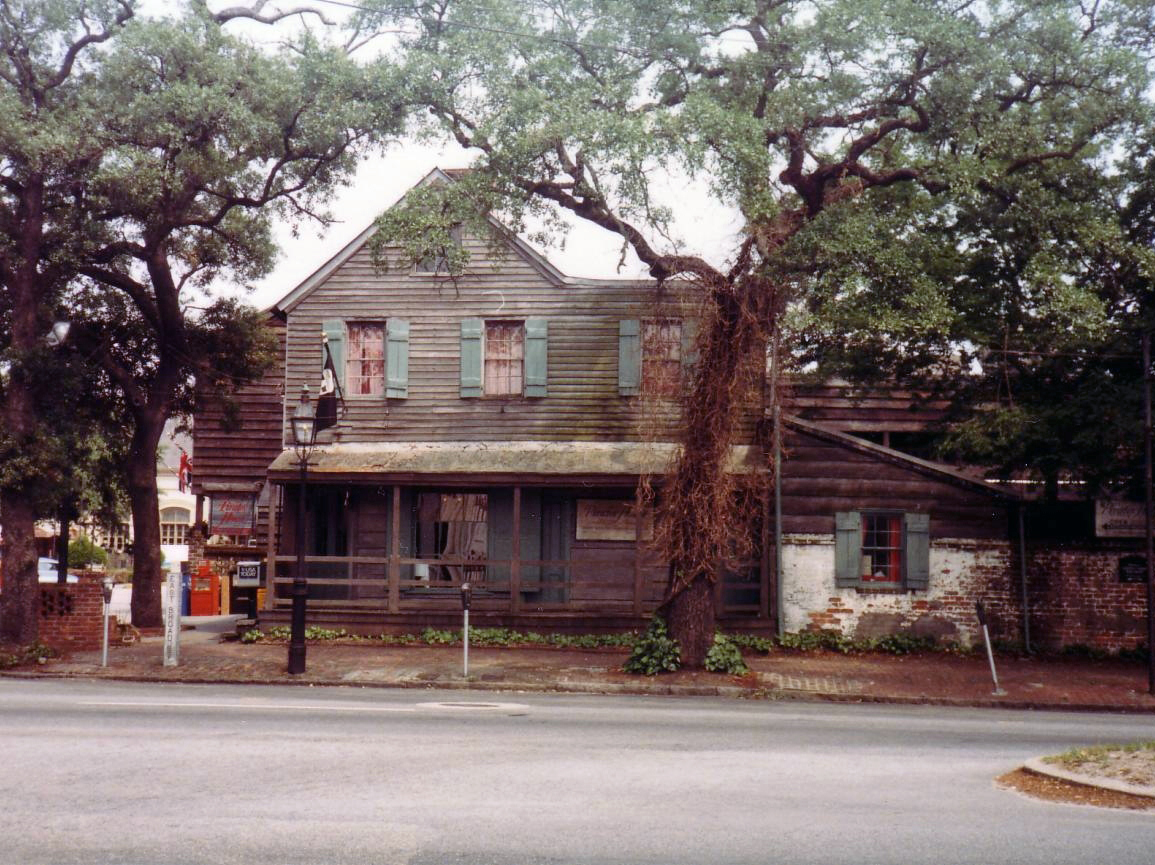
Pirates' House: Where Treasure Island Meets Southern Cooking
In Robert Louis Stevenson's 'Treasure Island,' the fearsome Captain Flint dies raving about buried gold in the upper room of a tavern in Savannah, Georgia. Stevenson never names the establishment, but Savannah knows exactly which one he meant. The Pirates' House sits on East Broad Street, a block from the Savannah River, and its oldest section - a small structure called the Herb House - dates to 1734, just one year after James Oglethorpe stepped ashore to found the colony. What began as a gardener's cottage on an experimental botanical plot became a seamen's tavern, a den of shanghaiers, a near-demolition, and finally one of Savannah's most visited restaurants. The building's basement still holds a tunnel that once connected to the river, and the line between documented history and Savannah ghost-story embellishment has long since blurred into something more interesting than either alone.
The Trustees' Garden
Before there were pirates, there were botanists. James Oglethorpe's original plan for Savannah designated a ten-acre plot on the eastern edge of the settlement as a botanical garden, modeled on the Chelsea Physic Garden in London. The idea was to test which crops - mulberry trees for silk, medicinal herbs, exotic plants - could thrive in Georgia's climate and turn the young colony profitable. A small cottage was built in 1734 to house the gardener who tended the experimental plots. This was the Herb House, and it still stands today as one of the oldest buildings in Georgia. The garden experiment itself lasted only about twenty years. The mulberry trees failed. The silk industry never materialized. By the 1750s, the botanical ambition had faded, but the buildings remained, and their location near the river made them useful for an entirely different kind of enterprise.
A Tavern on the Waterfront
By the mid-18th century, the Herb House and the structures growing around it had become an inn and tavern serving the sailors, merchants, and less reputable characters who moved through Savannah's busy port. The tavern's reputation grew rough. Savannah lore holds that sailors who drank too heavily at the Pirates' House sometimes woke up at sea, shanghaied through a tunnel in the basement that ran to the nearby Savannah River. Unconscious men were dragged through the passage and loaded onto ships needing crew. The tunnel is real - visitors can still see it in the restaurant's basement - though how many men actually vanished through it belongs to the category of stories Savannah tells with a wink and a straight face. The buildings expanded between 1794 and 1871 as additional structures grew around the original Herb House, creating the sprawling complex that stands today.
Stevenson's Ghost
When Robert Louis Stevenson published 'Treasure Island' in 1883, he placed Captain Flint's death in Savannah. The old pirate captain - the one who buried the treasure that drives the novel's plot - spent his last days in an inn in the port city, dying with rum on his lips and the words 'Darby M'Graw' on his tongue. Savannah immediately claimed the Pirates' House as Flint's deathbed. Whether Stevenson had the specific building in mind, or even visited Savannah, remains debated. But the association stuck. Today the restaurant leans into the legend, and Captain Flint's ghost is said to haunt the upper floors. In a city that collects ghost stories the way other places collect souvenirs, the Pirates' House holds one of the best.
Rescue and Rebirth
By the mid-20th century, the Pirates' House had fallen into disrepair. In 1945, the Savannah Gas Company purchased the property and the surrounding land. The buildings faced demolition. Then Mrs. Hansell Hilyer, wife of the gas company's president, took an interest. Instead of watching the historic structures come down, she championed their restoration. In 1953, the Pirates' House reopened as a restaurant, eventually growing to fifteen dining rooms capable of seating 120 guests. The menu turned to Southern cooking - the kind of food Savannah does well. The Herb House, nearly three centuries old, became the anchor of a restaurant where history is as much a draw as the food. Today the Pirates' House remains one of Savannah's most popular tourist attractions, a place where you can eat shrimp and grits in a room that once served rum to men who might not leave port voluntarily.
From the Air
Located at 32.078°N, 81.084°W on East Broad Street in Savannah's Historic District, one block south of the Savannah River. From the air, the Pirates' House sits near the eastern edge of Savannah's original grid plan, close to where the riverfront curves. The building complex is surrounded by the dense tree canopy typical of Savannah's historic core. The nearest airport is Savannah/Hilton Head International (KSAV), approximately 9 miles northwest. At low altitude, the Savannah River waterfront and the grid of historic squares provide clear orientation. The Pirates' House is roughly two blocks east of Emmet Park along the river bluff.