Pisa Baptistery
Sing a single note inside the Pisa Baptistery and wait. The sound does not simply echo -- it multiplies, splitting into harmonics that overlap and sustain for several seconds, turning the vast circular interior into a resonating instrument. Computer analysis has confirmed what visitors have sensed for centuries: the building functions as a giant acoustic chamber, its dome and walls shaping sound in ways that seem almost intentional. Whether the architect Diotisalvi planned this effect when he began construction in 1152, or whether it emerged as an accidental gift of geometry and marble, no one can say for certain. But it is fitting that a building dedicated to baptism -- the spoken word made sacrament -- should amplify the human voice so magnificently.
Two Centuries, Two Styles
Diotisalvi signed his name and the date on a pillar inside -- a rare act of authorial assertion for a medieval architect. He designed the lower stories in Romanesque style, with round arches and restrained figural decoration, all clad in the bichromatic Carrara marble that distinguishes Pisan religious architecture from the darker marmo verde preferred in Florence and Pistoia. But Diotisalvi died before his vision was complete. When Nicola Pisano took over, he brought the new Gothic language with him, adding pointed wimpergs and rich figurative programs to the upper levels. The result is a building that wears its construction history on its skin: rounded below, pointed above, two centuries of evolving taste unified by the white and blue-grey marble that wraps the entire structure. The dome itself tells two stories at once -- lead sheets on the southeast side facing the cathedral, red terracotta tiles on the northwest half facing the sea, creating a split appearance that seems to acknowledge the building's dual identity.
Portal of the Baptist
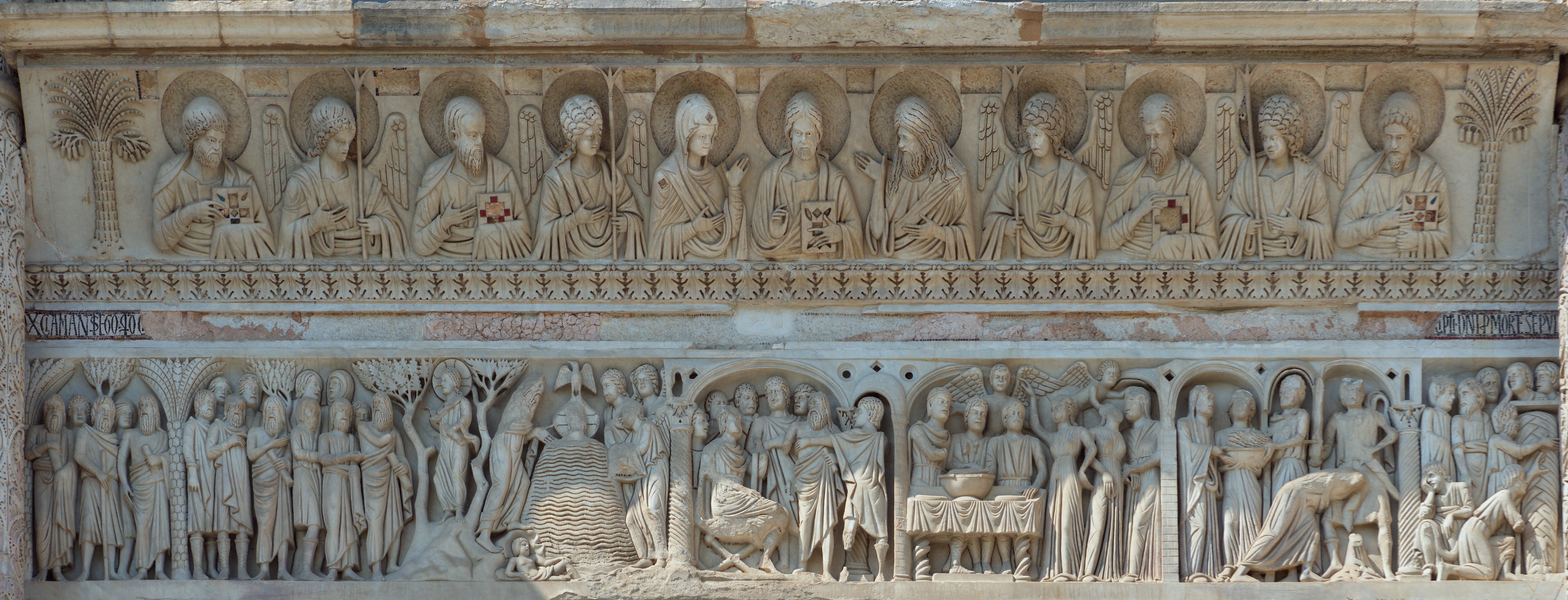
The east portal, probably carved around 1200, faces the cathedral facade in a deliberate architectural dialogue. Two columns with foliage decoration flank the door, directly copying classical models -- a medieval sculptor reaching back across centuries to Rome for inspiration. The jambs carry eleven figurative reliefs on each side executed in Byzantine style: months of the year on the left, beginning with January at the bottom, and on the right a sequence descending from the Ascension of Christ through pairs of Apostles to the Harrowing of Hell, with King David at the base. The architrave above divides into two tiers. The lower registers episodes from the life of Saint John the Baptist -- his sermon, the baptism of Christ, his imprisonment by Herod, Salome's dance, and his beheading. Above, Christ sits between Mary and the Baptist, flanked by angels and the four evangelists. The Twenty-Four Elders appear in medallions along the retreating archivolts, with the Lamb of God as the keystone.
Where the Renaissance Began
Art historians face a peculiar question: when did the Italian Renaissance start? Many point to a specific object in this baptistery. Between 1255 and 1260, Nicola Pisano carved a marble pulpit that broke with everything medieval sculpture had been doing. His depiction of Hercules -- naked, muscular, classical in every proportion -- drew directly from Roman sarcophagi he had studied, reinstating antique representations that had been suppressed for centuries. The pulpit stands on columns and carved figures, its panels narrating the life of Christ with a naturalism and emotional depth that anticipates Giotto by a generation. Nicola's son Giovanni would later carve the pulpit in the cathedral next door, advancing his father's innovations further. Surveys of Renaissance art routinely begin with 1260, the year Nicola dated this pulpit. The fact that this revolution happened not in Florence or Rome but inside a baptistery in Pisa -- on a piece of church furniture -- gives it an almost accidental quality, as if the Renaissance arrived before anyone was ready for it.
The Leaning Building Nobody Notices
Everyone knows the tower leans. Far fewer visitors notice that the baptistery leans too -- 0.6 degrees toward the cathedral, built on the same unstable sandy subsoil that tormented every structure on the Piazza dei Miracoli. The tilt is subtle enough to miss with the naked eye, but it connects the baptistery to the geological reality that defines this entire square: nothing here stands perfectly straight, because the ground beneath Pisa does not permit it. At 54.86 meters tall and 34.13 meters in diameter, the baptistery is the largest in Italy. With the statue of Saint John the Baptist atop the dome -- attributed to Turino di Sano -- it actually exceeds the Leaning Tower's height by a few centimeters. Inside, the vast space is surprisingly bare, its power deriving from scale rather than decoration. The octagonal font at the center, created by Guido Bigarelli da Como in 1246, and the bronze Saint John by Italo Griselli draw the eye downward, toward the water that gives the building its purpose. An undeciphered inscription remains on the left door jamb -- one more mystery in a building full of them.
From the Air
Located at 43.723N, 10.394E, the baptistery is the round domed structure immediately west of Pisa Cathedral in the Piazza dei Miracoli complex. At 55 meters tall, it is the largest building in the complex by footprint. Best viewed at 2,000-3,000 feet AGL. Nearest airport: Pisa International (LIRP/PSA), 2 km south. The half-grey, half-red dome is distinctive from the air in good light.