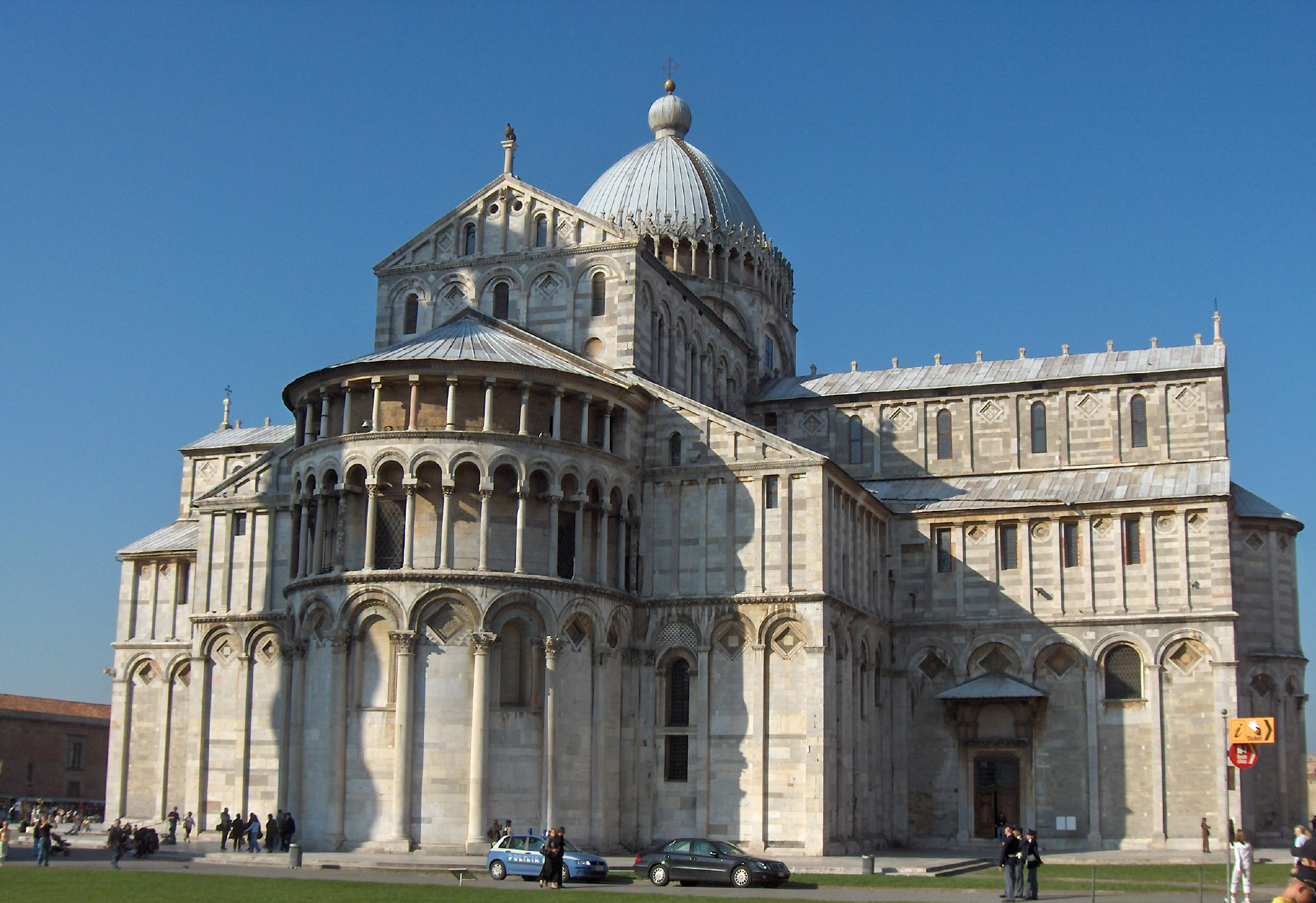
Pisa Cathedral
The columns came from a mosque. In 1063, Pisan warships overwhelmed Palermo's defenses, and among the spoils hauled back across the Tyrrhenian Sea were granite Corinthian columns that would be set between the nave and aisles of a cathedral not yet begun. Construction started the following year under the architect Buscheto, and from the very beginning Pisa Cathedral was a building that combined conquest with creation, Islamic precedent with Christian purpose, Roman spolia with medieval ambition. The result was something genuinely new: a style of architecture so distinctive that art historians gave it its own name. Pisan Romanesque would influence church building across Tuscany and beyond, but its purest expression remains here, on the eastern edge of the Piazza dei Miracoli.
A New Architectural Language
Buscheto's design layered traditions. Byzantine mosaics and pointed arches coexist with Romanesque arcading and classical proportions. The facade, built by a master named Rainaldo -- who left his signature above the middle door as Rainaldus prudens operator -- rises in tiers of grey marble and white stone inset with colored marble discs, then opens into four rows of delicate galleries topped by statues of the Madonna with Child and the Four Evangelists. The effect is simultaneously massive and airy, the weight of the stone counteracted by all those small openings that let light and wind pass through. High on the eastern apse, a replica of the Pisa Griffin once perched on a column -- the largest known Islamic metal sculpture, probably placed there in the 11th or 12th century, its original now in the Cathedral Museum. A building decorated with a trophy from the Islamic world, supported by columns from a Sicilian mosque: Pisa Cathedral is medieval Italy's relationship with the wider Mediterranean made architectural.
Fire, Restoration, and Galileo's Lamp
A devastating fire in 1595 destroyed most of the Renaissance artworks that had accumulated inside over five centuries. The coffered ceiling was replaced with the current gold-decorated version bearing the Medici coat of arms. The massive bronze doors, cast in Giambologna's workshop, replaced Bonanno Pisano's original bronze central door from around 1180. But the fire spared crucial treasures. The Christ in Majesty mosaic in the apse -- its head of Saint John the Evangelist executed by Cimabue in 1302 as his last work before dying in Pisa that same year -- survived and still evokes the mosaics of Monreale in Sicily. Giovanni Pisano's extraordinary carved pulpit, completed between 1302 and 1310, also survived the blaze, though it was packed away during redecoration and not rediscovered until 1926. Its nine narrative panels of New Testament scenes are carved with a chiaroscuro depth that anticipates painting techniques by centuries. And then there is the lamp. Galileo reportedly watched an incense lamp swinging from the nave ceiling and conceived his pendulum theory -- though the current lamp is not the one he observed. That simpler original rests in the Camposanto.
The Pulpit That Told Stories in Stone
Giovanni Pisano's pulpit deserves its own contemplation. Supported by columns mounted on lion sculptures, caryatids, and a telamon, it carries figures of Saint Michael, the Evangelists, the four cardinal virtues, and a bold nude Hercules that echoes his father Nicola's revolutionary classicism in the baptistery pulpit next door. A central plinth bearing the liberal arts supports the four theological virtues above. The nine upper panels depict scenes from the Annunciation through the Last Judgment, carved in white marble with such depth that figures seem to emerge from the stone into actual space. The present arrangement is a reconstruction -- the pulpit originally stood closer to the main altar, and the columns and panels have been reassembled from fragments. The original staircase, probably marble, was lost entirely. What remains is nonetheless among the finest achievements of medieval sculpture in Europe, a father-son artistic dialogue that spans two buildings and two generations.
Sacred Bones and a Solar Calendar
The cathedral holds the bones of Saint Ranieri, Pisa's patron saint, and once held the tomb of Holy Roman Emperor Henry VII, carved by Tino da Camaino in 1315. Political fortunes moved that tomb repeatedly -- the sarcophagus remains in the cathedral, but statues from it ended up in the Camposanto and atop the facade before finding their way to the Cathedral Museum. Pope Gregory VIII was also buried here until the 1595 fire destroyed his tomb. Crusade relics include alleged remains of three saints and a vase said to be one of the jars from the wedding at Cana. Perhaps most remarkable is the cathedral's role as calendar. From the tenth century until 1749, Pisa reckoned its new year from March 25 -- the Feast of the Annunciation -- with the precise moment determined by a sunbeam passing through a window on the left side and striking an egg-shaped marble near the pulpit at noon. For eight centuries, this building told the city not just how to worship but when to begin again.
From the Air
Located at 43.723N, 10.394E in the Piazza dei Miracoli, Pisa. The cathedral is the largest structure in the complex, its cross-shaped footprint and white marble clearly visible from the air. Best viewed at 2,000-4,000 feet AGL. Pisa International Airport (LIRP/PSA) lies 2 km south. The building sits north of the Arno River, which curves through the city. The Leaning Tower stands directly to its south as the cathedral's bell tower.