Pitons (Saint Lucia)
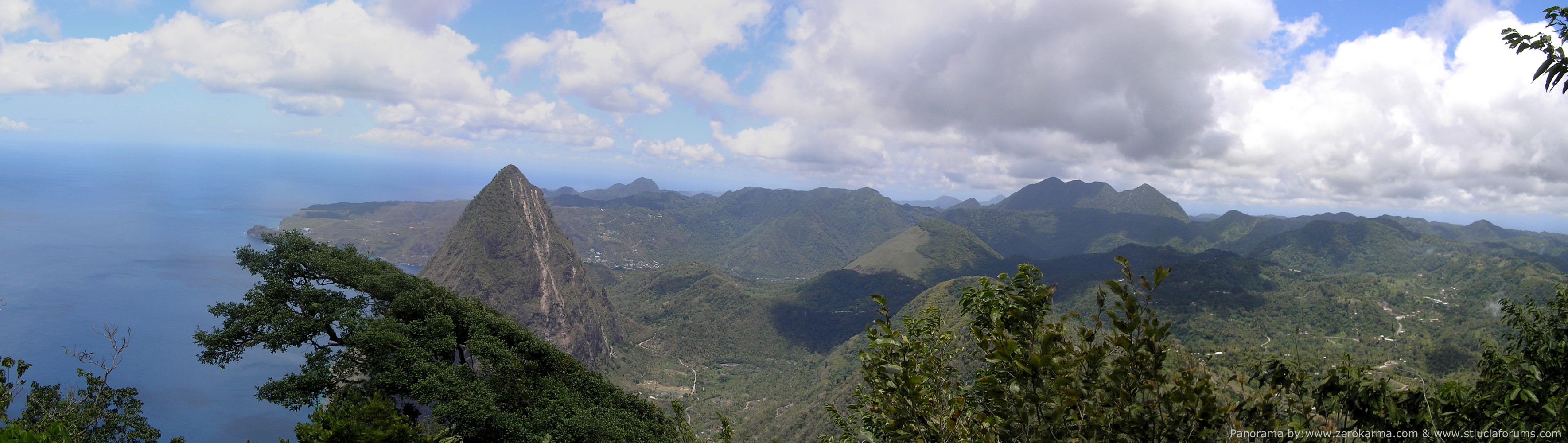
The Arawak people looked at the two volcanic spires on Saint Lucia's southwestern coast and saw a family. Gros Piton, the taller of the pair at 798 meters, was the father. Petit Piton, at 743 meters, was the mother. And Petit-Petit Piton -- a spur jutting from the flank of Petit Piton -- was their child. It is a reading of the landscape that captures something geological science would later confirm: these two towers of rock are intimately connected, linked by the Piton Mitan ridge and born from the same volcanic forces that built the island itself. Today the Pitons are a UNESCO World Heritage Site, the most recognizable landmark in Saint Lucia, and the image on the island's most popular beer. But to stand at the base of either spire and look up is to understand why the Arawak reached for metaphor. These are not mountains you describe in numbers. They demand a story.
Volcanic Bones
The Pitons are volcanic plugs -- solidified cores of magma left standing after the softer rock around them eroded away over millennia. They rise between the towns of Soufriere and Choiseul on Saint Lucia's southwestern coast, their dark flanks plunging steeply into the Caribbean. The volcanic complex beneath them is still active, feeding a geothermal field of sulphurous fumaroles and hot springs that visitors can explore at the nearby Sulphur Springs. Gros Piton, the broader of the two, offers a more gradual ascent that draws hikers from around the world. Petit Piton is steeper, more technical, and less forgiving. Between them, the Piton Mitan ridge connects the two summits like the spine of some enormous creature half-submerged in the sea.
A Forest in the Clouds
What makes the Pitons more than a dramatic silhouette is the life they harbor. The lower slopes are cloaked in tropical moist forest that transitions, as altitude increases, to subtropical wet forest. Near the summits, where mist condenses against the rock, patches of elfin woodland cling to the exposed ridges -- gnarled, stunted trees shaped by wind and moisture into forms that look ancient even when they are not. Botanists have recorded at least 148 plant species on Gros Piton alone, with 97 more on Petit Piton and the intervening ridge. Eight of these tree species are classified as rare. The fauna matches the botanical richness: 27 bird species inhabit Gros Piton, five of them endemic to the island. Three indigenous rodent species, an opossum, three species of bat, eight reptiles, and three amphibians round out the vertebrate census. The 2,909-hectare World Heritage Site protects not just the visual drama of the peaks but the biodiversity layered across their flanks.
Climbing the Father
Both Pitons attract hikers, but Gros Piton is the more popular climb -- steep but manageable, with established trails maintained by the Soufriere Foundation, a nonprofit dedicated to preserving the Pitons Management Area. The ascent takes most hikers several hours, winding through progressively thinner forest until the vegetation opens to reveal panoramic views of Saint Lucia's northern coastline, the Caribbean stretching west, and Petit Piton rising across the gap like a mirror image. Petit Piton's near-vertical western face makes it a more serious proposition, attempted by experienced climbers rather than casual day-trippers. The contrast between the two peaks reflects their names -- piton means mountain peak in French, and petit and gros simply mean smaller and larger -- but the experience of climbing each is more different than those labels suggest.
An Island's Identity, in Stone
The Pitons have become inseparable from Saint Lucian identity. The Windward and Leeward Brewery named the island's signature beer after them -- Piton lager, sold in green bottles that echo the lush slopes of their namesake. The twin peaks appear on postcards, currency, and government seals. UNESCO inscribed the Pitons Management Area as a World Heritage Site in recognition of both the geological significance and the ecological wealth of the area. But the most enduring tribute may be the Arawak one. Long before European cartographers mapped these spires, the indigenous people of the Caribbean had already given them meaning -- not as geological features to be measured but as figures in a family, standing together at the water's edge. That image persists. From a boat offshore, or from the air, the Pitons do look like they belong together, two figures bracing against the trade winds, with a smaller shape tucked between them.
From the Air
Located at 13.81°N, 61.07°W on Saint Lucia's southwestern coast between the towns of Soufriere and Choiseul. The twin volcanic spires are unmistakable from the air -- Gros Piton (798m / 2,619ft) to the south and Petit Piton (743m / 2,438ft) to the north, rising sharply from the coastline. The Piton Mitan ridge connects them. Soufriere town and its harbor sit just north of Petit Piton. Sulphur Springs is visible inland as a patch of bare, steaming ground. Nearest airports: Hewanorra International Airport (TLPL) at the island's southern tip, approximately 20km southeast; George F. L. Charles Airport (TLPC) near Castries to the north. Recommended viewing altitude: 3,000-5,000ft for dramatic perspective along the coast. Afternoon cumulus may obscure the summits.