Pitt Rivers Museum
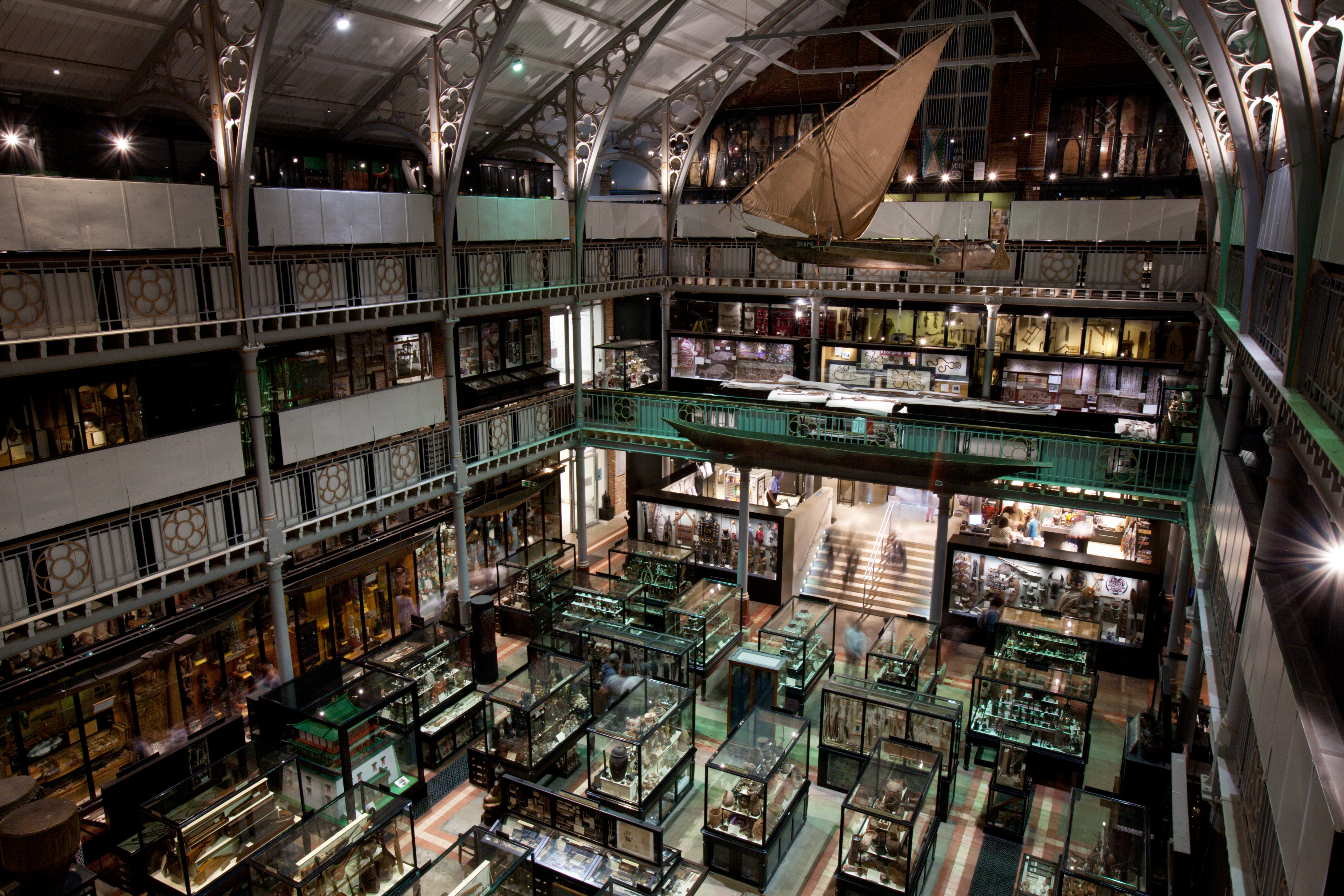
You enter through the back of the Oxford University Museum of Natural History, past the dinosaur skeletons, through a doorway that gives no warning of what lies beyond. Then the Pitt Rivers Museum opens up: a vast, dimly lit hall crammed with glass cases on two mezzanine levels, soaring to a vaulted ceiling, every surface dense with objects. Masks, weapons, textiles, musical instruments, amulets, boats, tools -- more than 600,000 items from every inhabited continent, arranged not by where they came from but by what they do. It is overwhelming, deeply strange, and unlike any other museum in the world.
The General's Gift
Augustus Pitt Rivers was a Victorian military officer, an archaeologist, and an evolutionary thinker who believed that human culture could be understood the way Darwin understood biology: as a progression from the simple to the complex. In 1884, he donated his private collection of approximately 22,000 objects to the University of Oxford, with two conditions. First, a permanent lecturer in anthropology must be appointed -- Edward Burnett Tylor took the post, becoming the first lecturer in anthropology in Britain. Second, a building must be provided for the collection and used for no other purpose. Thomas Manly Deane designed the adjoining hall at the rear of the Museum of Natural History, completed in 1886. Pitt Rivers intended his typological arrangement to demonstrate the evolution of human technology: rows of similar tools showing development over centuries and across continents. That evolutionary framework is no longer considered appropriate, but the museum retains the original typological organisation, bound by the Deed of Gift.
The Case of the Shrunken Heads
For decades, the Pitt Rivers Museum was known -- to schoolchildren especially -- as the place with the shrunken heads. The tsantsas, as the Shuar people of Ecuador call them, had been on display since the 1940s, the museum's most famous and most troubling exhibits. In September 2020, during a closure forced by the pandemic, the museum removed the shrunken heads and other human remains from display. The director's statement was direct: displaying them "reinforced racist and stereotypical thinking that goes against the museum's core values." The decision attracted worldwide attention and opened a broader conversation about what a museum built on colonial-era collecting owes to the communities whose objects fill its cases. In 2022, the museum and the Museum of Natural History returned the remains of seventeen Aboriginal Australians to the Australian government.
Six Hundred Thousand Objects
The collection has grown from Pitt Rivers's original 22,000 items to over 600,000, nearly all acquired through donation by colonial officials, travellers, scholars, and missionaries. The largest object on display is a Haida house post -- an 11-metre totem pole from the village of Old Massett on Haida Gwaii in British Columbia, originally standing in front of Star House, home of Chief Anetlas. It was purchased by Tylor and transported to Oxford in 1901. Around it, the cases hold Japanese Noh masks, Polynesian fishhooks, African textiles, Arctic kayaks, and musical instruments from every tradition that makes music. The collection includes major photographic holdings. Objects on display change periodically, but the sheer density never diminishes: the Pitt Rivers is a museum where looking closely at one case means missing a hundred others.
Reckoning with the Past
The Pitt Rivers Museum now describes itself as "sector-leading" in its work on decoloniality, and the changes go beyond removing problematic displays. New labels incorporate the voices of artists and indigenous leaders. The Living Cultures initiative, a collaboration with a Maasai community campaign group called Oltoilo Le Maa, allows the communities whose objects are held in Oxford to tell their own stories about them. The Multaka network, joined in 2019, trains Arabic-speaking guides to lead tours for refugees and migrants, connecting the museum's collections to their visitors' own cultural heritage. Whether these initiatives adequately address the fundamental question -- who has the right to hold, display, and interpret objects taken from other peoples' cultures -- is a debate the museum invites rather than avoids. The Pitt Rivers won The Guardian's Family Friendly Museum award in 2005. Its challenge now is being honest about a history that was anything but friendly to many of the people whose belongings fill its extraordinary, overwhelming cases.
From the Air
Located at 51.76N, 1.26W in central Oxford, behind the Oxford University Museum of Natural History on Parks Road. The museum building is not individually distinguishable from the air but sits within the cluster of university science buildings north of the city centre. Oxford's spires and college quadrangles are the primary landmarks. Nearest airports: EGTK (Oxford Kidlington, 5nm north), EGUB (RAF Benson, 12nm southeast).