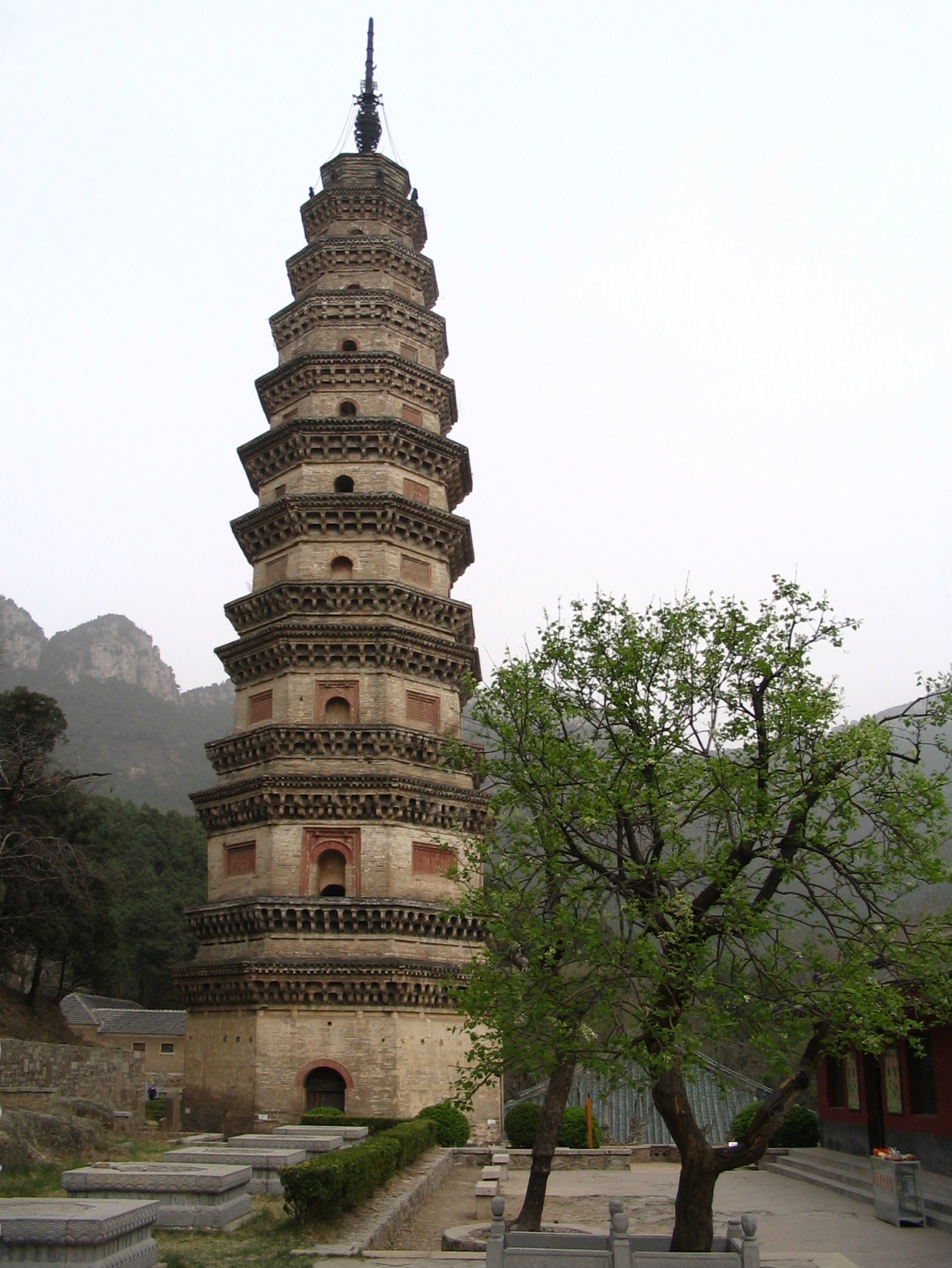
Pizhi Pagoda
At the base of the Pizhi Pagoda, carved into the stone pedestal on all four sides, are scenes of the Buddhist afterlife -- and torture scenes in Hell. It is an unusual welcome mat for a structure that rises 54 meters into the sky above one of China's most serene temple valleys. But the pagoda, like the Buddhism it serves, has always held beauty and suffering in the same frame. Originally built in 753 AD during the Tang dynasty, the Pizhi Pagoda was reconstructed between 1056 and 1063, during the final years of Emperor Renzong of Song. The result is one of the finest surviving examples of Song dynasty pagoda architecture.
Two Dynasties in One Tower
The pagoda that stands today is fundamentally a Song dynasty creation, but its Tang dynasty origin shapes everything about it. The octagonal plan, the nine stories, the transition from elaborate lower floors to austere upper levels -- all reflect architectural conventions that evolved across centuries of Chinese Buddhist building. The basic structure is brick, though the exterior facade incorporates carved stone elements that give it a hybrid character. The first three stories feature balconies supported by dougong brackets, those interlocking wooden arms that are Chinese architecture's answer to the flying buttress. From the fourth story upward, only pent roofs project from the walls, creating a tapered profile that draws the eye toward the iron steeple at the summit.
Celestial Guards in Iron
The steeple crowning the pagoda is a work of art in its own right. Composed of an inverted bowl, a series of discs, a sun, a crescent, and a bead, it condenses Buddhist cosmology into a few meters of ironwork. Chains anchor the steeple to the rooftop, and at each chain's attachment point sits a small iron statue of a celestial guard -- supernatural sentinels believed to hold the chains in place through spiritual force as much as engineering. The arrangement speaks to a culture that saw no contradiction between practical construction and spiritual purpose. The chains keep the steeple from toppling in the wind; the guards ensure the chains hold. One explanation is physical, the other metaphysical, and both are considered necessary.
The Stairway Between Worlds
Inside the pagoda, a large brick pillar and stairway lead visitors to the fifth floor. Beyond that point, only an external winding staircase reaches the top. This split arrangement -- interior stairs below, exterior stairs above -- is common in Chinese stone pagodas but rare in brick ones. The transition from enclosed ascent to open-air climbing transforms the experience of the pagoda from architectural interior to mountain trail. At the fifth floor, visitors step outside and the valley opens below them: the temple complex of Lingyan with its 167 stupas, the forested slopes of the Taishan range, and on clear days, the plains stretching north toward Jinan. The carved pedestal with its Hell scenes feels very far away. The view from the top belongs to a different register entirely -- one of sky, distance, and the particular silence that comes with height.
From the Air
The Pizhi Pagoda stands at 36.36°N, 116.98°E within the Lingyan Temple complex in Changqing District, near Jinan, Shandong Province. At 54 meters (177 feet), the pagoda is the tallest structure in the immediate area and is visible from the air against the surrounding forested hills of the western Taishan range. Nearest major airport: Jinan Yaoqiang International (ZSJN), approximately 50 km northeast. The pagoda sits in a valley, so approach from the east or south for best visibility. Mount Tai (1,545 m) is approximately 20 km to the southeast.