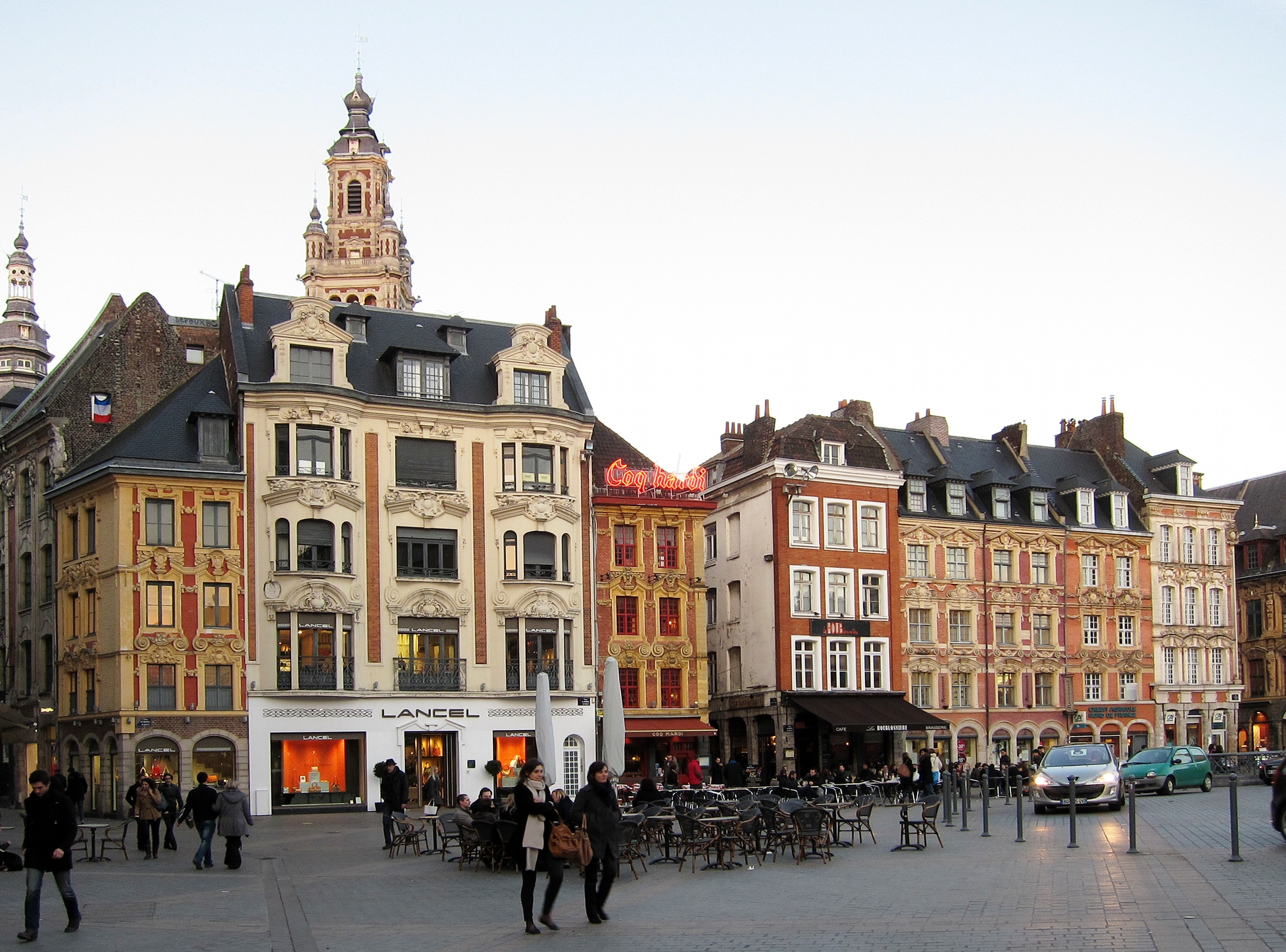
Place du Général-de-Gaulle (Lille)
Before there was a square, there was a swamp. Until the thirteenth century, the place where Lille's main plaza now stretches in its pink-and-blue granite checkerboard was the alluvial floodplain of the Deûle river — a marsh bordered by an alderman's hall that burned in 1213, was rebuilt in 1233, and looked out over standing water and reeds. The aldermen of Lille fixed that. In 1242 they canalised the Lower Deûle between La Bassée and Lille, flooding the cellars of the houses around what would become the square but creating, at last, a permanent body of water they could route around. By 1271 the upper Deûle was canalised too. The marsh drained. They paved it with chalk first, then with packed limestone, and turned it into a market. The Grand'Place has been the heart of Lille for seven hundred years. Twentieth-century war just gave it a new name.
The Vieille Bourse in the Middle
Until 1652, the square was a single trapezoidal market — pillory at one end, stalls everywhere, the Épinette joust held in front of the alderman's hall on the first Sunday of Lent. Then the aldermen, scrambling to pay for the Spanish garrison Lille was forced to host during the War of Devolution, sold off houses in the square's centre. In 1651 the city decided to put a merchants' exchange — a Bourse de Commerce — exactly in the middle of the Place du Marché. Julien Destrée drew the plans. Work began in 1652 and finished the following year. Twenty-four identical brick-and-stone Flemish houses were interlocked face-to-face around an inner courtyard, splitting the old market in two: the Grand'Place to the north-west, the Petite-Place (today's Place du Théâtre) to the south-east. The Vieille Bourse is one of the great pieces of seventeenth-century Flemish Renaissance architecture in Europe — listed since 1921, still ringed daily by chess players, second-hand booksellers, and a small Sunday flower market in the courtyard.
The Goddess on the Column
Standing in the centre of the square is a bronze woman in a mural crown, holding a fuse to a cannon, on a marble column nearly twenty metres tall. This is the Column of the Goddess, designed by Charles Benvignat and sculpted by Théophile Bra. The foundation stone was laid on 8 October 1842; the inauguration came three years later, on 8 October 1845. She commemorates the Austrian siege of 1792, when Lille was bombarded for nine days during the early French Revolutionary Wars and refused to surrender — the town's mayor François André-Bonte famously replied to the demand for capitulation with a one-line letter the people of Lille still quote. The goddess is the city itself, defending its walls, with the bombardment behind her in bronze relief. She watches everything: the Christmas market every December, the Braderie de Lille every September, the football celebrations, the protests, the wedding parties pouring out of the surrounding hôtels.
De Gaulle's Square
Charles de Gaulle was born at 9 rue Princesse on 22 November 1890 — a five-minute walk north into Vieux-Lille. The house is now a museum; the parish church where he was baptised, Saint-André, is around the corner. He grew up in Lille before his family moved to Paris, fought in both world wars, walked away from Pétain's government in June 1940 and broadcast his refusal from London on the 18th. In September 1944, after the city's liberation, Lille's municipality renamed its main square in his honour. The square had been called Place du Marché in the fourteenth century, then Grand'Place, then Grande-Place, then briefly Place de la République under successive regimes. Locally, people still call it the Grand'Place — or, more affectionately, the Place de la Déesse, the Goddess's Square. The new name stuck on the maps. The old one stuck in the mouth.
La Voix du Nord and the Quiet Reckoning
On the north side of the square, beside the eighteenth-century Grande Garde guardhouse that is now the Théâtre du Nord, stands a 1936 building with a stepped Flemish gable. Albert Laprade designed it in neo-Flemish style for L'Écho du Nord — at the time the dominant local newspaper. During the occupation, L'Écho du Nord became the Grand Echo du Nord and collaborated. After the Liberation, with the city's resistance newspaper La Voix du Nord coming up out of clandestinity, the purge handed the building over to it. The paper still publishes from those offices today. Above the doorway, a gilded bronze group of Three Graces by sculptor Raymond Couvègnes looks down at the square — an allegory of the three historic provinces of the region: Flanders, Artois, and Hainaut. Stand in the goddess's shadow and look at the gable: in 1936 it was the headquarters of a collaborationist daily; in 1944 it became the home of the underground press that had defied them. The building is the same. The masthead changed.
From the Air
50.6369°N, 3.0634°E. The Grand'Place is a 155 m by 72 m rectangle in the centre of Lille, immediately south of Vieux-Lille and north of the pedestrian zone. From above, the giveaway is the small free-standing block of the Vieille Bourse separating two paved spaces — Place du Général-de-Gaulle to the north-west and Place du Théâtre to the south-east — with the Column of the Goddess as a pin in the middle of the north square. The town hall's Belfry of Lille (104 m, the city's tallest object) is roughly 1 km south-east. Recommended viewing altitude 1,500–2,500 ft AGL. Nearest airports: Lille-Lesquin (LFQQ) 5 nm south; Brussels (EBBR) 50 nm east; Charles de Gaulle (LFPG) 100 nm south.