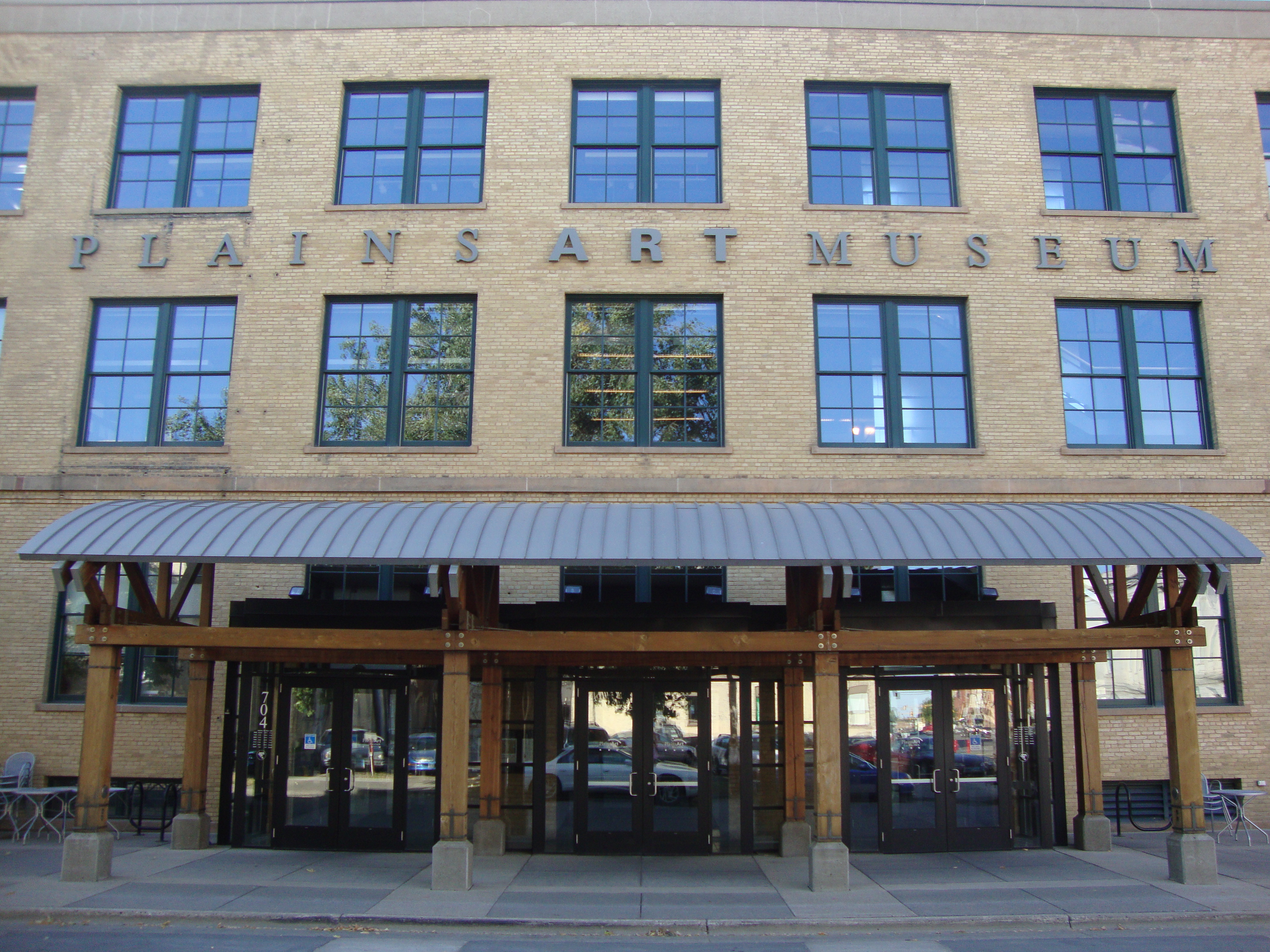
Plains Art Museum
A Warhol hangs in an old farm equipment warehouse on the northern plains. That single fact captures the unlikely story of the Plains Art Museum in downtown Fargo, North Dakota, where approximately three thousand works of art -- spanning Andy Warhol, Salvador Dali, James Rosenquist, Helen Frankenthaler, Ellsworth Kelly, Sol LeWitt, traditional American Indian art, and regional folk art -- fill a renovated turn-of-the-century International Harvester building. The museum is one of only two in North Dakota accredited by the American Alliance of Museums, a distinction earned in 2003. It arrived at this address after a journey almost as restless as the prairie landscape it serves.
From Post Office to Warehouse
The museum's story begins not in Fargo but across the Red River in Moorhead, Minnesota. In 1965, the Red River Art Center opened in a former Moorhead post office, bringing organized fine arts exhibition to the Fargo-Moorhead metropolitan area for the first time. A decade later, in 1975, the Red River Art Center merged with the O'Rourke Art Gallery Museum to form the Plains Art Museum, while simultaneously operating the Rourke Gallery a few blocks away. Founding director James O'Rourke led both institutions until a 1987 schism split the organizations apart. The Plains Art Museum and the Rourke Art Museum became separate entities, each carrying forward a different piece of the original vision. The Plains remained in downtown Moorhead until 1996. Then came the move that defined its modern identity: in 1994, the museum acquired a turn-of-the-century International Harvester warehouse in downtown Fargo, and in October 1997 it reopened in the renovated industrial space, its high ceilings and exposed structural bones providing a dramatic backdrop for contemporary art.
Warhol Meets the Prairie
The permanent collection of approximately three thousand works reflects an institution that refuses to be defined by geography alone. National and regional contemporary art shares gallery space with traditional American Indian art and folk art traditions rooted in the immigrant communities of the northern plains. Works by Andy Warhol and Salvador Dali anchor the contemporary holdings, while James Rosenquist, himself born in Grand Forks, North Dakota, represents a native son who became a founding figure of American Pop Art. Helen Frankenthaler's color field paintings, Ellsworth Kelly's hard-edge abstractions, and Sol LeWitt's conceptual works round out a collection that would hold its own in cities many times Fargo's size. The juxtaposition is deliberate: world-class contemporary art displayed alongside the beadwork, quillwork, and ceremonial objects of the region's Indigenous peoples creates a dialogue between global art movements and the deep cultural history of the northern Great Plains.
Art on Eighteen Wheels
In 1993, the Plains Art Museum launched one of its most inventive programs: the Rolling Plains Art Gallery, a climate-controlled semi-trailer that carried curated selections from the permanent collection to communities across North Dakota and Minnesota. The semi-trailer was not merely a transport vehicle but the gallery itself, its interior designed for exhibition display. An art educator traveled with each tour, turning the experience into something more than a drive-by viewing. For small towns scattered across the northern plains -- places without museums, without galleries, sometimes without a bookstore -- the Rolling Plains Art Gallery brought original works of art directly to the community. The program is not currently touring, but its legacy endures as one of the more creative solutions to the challenge of serving a vast, sparsely populated region where the nearest museum might be a three-hour drive away.
Indigenous Voices on the Air
The museum's commitment to American Indian art extends beyond gallery walls. Joe Williams, director of Native American programs at the Plains Art Museum, hosts the weekly podcast '5 Plain Questions,' where he interviews Indigenous artists about their work and creative processes. The podcast launched in May 2020, produced in conjunction with Eleven Warrior Arts, and has earned attention from The New York Times as an example of smaller museums using digital media to broaden their reach. For an institution rooted in the Fargo-Moorhead area -- a region where the Ojibwe, Dakota, and Lakota peoples have deep historical ties -- the podcast represents a continuation of the museum's founding impulse: to connect art and community across distances that the Great Plains imposes on everyone who lives here.
From the Air
Located at 46.877N, 96.792W in downtown Fargo, North Dakota, approximately 2 miles south-southeast of Hector International Airport (KFAR). The museum sits in the commercial district near the Red River of the North, which marks the Minnesota border immediately to the east. Moorhead, Minnesota -- where the museum originated -- is visible just across the river. From the air at 3,000-5,000 feet AGL, downtown Fargo's grid is clearly distinguishable, with the old warehouse district where the museum is located standing out among the commercial blocks. The BNSF Railway mainline runs through the heart of downtown, a reminder of the railroad era that built both cities.