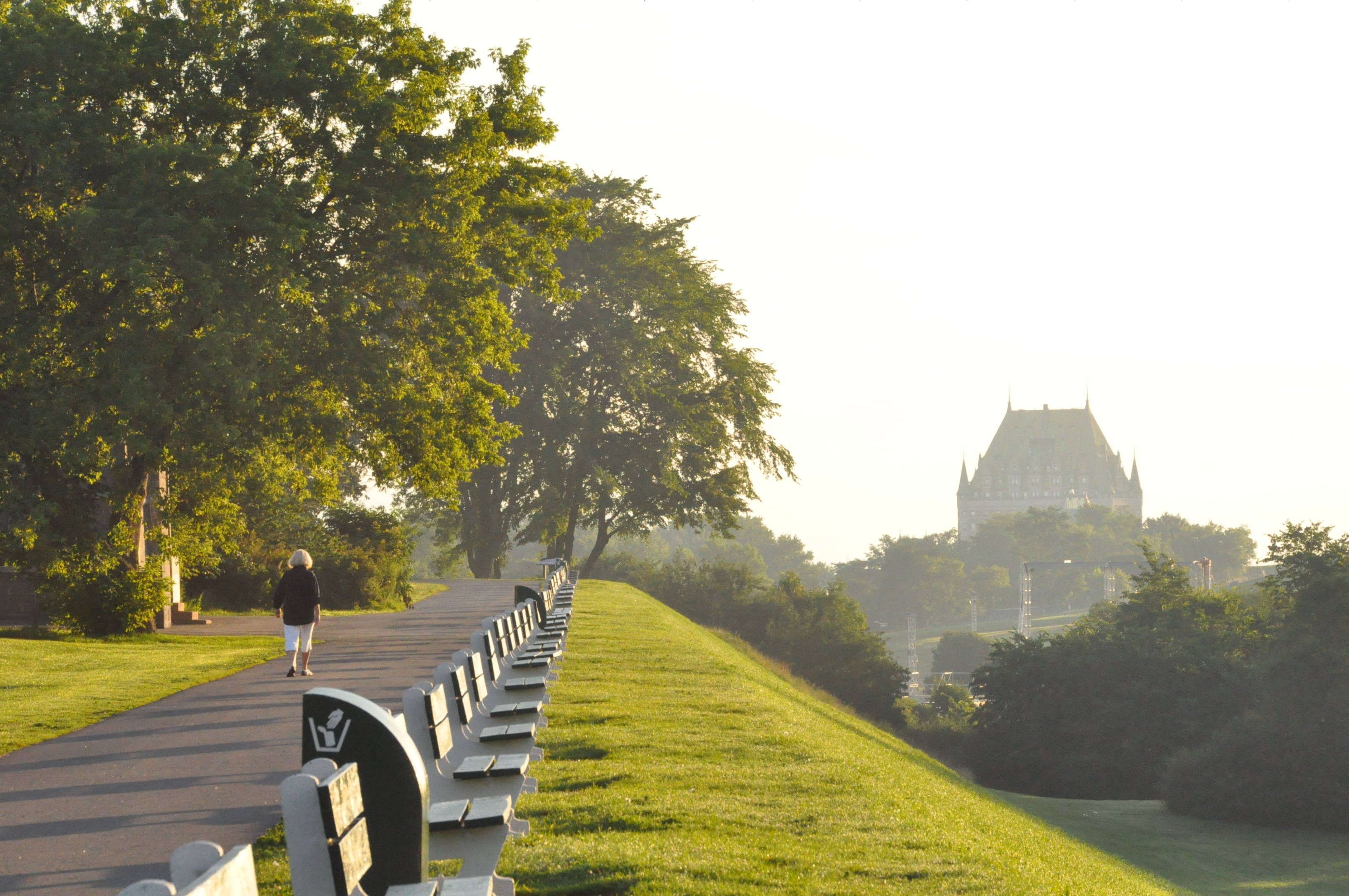
Plains of Abraham: Thirty Minutes That Decided a Continent
The plains are named after a fisherman. Abraham Martin, also known as L'Écossais -- The Scot -- was a river pilot who arrived in Quebec City around 1620 with his wife Marguerite Langlois and received a grant of land from the Company of New France, divided between the lower town and the promontory above. His name stuck to the landscape, appearing in 17th-century deeds and on a 1734 plan that precisely located an Abraham Street. The journals of the Chevalier de Lévis and the Marquis de Montcalm later referred to the Heights of Abraham; British soldiers' diaries used Plains of Abraham. A fisherman's fields became the stage for one of the most consequential battles in North American history.
The Thirty-Minute War
On September 13, 1759, British soldiers under General James Wolfe climbed the steep cliffs below Quebec City in darkness. The French thought the approach unscalable. At dawn, 4,500 British troops stood in formation on the plains outside the walls. General Louis-Joseph de Montcalm, the French commander, chose to attack rather than wait for reinforcements. A single devastating volley of musket fire shattered the French line. The battle was over in approximately thirty minutes. Both commanders died of their wounds -- Wolfe on the field, Montcalm the following morning. The British held Quebec City; France surrendered Canada the following year. The engagement that decided whether most of a continent would speak English or French lasted less time than a church service.
From Battlefield to Parkland
After the battle, the plains reverted to ordinary fields. Grazing, housing, and small industrial structures covered hundreds of acres. Only a monument to Wolfe -- an astronomic meridian marker raised in 1790 by the Surveyor-General of Canada, Major Holland, at the site where Wolfe reportedly died -- reminded anyone of what had happened. In 1908, as Quebec City prepared to celebrate its 300th anniversary, Mayor Jean-Georges Garneau appointed a landmark commission that called for nationalizing the battlefields. Prime Minister Wilfrid Laurier agreed that preserving the plains themselves would be the most fitting tribute. On March 17, 1908, the park was created -- becoming the first National Historic Site in Canada. On July 24 that year, Prince George, Prince of Wales (later George V), presented the title deeds to the Governor General. Laurier observed that Quebecers were 'monarchical by religion, by habit, and by the remembrance of past history.'
The Hidden Reservoir
Between 1931 and 1933, workers performed an extraordinary feat of engineering beneath the parkland. Nearly every bit of soil on the plains was removed, a massive drinking water reservoir was constructed, and the soil was replaced on top. The reservoir's base lies about two metres under the surface. It holds approximately 136 million litres of water, sits on one of Quebec City's highest points, and supplies drinking water to the districts of Saint-Roch, Saint-Sauveur, Champlain, and parts of Saint-Jean-Baptiste and Limoilou. Its vault rests on some 900 columns, and about 20 supply grilles are camouflaged by clusters of shrubs. Visitors walk, jog, and picnic above it without knowing that beneath their feet lies one of the city's critical pieces of infrastructure.
The Park That Works Like Central Park
The National Battlefields Commission has compared the Plains of Abraham to Central Park in New York City and Hyde Park in London -- an urban green space that serves the daily life of the city, not just its memory. Four million visitors and tourists use the park annually for sports, festivals, and relaxation. The Quebec Winter Carnival fills the grounds with ice sculptures and crowds each February. The Quebec City Summer Festival brings outdoor concerts. The Fête nationale du Québec stages its celebrations here. In 1913, the Commission placed a column identical to one built in 1849, and a Cross of Sacrifice was later constructed to commemorate soldiers lost in World War I. Remembrance Day ceremonies continue at the site every November. The battlefield has become what battlefields rarely do: a place of genuine, daily joy.
Echoes in Music and Memory
The Plains of Abraham have seeped into Canadian culture beyond the history books. The Band's 1975 song 'Acadian Driftwood' references the site, as does Daniel Lanois's 'The Maker.' Gordon Lightfoot mentioned it in 'Nous Vivons Ensemble' in 1971, and Geddy Lee of Rush invoked the plains in his solo track 'My Favourite Headache' in 2000. In 1959, Canada Post issued a commemorative stamp marking the 200th anniversary of the battle. The plains occupy Canadian consciousness as both wound and park, defeat and survival, the place where French Canada lost military control but never lost itself. The museum at 835 Wilfrid-Laurier Avenue tells the story through archaeological artifacts found in the park -- fragments of a battle that shaped a nation, turned up by the same soil that covers a reservoir and hosts winter carnivals.
From the Air
Located at 46.80°N, 71.22°W on a plateau above the St. Lawrence River in Quebec City. From altitude, the Plains of Abraham appear as a large expanse of urban parkland extending westward from the star-shaped Citadelle of Quebec and the fortified walls of Old Quebec. The green rectangle is clearly distinct from the surrounding urban fabric. The Château Frontenac is visible to the east on the bluff. The St. Lawrence River runs along the southern edge, with the cliffs that Wolfe's troops scaled in 1759 dropping steeply to the waterfront. The Cross of Sacrifice and Wolfe monument are visible landmarks within the park. Nearby airport: Jean Lesage International Airport (CYQB), approximately 15 km west. Best viewed at 3,000-5,000 feet to appreciate how the park sits between the fortified old city and the modern suburbs.