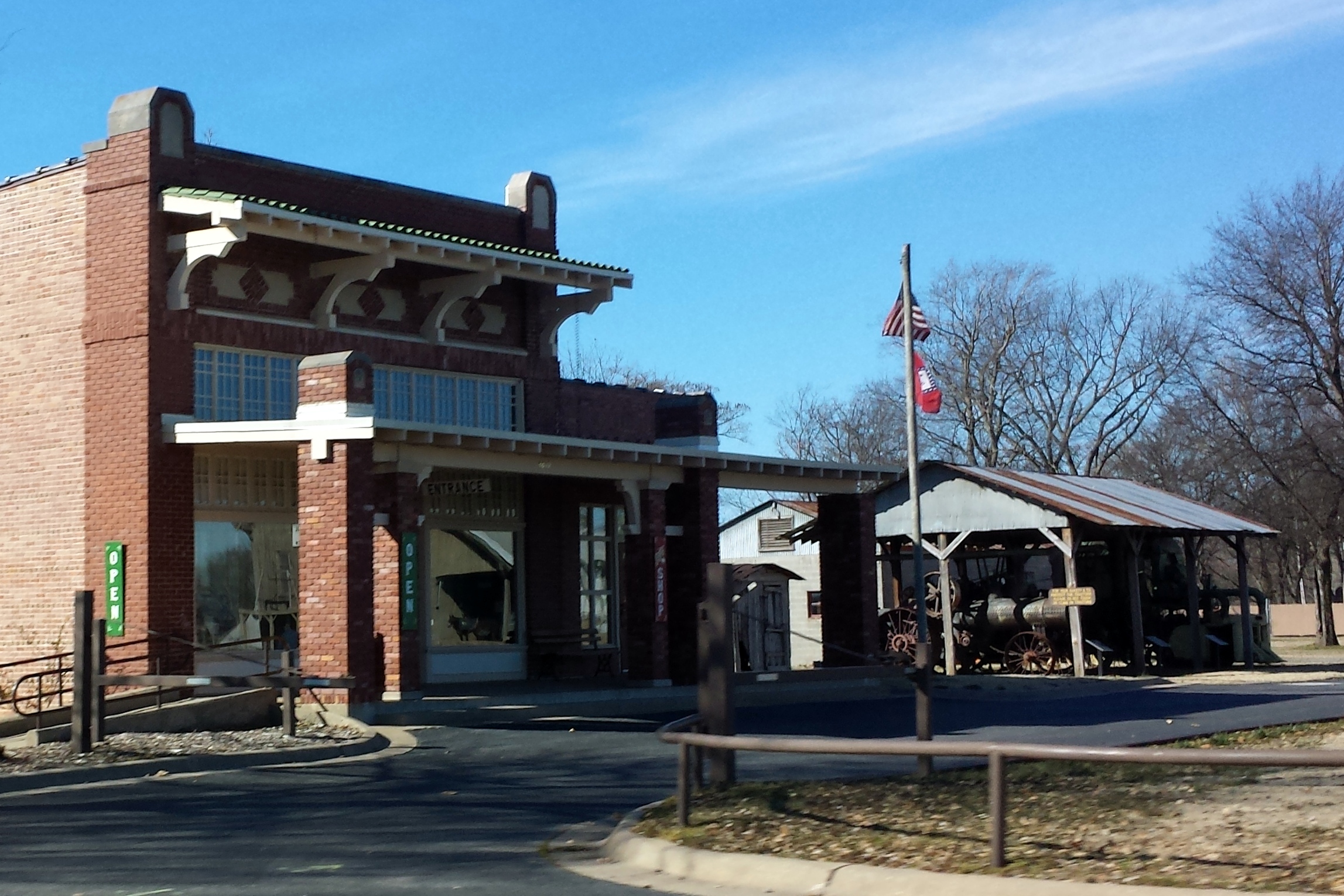
Plantation Agriculture Museum
The town got its name from a broken sign. When the St. Louis Railroad -- known as the Cotton Belt -- built a station on land belonging to Conoway Scott Sr., the stop was marked 'Scott's Station.' Over time, damaged signage shortened the name to simply 'Scott.' That accidental abbreviation stuck to a community that, by the early twentieth century, was dominated by cotton plantations stretching across the fertile Arkansas River lowlands east of Little Rock. Today, the Plantation Agriculture Museum sits in this landscape of soybean fields and pecan trees, its main building a 1912 brick general store that has outlived every plantation it once served.
The Dortch Legacy
Robert L. Dortch was a plantation owner and cotton seed breeder who saw the past slipping away. In the 1960s, Dortch and his daughter Floride Dortch Rebsamen purchased the old general store building and opened the Plantation Museum, documenting Arkansas's cotton farming life. They amassed thousands of artifacts -- blacksmith tools, kitchen appliances, steam traction engines, and tractors. Floride started a 'key club' so that local people could drop off artifacts during her absences. The Dortches had plans for a living history compound of more than 20 structures illustrating an everyday Arkansas cotton plantation. Those grand plans were never fully realized, but the collection kept growing. Dortch also established the Scott and Bearskin Lake Railroad as a tourist railway. After his death in 1978, his son moved the locomotives and rolling stock to Eureka Springs, where they became the Eureka Springs and North Arkansas Railway.
One Dollar for a Museum
In 1984, State Representative Bill Foster -- the son of the last owner of Foster's General Store, who had operated the building into the early 1960s -- lobbied for the state to acquire the museum. On April 14, 1986, the warranty deed was filed in Pulaski County, transferring the property to Arkansas State Parks for the sum of one dollar. The Dortch family donated the entire artifact collection along with the building. It took until 1989 to remodel the structure. The museum was dedicated on June 25, 1989, with a mission to collect, preserve, record, and interpret the history of cotton agriculture. The initial exhibit budget was a little over $5,000.
From Field to Gin
The museum's signature exhibit is the Dortch Cotton Gin, a 1920s two-stand Munger system that was salvaged piece by piece from the Dortch family's property near Bearskin Lake. In 1993, inmates from the Wrightsville unit of the Arkansas Department of Corrections disassembled hundreds of ginning components and transported them to the museum grounds. A decade of planning, architectural research, and conservation work followed. Conservation Solutions Inc. transported delicate components to their studios in Washington, D.C. for treatment. A ginning expert from Chandler, Arizona, with over 30 years of experience, identified each of the hundreds of pieces and supervised reassembly. The gin building was completed in 2003 and now stands as an authentically preserved example of the machinery that separated cotton fibers from seeds -- the industrial heart of the plantation economy.
Tractored Off
The museum's most powerful story is about the end of a way of life. After the Civil War, the plantation system survived through sharecropping and tenant farming. In Arkansas, large numbers of both Black and white sharecroppers worked the fields with animal-drawn implements and picked cotton by hand. The system changed remarkably little from the post-war years through the 1930s. Then came the tractor. By World War II, mechanization was driven by economics and wartime shortages of laborers and mules. One man with a tractor could do the work of twenty men with mules. Sharecroppers and tenant farmers coined the term 'tractored off' for being pushed out of their livelihoods. The museum's Historic Tractor Exhibit displays five rare antique tractors alongside three mechanical cotton pickers and two steam traction engines -- monuments to the machines that ended the age of hand-picked cotton. Dortch's 1943 Seed Warehouse No. 5, a 10,000-square-foot structure now listed on the National Register of Historic Places, stands nearby as the museum's final exhibit space.
From the Air
Located at 34.715N, 92.054W near Scott, Arkansas, in the Arkansas River lowlands approximately 15 nm east of Little Rock. The museum sits in flat agricultural terrain at roughly 230 feet MSL, surrounded by cotton, rice, and soybean fields typical of the Arkansas Grand Prairie region. Bill and Hillary Clinton National Airport (KLIT) is approximately 12 nm to the west. The landscape is pancake-flat delta farmland, and the museum's buildings, cotton gin, and warehouse are visible along Highway 165. Best viewed at 1,500-2,500 feet AGL.