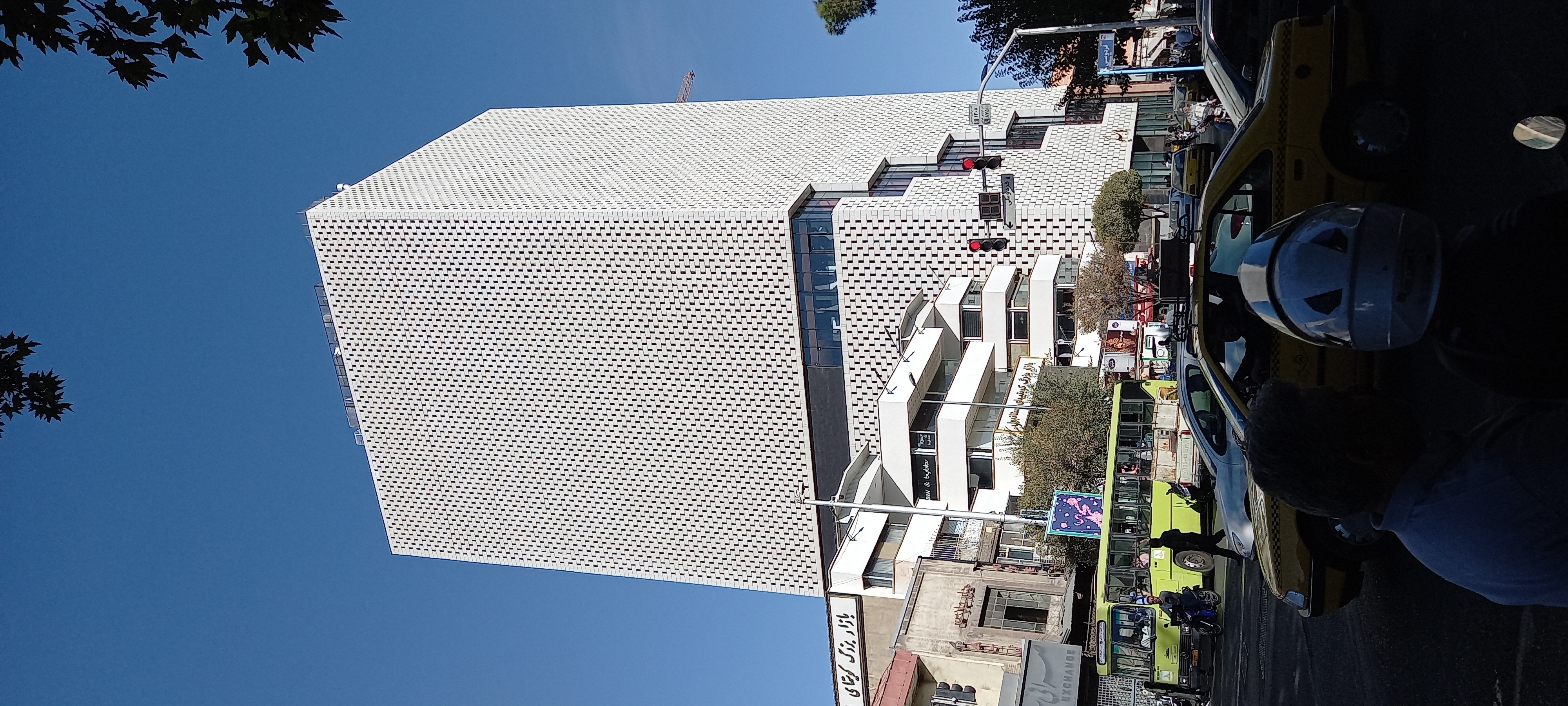
Plasco Building
The collapse happened on camera. Iran's state-run Press TV was filming the firefighting effort when the Plasco Building's north wall buckled without warning at 11:30 in the morning on January 19, 2017. The rest of the structure followed moments later, dropping vertically into itself like a controlled demolition that no one had planned. Sixteen people died, including fifteen firefighters who had been inside the building trying to stop a fire that had started on the ninth floor nearly four hours earlier. The building that had once defined the Tehran skyline -- the tallest in Iran when it was built in the early 1960s -- was gone in seconds.
The Tower That Touched the Sky
When the original Plasco Building rose in the early 1960s, it was a statement. Tehran had nothing like it. The high-rise towered over a city that was still largely low-slung, and its presence on the skyline announced that Iran was building upward, modernizing, reaching. Over the decades, the building settled into a different role: a mixed-use structure with a major shopping center on the ground floor, a restaurant on the upper floor, clothing workshops spread across multiple levels, and residential units above. It became part of the city's daily texture, the kind of landmark people used to give directions rather than to admire.
Four Hours of Fire
The fire started on the ninth floor at approximately 7:50 a.m. local time. Ten fire brigades responded. The building was occupied: residents in their apartments, garment workers at their machines, tour groups being shown through the building. As firefighters worked to contain the blaze and evacuate occupants, hours passed. The north wall collapsed at approximately 11:30 a.m., and the rest of the building followed. At least 70 people were injured, with 23 requiring hospitalization for severe injuries. The vertical nature of the collapse -- the building fell largely into its own footprint -- limited damage to neighboring structures. But nothing could limit the grief.
Fifteen Who Went In
The remains of fifteen firefighters were recovered over nine days of search-and-rescue operations, aided by the military. Tens of thousands of Iranians attended the funeral ceremony at Tehran's Grand Mosalla. The fallen were laid to rest in a section of the Behesht-e Zahra cemetery reserved for martyrs. Ayatollah Khamenei eulogized them as heroes and shaheeds. The scale of public mourning reflected something beyond the loss of individual lives -- it was an acknowledgment that these men had entered a building they knew was dangerous, in service of people they had never met, and that the system meant to protect them had failed.
Warnings Ignored
In April 2017, the government released a report that laid the blame broadly. The Mostazafan Foundation, which owned the building, had ignored warnings from authorities about safety deficiencies. Government ministries, for their part, had failed to enforce 22 national building regulations. The building's owner declined to make a public statement after the collapse. The report painted a picture of institutional failure on every level: the building should have been safer, the warnings should have been heeded, the regulations should have been enforced. None of it happened, and sixteen people paid the price.
Plasco 1400
A new building now stands on the same site. Designed by the Iranian architectural firm KRDS (Kourosh Rafiey Design Studio), construction lasted from 2018 to 2021. The replacement, named Plasco 1400, matches the original's configuration: twenty stories total, with five below ground and fifteen above. It opened in mid-2021. The name links the new structure to the old, acknowledging the address's history while asserting that the site has been made whole. Whether the new Plasco will achieve the iconic status of its predecessor remains to be seen. What it cannot do is erase the morning when Tehran watched its skyline change in real time, and fifteen firefighters did not come home.
From the Air
Located at 35.695N, 51.421E in central Tehran, near the intersection of Jomhouri Avenue and Istanbul Street. The new Plasco 1400 building occupies the same site as the original and is identifiable as a prominent high-rise in the commercial core. Nearest airports are Mehrabad International Airport (OIII), approximately 9 km to the west, and Tehran Imam Khomeini International Airport (OIIE), about 50 km to the southwest. The building sits in one of Tehran's densest commercial districts, near the Grand Bazaar. Best spotted from the east or west on approach to Mehrabad.