Playa Zipolite: Beach of the Dead, Beach of the Free
Translated from Zapotec, Zipolite means "beach of the dead." The name is not decorative. Circular currents just offshore pull swimmers seaward with a force that has drowned people regularly enough to prompt a volunteer lifeguard team and a flag warning system. One local tradition says the Zapotecs once offered their dead to the sea here, which is why the beach remained unoccupied for centuries. Another etymology traces the name to the Nahuatl word zipotli, meaning "bumpy place" - a reference to the rocky terrain at either end. Both explanations carry truth. Zipolite is beautiful and dangerous in equal measure: two kilometers of gold sand, forty meters wide, backed by the Sierra Madre del Sur, with water that shifts between blue and green in tones that belong on a postcard - and undertow that does not.
The Counterculture Arrives
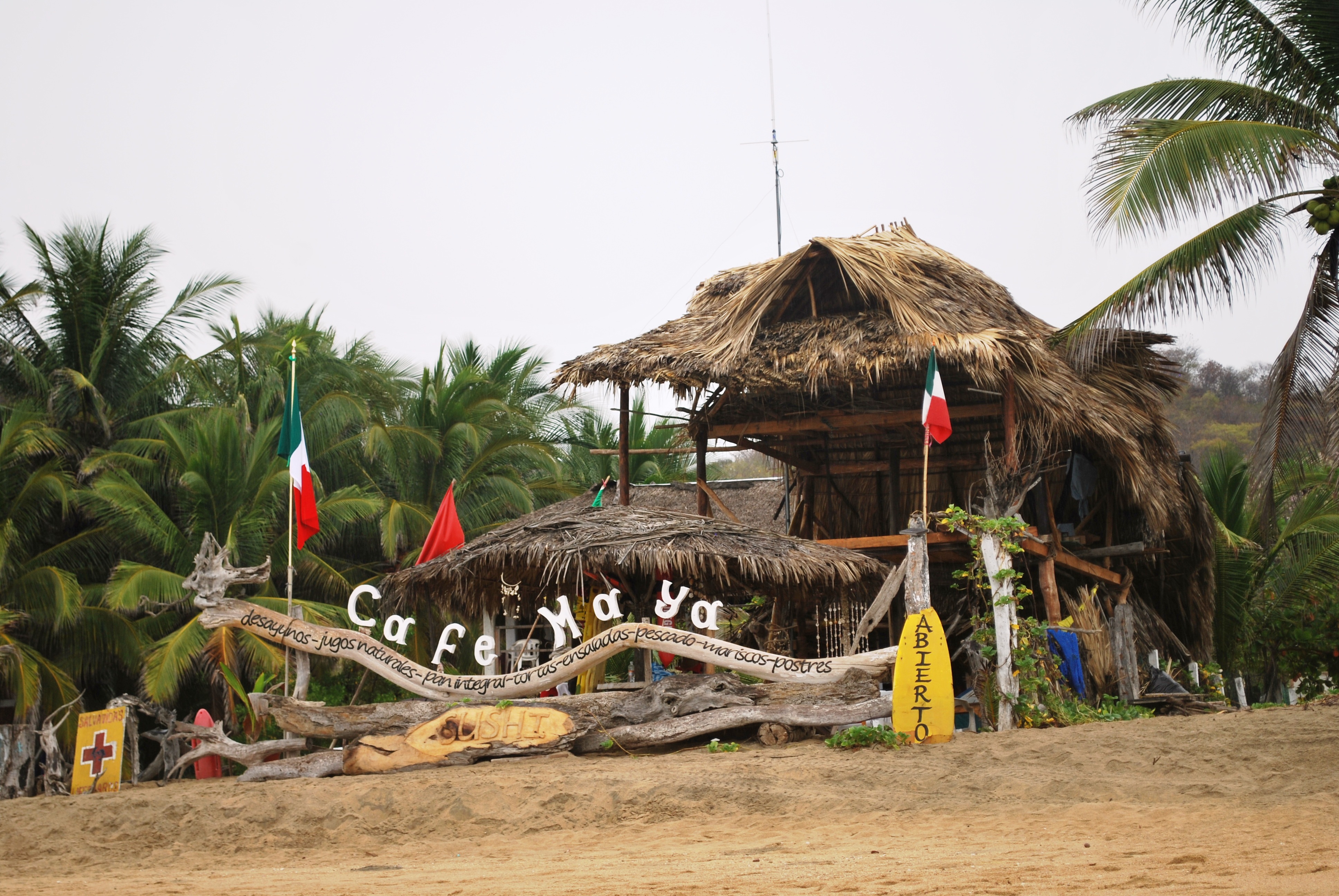
For the first half of the twentieth century, a single family lived at Zipolite. The beach was too remote, too dangerous, and too far from anything to attract settlement. That changed in the 1960s and 1970s, when counterculture travelers - hippies, in the language of the era - began drifting down the Oaxacan coast in search of isolation. Zipolite delivered it. There was no law enforcement to speak of, no infrastructure, and no neighbors. What there was: a pristine beach, cheap living, and the kind of freedom that comes from being at the end of a road nobody else was using. Drug use became common. The community that grew up was built of beachfront cabanas and palm-thatched palapas, structures that could be erected in a day and destroyed by a storm in less. Over the decades, Zipolite evolved from those temporary shelters into concrete hotels - basic, but permanent - with a main street called the Adoquin running through a neighborhood named Colonia Roca Blanca, after the guano-whitened rock island visible just offshore.
Storms, Fire, and Film
Zipolite has been knocked down repeatedly and rebuilt each time. Hurricane Pauline struck in 1997, followed almost immediately by Hurricane Rick, damaging roads and infrastructure that had barely been constructed in the first place. On February 21, 2001, a fire swept through the beach, burning many of the wood and palm-thatched structures that lined the waterfront. Each disaster peeled the community back to something close to its starting point, and each time people rebuilt - a little more permanently, a little less romantically. The beach gained wider attention when it appeared in Alfonso Cuaron's 2001 film Y tu mama tambien, which captured the languid, sun-bleached mood of the Oaxacan coast and introduced it to international audiences. Zipolite's reputation as a place apart - from mainstream Mexico, from conventional tourism, from the rules that govern other beaches - only solidified. The municipality eventually responded with tourist information services and regular police patrols during high season, small concessions to the reality that Zipolite had become a destination rather than a hideaway.
Where Nudity Became Law
Nudity had been practiced at Zipolite informally for decades, concentrated at Playa del Amor on the sheltered eastern end and the far western stretch of sand. In 2016, the municipality of San Pedro Pochutla made it official: Playa Zipolite became Mexico's first and only legally designated nude beach. Mexican law elsewhere condemns only "immorality," leaving enforcement to judicial interpretation - a vagueness that has historically made nudity tolerable in remote areas but legally precarious. Zipolite's formal designation removed the ambiguity. The Federacion Nudista de Mexico, along with the local hoteliers' association, organizes an annual nudist festival that has drawn participants even through difficult circumstances - the 2021 edition proceeded during the pandemic, with face masks recommended as the sole concession to the times. The beach's identity as an LGBTQ-friendly haven has grown in parallel, attracting a diverse community of visitors. Clothing-optional accommodations like CAMP, a hostel with a pool and sauna located half a kilometer from the beach, cater to those who want the experience without the sand.
Pina Palmera and the Quiet Work
Not everything at Zipolite is about the beach. Tucked into the community is Pina Palmera, a rehabilitation and educational center for disabled children and adults from rural Oaxacan communities, the majority of them indigenous. The charity has existed since the 1980s, operating on volunteer staff and funding from a Swedish charitable organization, with no political or religious affiliation. Over five thousand people have enrolled in one or more of its programs, and about 350 are active participants at any given time. It is an unlikely location for such work - a nude beach town known for its counterculture roots - but the combination makes a certain kind of sense. Zipolite has always attracted people who fell outside conventional categories, and Pina Palmera extends that ethos to some of the most marginalized communities in Oaxaca. The center provides services that barely exist elsewhere in the state's rural reaches, doing quiet, essential work in a place better known for its lack of clothing than its depth of compassion.
From the Air
Located at 15.66N, 96.52W on the southern Oaxacan coast between Huatulco and Puerto Escondido. The beach is approximately two kilometers long and forty meters wide, running roughly east-west with the Sierra Madre del Sur rising immediately behind. Roca Blanca - the guano-whitened rock island - is visible just offshore at the western end. Playa del Amor, the sheltered eastern cove, is tucked against a rocky headland. Nearest airports: Huatulco-Bahias de Huatulco International Airport (MMBT/HUX), approximately 40 km east; Puerto Escondido Airport (MMPS/PXM), approximately 70 km west. Coastal Highway 200 is the main access road. Best viewed at 2,000-4,000 feet. The beach is part of the Riviera Oaxaquena chain that includes nearby Puerto Angel and San Agustinillo.