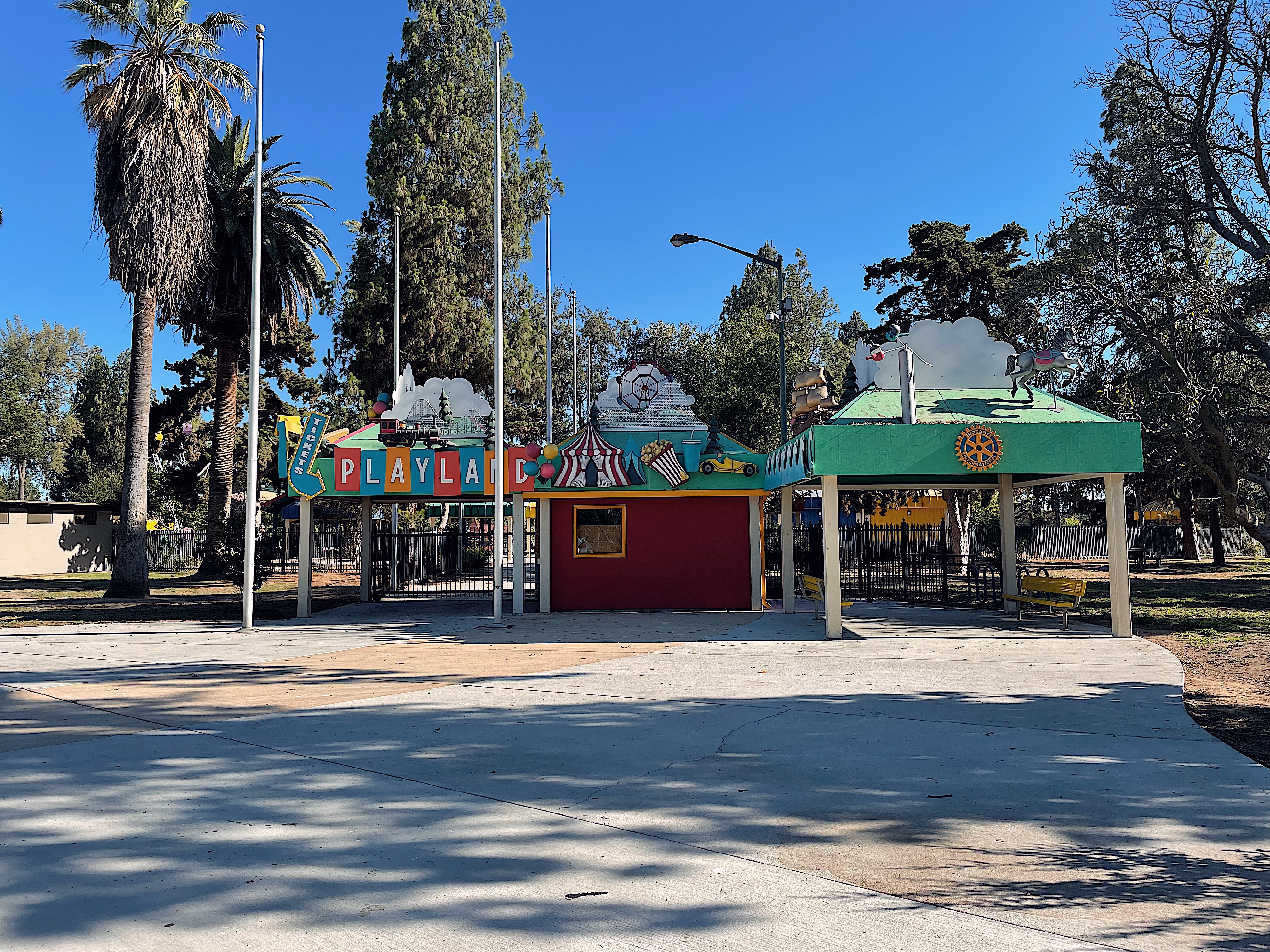
Playland: Fresno's Scrappy Little Amusement Park
Six weeks before Walt Disney welcomed the world to Anaheim, Dr. Joe Logan and Fresno's Rotary Clubs pulled off something smaller, scrappier, and arguably more improbable. On opening day in 1955, Playland sold 14,000 ride tickets at a dime apiece. No corporate sponsors, no television special, no Magic Kingdom fanfare - just a handful of civic-minded locals who believed the kids of California's Central Valley deserved a place to ride a Ferris wheel. The construction debt was paid off within three years. Disneyland, meanwhile, nearly went bankrupt in its first year. Playland never had Disneyland's ambitions or its budget, but it had something Walt Disney could not manufacture: a neighborhood amusement park built, owned, and sustained by the community it served.
Dimes and Dreams
The idea came from Dr. Joe Logan, then president of the North Fresno Rotary, who proposed that the city's Rotary Clubs pool their resources to build a family amusement park inside Roeding Park. The site made sense - Roeding already had mature tree canopy, a lake, and plenty of open acreage on its southwest corner. Logan's pitch was persuasive enough that multiple Rotary chapters signed on, and the money came together fast. Playland opened in the summer of 1955, sharing its corner of Roeding Park with Storyland, a fairy-tale-themed park geared toward younger children. A miniature train connected the two parks, its diesel locomotive dressed up to look like a steam engine. Together they formed a modest but complete family destination, with the Fresno Chaffee Zoo occupying the park's southern half. For decades, a weekend afternoon might begin with elephants and end with cotton candy, all without leaving Roeding Park's 159 acres.
The Long Middle Act
Playland was never flashy. Its rides were the dependable type - the kind that rattle just enough to thrill a six-year-old but not enough to worry a grandmother. What kept it alive was not spectacle but habit. Generations of Fresno families built their childhoods around it: birthday parties at Storyland, first roller coaster screams at Playland, sticky popsicle hands on a July afternoon. But habit fades when options multiply, and by the early 2000s, Fresno families had more options than ever. Attendance thinned. The rides aged. The paint peeled in the Valley sun. By 2015, after nearly sixty years of continuous operation, the park closed for lack of funds. An editorial in the Fresno Bee pleaded for donations, recounting the park's history and asking whether the community still valued what it had built. Some even suggested a dedicated sales tax - a "Storyland/Playland tax" - to fund ongoing operations.
The Comeback That Almost Held
The money did come, faster than anyone expected. By September 2015, Storyland's volunteer operational director, Elaine Robles-McGraw, announced that enough funding had arrived to reopen for the 2016 season. The parks underwent a massive renovation, modernizing attractions and repairing decades of deferred maintenance. More importantly, the Playland and Storyland Board began collaborating with the Fresno Chaffee Zoo for the first time, offering cross-promotional discounts and coordinating special event days around Halloween and Christmas. It was the partnership the three parks should have forged decades earlier - a recognition that cooperation, not competition, was the path to survival in a city where entertainment dollars are finite. For a few years, the strategy worked. Families returned. The miniature train ran again.
Final Rides
Then the pandemic arrived. In March 2020, Playland, Storyland, and the zoo all shut down. The zoo reopened that June under Governor Newsom's outdoor-recreation order, but Playland and Storyland stayed dark through 2020 and 2021, their gates chained while the rides stood motionless in the heat. The parks eventually reopened in 2023, but the interruption proved fatal. Attendance never recovered to pre-pandemic levels, and the financial pressures that had nearly killed Playland in 2015 returned with compounding interest. In early 2025, the announcement came: Playland would close for good. The original date was set for March 30, but the actual closure arrived a week early, on March 23. Seventy years after Dr. Logan's Rotary Clubs sold those first dime tickets, the rides stopped for the last time.
What Remains in Roeding Park
Playland's closure leaves a gap in Fresno's southwest corner of Roeding Park, but the park itself endures. The Fresno Chaffee Zoo, buoyed by Measure Z's tenth-of-a-cent sales tax and its transition to nonprofit management, continues to grow. Storyland's future remains uncertain but its fairy-tale scenes and summer student theater productions still draw families. The mature groves of cedar, eucalyptus, and redwood that shade the park's walking paths predate all three attractions. Roeding Park has been a public park since 1903, when the Roeding family donated 70 acres with the stipulation that the city spend $3,500 per year improving it. The park has outlasted streetcars, two world wars, and now an amusement park. From the air, its green canopy still reads as an island of shade in the grid of Fresno's streets - a reminder that civic gifts, when given with conditions and conviction, tend to outlast the things built upon them.
From the Air
Located at 36.75°N, 119.82°W in western Fresno, California. From the air, Roeding Park is a distinct green rectangle in Fresno's urban grid, bordered by West Olive Avenue to the north and Highway 99 to the east. The zoo structures and parking areas are visible in the park's southern half. Fresno Yosemite International Airport (FAT) is approximately 7 miles northeast. Fresno Chandler Executive Airport (FCH) is about 3 miles south. The Central Valley floor is flat at roughly 300 feet elevation, offering clear visibility in good conditions, though summer haze and agricultural dust can reduce it.