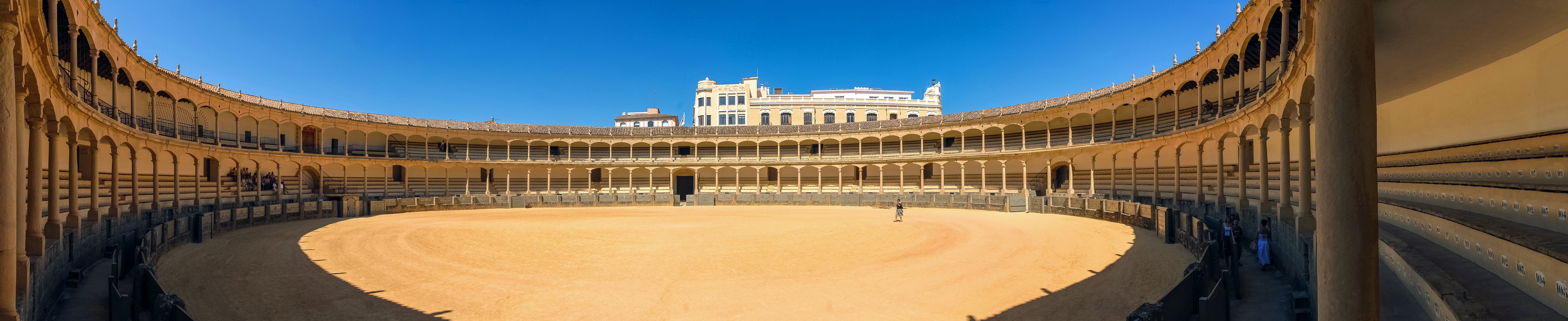
Plaza de Toros de Ronda
Pedro Romero killed more than 5,600 bulls in his career and was never seriously injured. Born in Ronda in 1754, he became the most celebrated matador of the 18th century, and the bullring where he made his name still stands two blocks from the edge of the El Tajo gorge. The Plaza de Toros de Ronda is not the oldest ring in Spain, but it is one of the first built entirely from stone rather than the usual mix of stone and brick, and its 66-meter arena remains the largest bullring in Spain. The structure opened in 1785 and has been shaping the mythology of bullfighting ever since.
The Horsemen's Ring
The Plaza de Toros belongs to the Real Maestranza de Caballeria, the oldest and most noble order of horsemanship in Spain, established in Ronda since 1485, the year Ferdinand and Isabella recaptured the town from the Moors. Construction began in 1779 and was completed in 1785. The architect Martin de Aldehuela, who also designed the nearby Puente Nuevo bridge, gave the ring a distinctive double colonnade of 136 Tuscan pillars forming 68 arches across two levels of seating. Every seat in the ring is covered, an unusual design choice that sets it apart from most Spanish bullrings. The Royal Box features a sloping roof of Arabic tiles, and the main entrance was built wide enough for horse-drawn carriages to pass through. Above the door, an iron-wrought balcony surveys the street.
The Romero Dynasty
The Romero family dominated Ronda's ring for three generations, establishing the rules and techniques that would define modern bullfighting. Pedro Romero, the greatest of the line, faced his rival Pepe Hillo at the ring's second inaugural event in May 1785, the first having ended in a partial collapse of the stands the year before. After the Romeros came the Ordonez family, widely considered Ronda's second bullfighting dynasty. Bronze statues of Cayetano Ordonez and his son Antonio Ordonez stand outside one of the entrances. Antonio created the Feria Goyesca, a bullfight held the first week of September each year in honor of Pedro Romero, with participants dressed in costumes inspired by the paintings of Francisco Goya. The event transforms the ring into a living tableau of 18th-century Spain.
The Museum Inside
The ring houses the Museo Taurino, a museum holding two centuries of bullfighting regalia: embroidered capes, ornate suits of lights, swords, and the ceremonial weapons of the Real Maestranza used in Spain's military campaigns. The collection documents bullfighting not as sport but as cultural institution, tracing its evolution from mounted horseback combat to the on-foot form the Romeros pioneered. Because of Ronda's relatively remote location and small population, the ring hosts fewer fights than larger venues like Seville's Plaza de la Maestranza. For most of the year, visitors walk the sand-covered arena floor and look up at the elegant double tier of arches in near-solitude, the architecture speaking for itself.
An Unlikely Stage
The ring's striking appearance has attracted uses its builders never imagined. In 1994, Madonna filmed the music video for "Take a Bow" here, co-starring with Spanish bullfighter Emilio Munoz. In 2001, the final challenge of the first season of the American reality show The Mole, hosted by Anderson Cooper, took place inside the arena. These moments of pop culture sit oddly alongside the ring's austere stone colonnades and the weight of its history, but they speak to the same quality that drew the cameras: the Plaza de Toros de Ronda looks like no other arena in the world. Its beauty is inseparable from the violence it was built to contain, and that tension gives the empty ring a charge that needs no bull to feel.
From the Air
Located at 36.74N, 5.17W on the western edge of Ronda, about two blocks from Puente Nuevo and the El Tajo gorge. The circular bullring is visible from altitude as a distinctive white structure on the town's western rim. Best viewed at 2,000-3,000 feet. Nearest airports: Malaga-Costa del Sol (LEMG, 100 km), Gibraltar International (LXGB, 100 km).