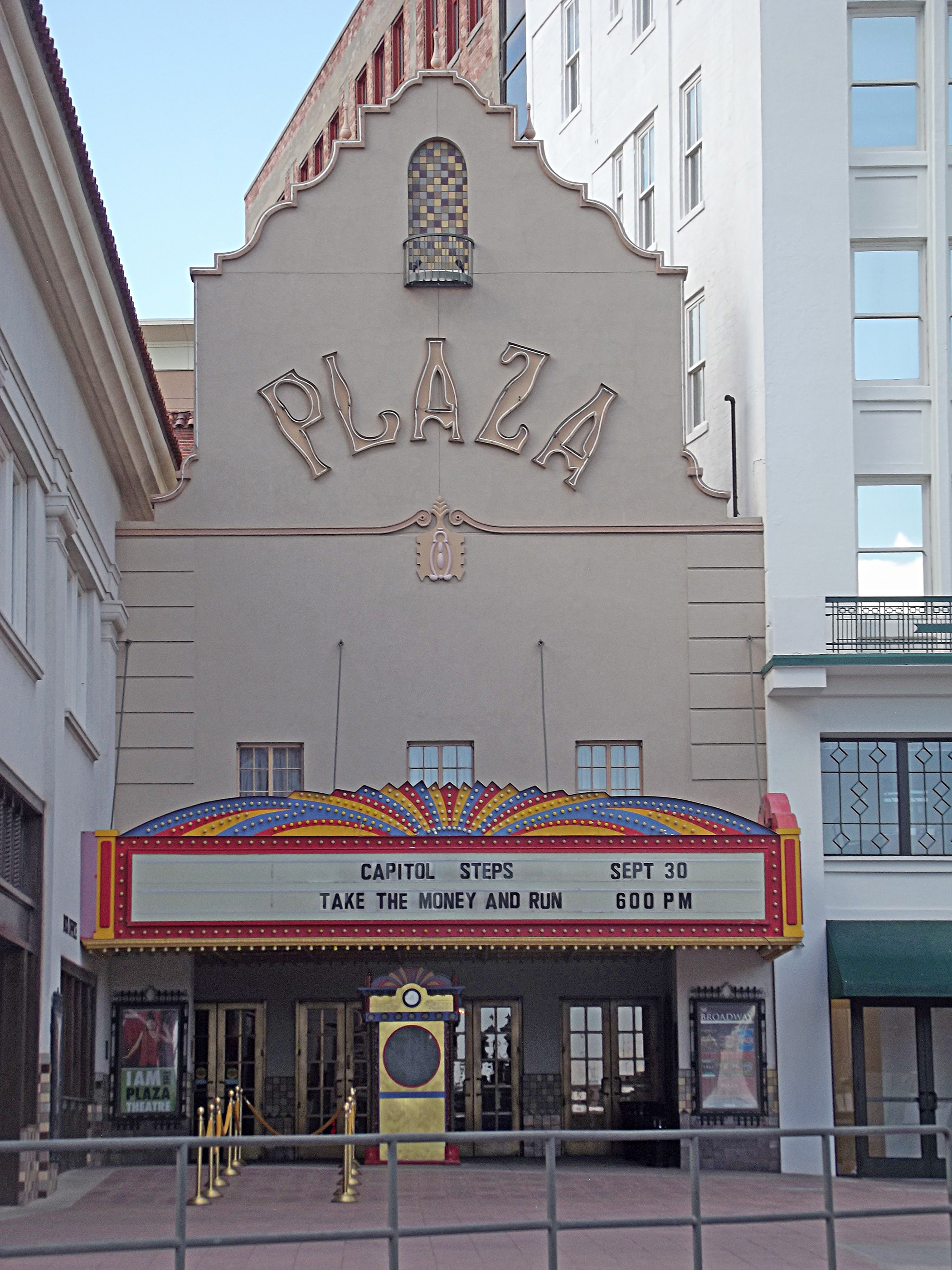
Plaza Theatre (El Paso)
When theater impresario Louis L. Dent purchased a produce warehouse on Pioneer Plaza in 1927, he made a promise to El Paso: 'El Paso has been good to me, and I am going to put something everybody will be proud of.' Three years later, on September 12, 1930, the Plaza Theatre opened its ornate doors -- a Spanish Colonial Revival masterpiece that would earn the title 'The Showplace of the Southwest.' Nearly a century later, the theater still operates as one of Texas's most spectacular historic venues.
A Palace in the Desert
Dallas architect W. Scott Dunne, credited with designing more than 30 theaters across Texas and Oklahoma, created what would become his surviving masterpiece. The Plaza rises three tiers in a domed tower where its entrance wing meets the auditorium, its stepped and curved parapets accented with tile in the Spanish mission style. But the exterior only hints at the opulence within. Patrons entering the Plaza encountered intricately painted ceilings, mosaic-tiled floors, decorative wrought iron banisters and sconces, and antique furnishings throughout. The rococo grandeur earned the theater its legendary nickname. The original seating capacity reached 2,410, with 1,510 seats on the main floor, 508 in the mezzanine, and 392 in the balcony -- though this arrangement came with the dark reality of segregation, with Black patrons restricted to balcony seating only.
The Mighty Wurlitzer
The $60,000 Mighty Wurlitzer organ became the Plaza's most distinctive feature. Designed to rise dramatically from the orchestra pit, it accompanied vaudeville shows, sing-alongs, and entertained audiences before and after films. Its 'toy box' could replicate horses' hooves, ocean surf, and birds chirping through 15 ranks of 61 pipes each. In 1973, the beloved organ was sold at auction to a private collector in Dallas, seemingly lost to El Paso forever. But in 1998, the late Karl O. Wyler, Sr. donated the restored instrument back to the city. Rebuilt by Pipe Organ Artisans of Arizona, the Opus 2123 console was returned to its original finish. It remains the only intact Wurlitzer Balaban III in existence.
Legends on the Marquee
The Plaza's stage hosted a who's who of Golden Age Hollywood and entertainment royalty. Roy Rogers and Dale Evans rode through, the Barrymore family performed, Sally Rand scandalized, and Tallulah Bankhead dazzled. Hopalong Cassidy, John Wayne, the Marx Brothers, Rita Moreno, Henry Fonda, Tom Mix, and James Stewart all appeared beneath the Plaza's painted ceilings. The theater also served more somber purposes during the Cold War, maintaining a fallout shelter beneath the stage -- where food rations with original packaging could still be found prior to restoration.
Revival and Restoration
Like many grand movie palaces, the Plaza fell into decline with the rise of suburban multiplexes. But where other cities watched their theaters crumble, El Paso fought back. Today, the restored 2,050-seat Kendall Kidd Performance Hall anchors the facility, joined by the intimate 200-seat Philanthropy Theatre. The venue hosts Broadway productions, musical concerts, individual performers, and the annual Plaza Classic Film Festival. The El Paso Community Foundation continues appropriating funds to buy back original art and furnishings, slowly reassembling the Plaza's heritage piece by piece. What Louis L. Dent promised El Paso in 1927 endures: something everybody can be proud of.
From the Air
The Plaza Theatre sits in downtown El Paso at approximately 31.76N, 106.49W, in the heart of the city's historic core along Pioneer Plaza. From the air, downtown El Paso is clearly visible as a concentrated cluster of mid-rise buildings northwest of the distinctive Rio Grande/US-Mexico border crossing. The theater's three-tiered domed tower is difficult to distinguish at altitude, but the overall downtown grid contrasts sharply with the residential neighborhoods to the north and the international bridge complexes to the south. El Paso International Airport (KELP) lies approximately 6 nm northeast. Best viewing at lower altitudes when approaching from the east, with the Franklin Mountains providing dramatic backdrop to the north.