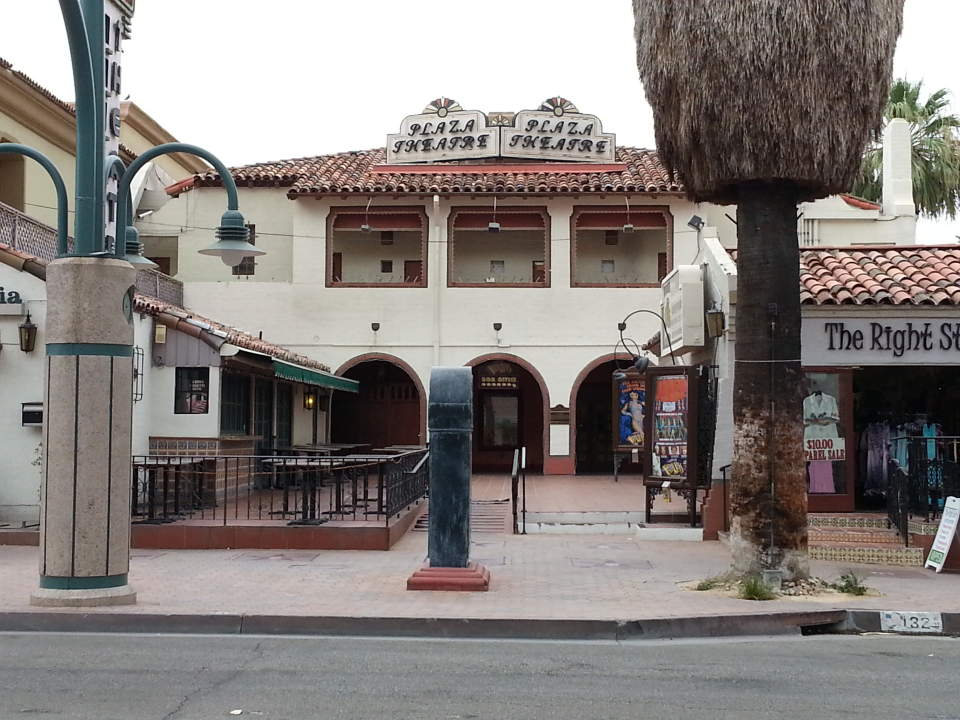
Plaza Theatre (Palm Springs, California)
The first ticket sold at the Plaza Theatre went to Annette Freeman, sold by theater operator Earle C. Strebe, on the night of December 12, 1936, for the premiere of Greta Garbo's *Camille*. It was the kind of opening night that a new theater could hardly have scripted better: a Hollywood premiere in a brand-new building that was itself part of La Plaza, one of the first planned shopping centers in Southern California. Garbo onscreen; the desert winter night outside; a city that was still finding the scale of its own ambitions. The Plaza Theatre opened knowing what it wanted to be.
Part of Something Larger
La Plaza, the development that contained the Plaza Theatre, was itself a significant achievement for 1936 Palm Springs. The concept of a planned shopping center — multiple retail and entertainment uses organized around a shared outdoor space — was new enough in the 1930s to be genuinely innovative rather than merely fashionable. In Southern California, where the automobile was already reshaping commercial geography, La Plaza anticipated design principles that would become standard in postwar development. The theater anchored the entertainment end of the complex, and its presence gave La Plaza a draw that purely retail developments could not match. People came for the movies; they stayed for the shopping.
The Fabulous Palm Springs Follies
From October 1990 through May 2014, the Plaza Theatre was home to the Fabulous Palm Springs Follies, a revue show that made a defining aesthetic choice: its performers were all senior citizens, mostly professionals from the golden age of Hollywood entertainment. The Follies ran on a schedule matching Palm Springs' seasonal rhythms — October through May, the city's high season — for twenty-four consecutive years. It was simultaneously a nostalgia act and a genuine celebration of professional performers who had been largely forgotten by the entertainment industry, given a stage that allowed them to remind audiences what sustained practice and genuine talent look like. When the Follies closed in 2014, it left the theater without its primary tenant.
A Producer Steps Forward
In October 2021, David Lee — known as the producer of the television series *Frasier* — donated $5 million toward the Plaza Theatre's restoration, the most significant private gift in the restoration campaign's history. Lee's donation reflected a pattern familiar in historic theater preservation across the United States: an individual with both the resources and the specific attachment to a place or institution steps forward when institutional funding has fallen short. The restoration campaign had been building toward this moment for years, with the theater's supporters arguing that the Plaza represented an irreplaceable piece of Palm Springs' cultural and architectural history.
A Building Worth Saving
The Plaza Theatre's architecture reflects the Spanish Colonial Revival aesthetic that shaped much of Palm Springs' early commercial development, a style that felt appropriately warm and Mediterranean in a desert city that was positioning itself as a comfortable alternative to the gray winters of the American Northeast and Midwest. The building has survived long enough to become a historic resource rather than simply an old building — the distinction that restoration advocates must make to secure public and private funding. With its Greta Garbo premiere night, its Follies legacy, and its place in La Plaza's history as an early planned shopping center, the theater has a story rich enough to justify the effort of keeping it standing.
From the Air
Located at 33.82°N, 116.55°W in downtown Palm Springs, California. Palm Springs International Airport (ICAO: KPSP) is approximately 2 miles to the east.