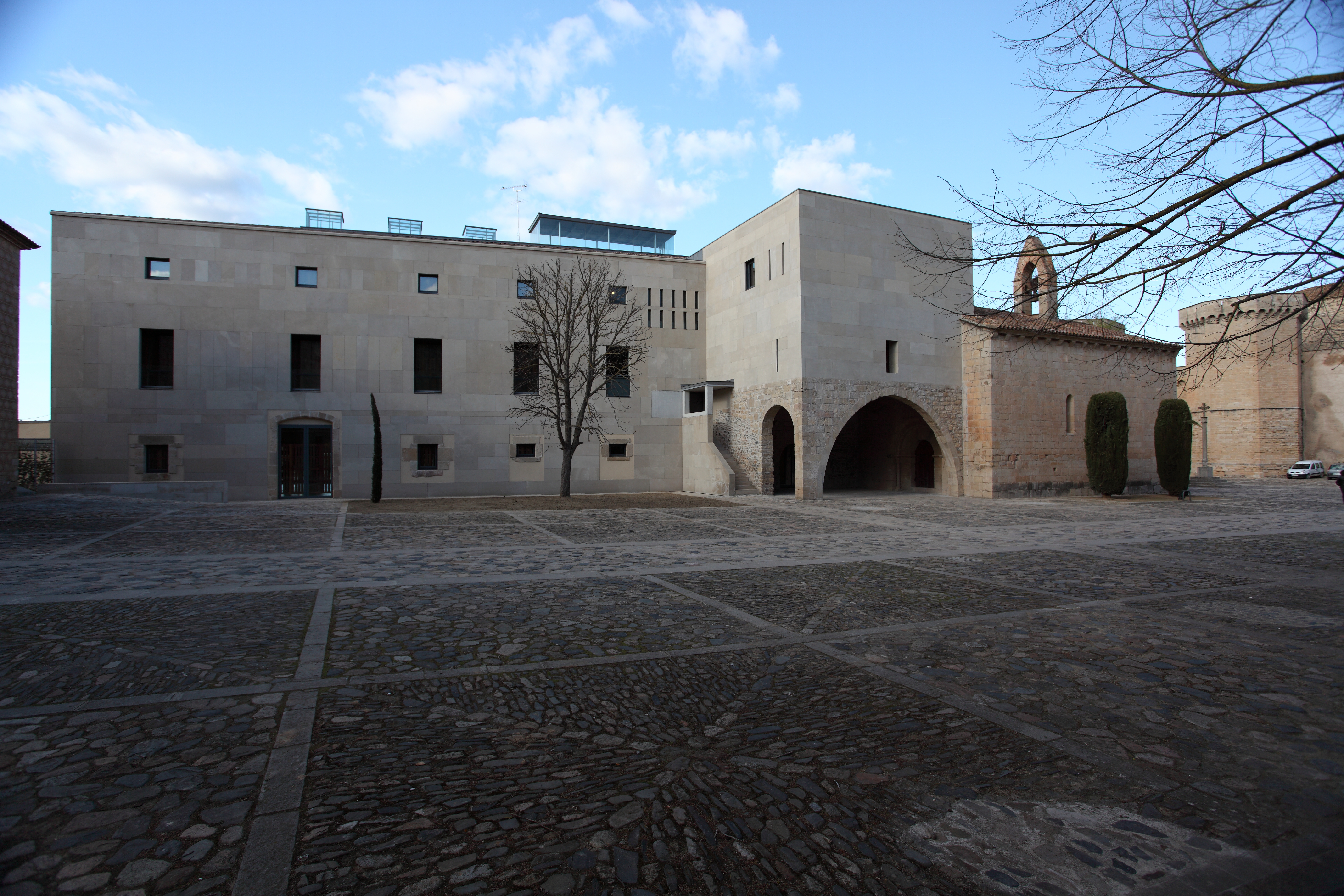
Poblet Abbey
Peter IV of Aragon made every future king swear an oath: they would all be buried at Poblet. Only one broke the promise. Ferdinand II, having merged Aragon with Castile, chose Granada instead - a political statement disguised as a funeral preference. The rest kept their word, and for three centuries the alabaster tombs accumulated beneath the vaults of this Cistercian monastery at the foot of the Prades Mountains. Lions crouch at the feet of the kings. Dogs lie at the feet of the queens. The distinction mattered to the medieval mind, and at Poblet, medieval minds built something that endured far longer than the kingdom that created it.
The Cistercian Triangle
Poblet was founded in 1151 by Cistercian monks from France, the first of three sister monasteries - along with Vallbona de les Monges and Santes Creus - that formed what became known as the Cistercian Triangle. These three foundations helped consolidate Christian power in Catalonia during the 12th century, serving as centers of worship, agriculture, and political influence in roughly equal measure. At its height, Poblet housed more than 300 monks and operated numerous farms run by lay brothers who worked the abbey's extensive agricultural lands and forests. The monastery buildings eventually grew to cover some 12,000 square meters, a small city unto itself nestled against the mountains. The altar of 1527-1529, sculpted by Damian Forment, remains one of the finest examples of Renaissance work in Catalonia.
Where Kings Rest
The royal connection began with Alfonso II, who died in 1196 and was the first Aragonese king interred at Poblet. James I the Conqueror followed in 1276, then Peter IV in 1387, along with his first three wives - Maria of Navarre, Eleanor of Portugal, and Eleanor of Sicily. John I and Martin I, Ferdinand I and Alfonso V, John II and his wife Joana Enriquez: the pantheon grew with each generation, the most important tombs topped with reclining alabaster figures of striking realism. Less expected burials include Beatrice of Naples, a Hungarian queen who died in 1508, and Philip Wharton, the 1st Duke of Wharton, an English Jacobite who ended his restless life here in 1731. The tombs were eventually restored by Catalan sculptor Frederic Mares in 1948, though by then the original remains had been scattered and could only be returned as commingled bones.
The Mob and the Silence
The First Carlist War had already damaged the monastery when, in 1835, the Spanish government's Ecclesiastical Confiscations under Mendizabal delivered the final blow. On 24 July, government representatives and mobs descended on Poblet. They stripped the abbey of its paintings and furniture, scattered what they could carry, and set fire to parts of the complex. Monastic life ended overnight. In the decades that followed, the roofs caved in and the buildings fell to ruin. The royal tombs were desecrated - the bones of Aragon's kings pulled from their alabaster beds and scattered. Only the intervention of a local priest, Reverend Antoni Serret from the neighboring town of L'Espluga, saved the remains from total loss. He gathered what he could and transferred them to the Cathedral of Tarragona, where they waited in temporary safekeeping for over a century.
Return of the Monks
In 1940, Italian Cistercian monks refounded Poblet, and the long process of reconstruction began. Close to the church entrance, one building has been deliberately left in its ruined state - a reminder of what happened when the monastery was unprotected. The royal remains were returned to their tombs, though centuries of displacement meant the bones of different monarchs could no longer be distinguished from one another. Today, 29 professed monks live within Poblet's walls, continuing a tradition of prayer and work that stretches back to 1151. UNESCO recognized the abbey as a World Heritage Site in 1991, and visitors can walk through cloisters where a dragon handrail by sculptor Ramon Marti i Marti curls along a staircase, and where the ablution fountain still catches light in the same angles that the original builders planned. The current abbot is the 105th in the monastery's line of succession - a number that speaks to both continuity and the determination to resume it when continuity was violently broken.
From the Air
Located at 41.38N, 1.08E at the foot of the Prades Mountains in the comarca of Conca de Barbera, Catalonia, Spain. The monastery complex covers approximately 12,000 square meters and is a recognizable visual landmark from the air - a large rectangular compound of stone buildings with prominent church towers set against the green foothills. Nearest airports: Reus Airport (LERS) approximately 35 km southeast, Barcelona-El Prat (LEBL) about 120 km east. The surrounding landscape is agricultural with vineyards and forest. Best viewed at lower altitudes in clear conditions.