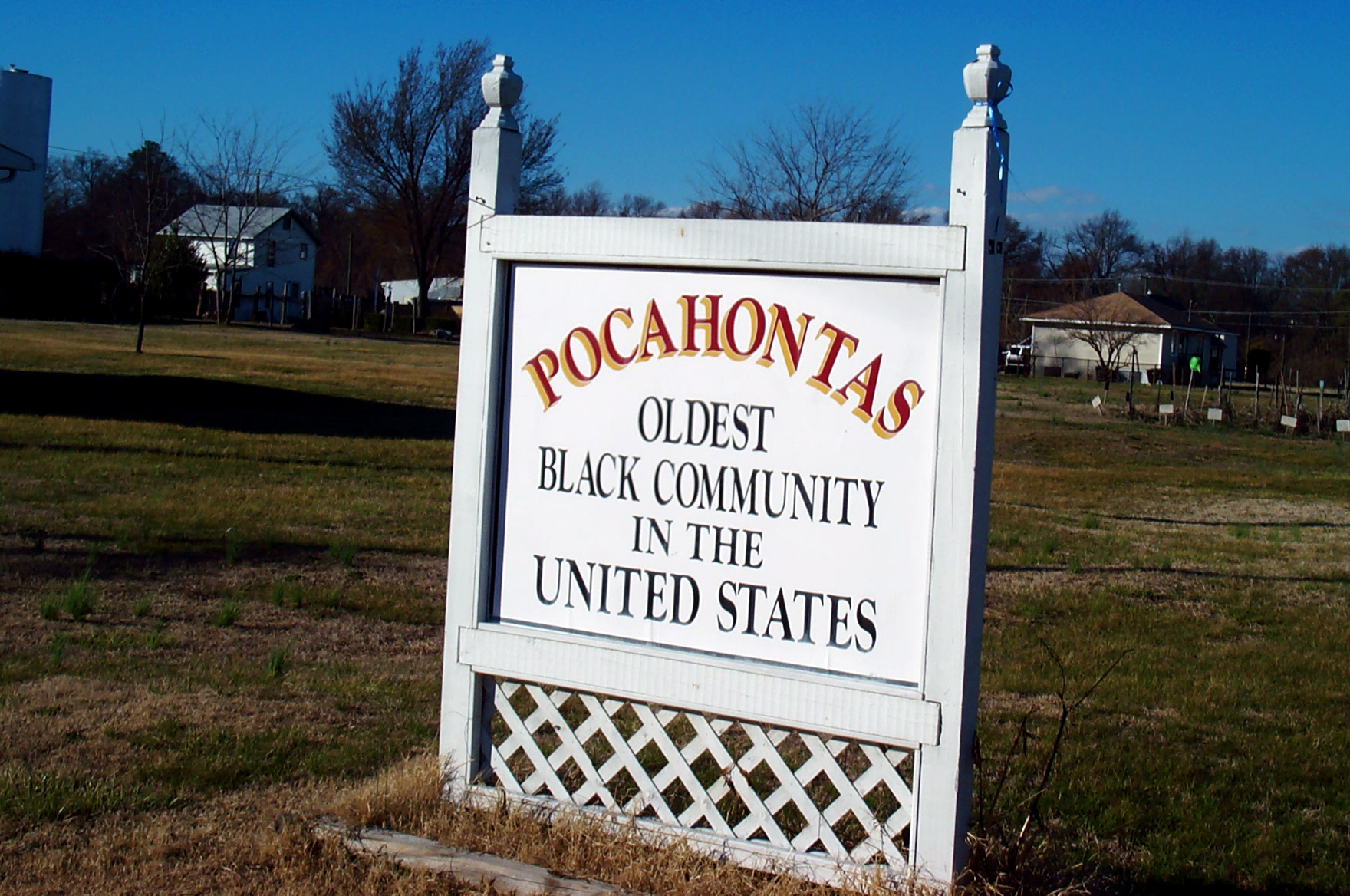
Pocahontas Island
In 1860, one-third of Petersburg's Black population -- 3,244 people -- were free, and many of them lived on a sliver of land along the Appomattox River called Pocahontas Island. It was the first predominantly free Black settlement in Virginia and, by mid-century, one of the largest in the entire nation. But the island's story reaches far deeper than the antebellum era. Archaeologists have found evidence of human habitation here dating to 6500 BC, when the indigenous Appomattoc people made their home along these riverbanks thousands of years before European colonists arrived at Jamestown in 1607.
From Wittontown to Pocahontas
The Appomattoc people, part of the Powhatan Confederacy, were the first known inhabitants of this peninsula on the north side of the Appomattox River. Colonial settlement began in the 18th century, when enslaved Africans were brought to work in John Bolling's tobacco warehouses in 1732. Surveyors platted the land in 1749, and white settlers named the village Wittontown. When formally organized as a town in 1752, it was renamed Pocahontas after the famous daughter of Chief Powhatan, who along with her husband John Rolfe became an ancestor of numerous First Families of Virginia. The geography itself has shifted over the centuries: a new channel for the Appomattox River in 1915 separated the peninsula from Chesterfield County, while the former channel silted in, connecting it permanently to Petersburg.
A Freedom Colony on the River
By the early 19th century, Pocahontas Island had evolved into something remarkable -- a freedom colony where free Black residents built lives, businesses, and community in a slave-holding state. The population was complex: enslaved people also lived on the island, and some free Black residents owned enslaved people themselves. But the settlement's significance is unmistakable. By 1860, slightly more than half of Petersburg's entire population was Black, and the free Black community here was the largest in the country. Two houses still standing on the island have been linked to the Underground Railroad: the Jarratt House at 808-810 Logan Street, the island's sole surviving brick building predating 1820, and the double house at 215 Witten Street, informally called the Underground Railroad House, which predates 1838.
Rails, War, and Industry
From 1830 until 1860, a recently excavated 30-by-300-foot railroad depot on Pocahontas Island served as the terminus of the Richmond and Petersburg Railroad, Petersburg's main freight and passenger station. When the Civil War came, the depot transported Confederate troops and supplies. A short railroad line built in 1863 simplified transshipment of goods from the Norfolk and Danville lines to Richmond, though it was torn up immediately after the war. The Union Signal Corps filed numerous reports of railroad activity on Pocahontas during the conflict. After the war, Pocahontas-born free Black William N. Stevens became a lawyer and the first African American to serve in both houses of the Virginia General Assembly, though his legislative district centered on nearby Sussex County. He maintained a house on the island that still survives.
The Cream of the Crop
The 20th century brought both opportunity and loss. Ice, coal, oil, and lumber companies operated on Pocahontas, and the DuPont munitions factory in nearby Hopewell, established in 1914, drew many Black workers to the area. But devastating floods in 1910 and 1920 took their toll, and the river itself rechanneled midway between. The Great Migration -- the mass movement of Black Americans from the rural South to northern industrial cities starting around World War I -- drained the island's vitality. Islanders remember it as the time they lost the "cream of the crop." The younger and more ambitious left for opportunities elsewhere, and the remaining population aged. By the late 20th century, fewer than 100 people lived on the island, down from a peak of 1,700.
Enduring Against the Wind
A 1993 tornado severely damaged houses and destroyed the original Pocahontas Chapel, which had been built at the Civil War's end by the New York Freedman's Relief Society and doubled as a school for freedmen. The chapel was rebuilt and remains a community center. In 1975, residents had already fought back once, securing renewed residential zoning to protect their neighborhoods from industrial development proposed by the city. In 2006, that persistence was recognized when the Pocahontas Island Historic District was listed on both the Virginia Landmarks Register and the National Register of Historic Places, honored for its significance in African American history and its prehistoric indigenous archaeological assets. The Pocahontas Island Black History Museum now tells the story of this small peninsula that witnessed 8,500 years of human habitation and became one of America's most important free Black communities.
From the Air
Pocahontas Island sits at 37.239°N, 77.400°W, a small peninsula along the Appomattox River in Petersburg, Virginia. The river bends are clearly visible from the air, and the island's position at the confluence of old and new river channels is distinctive. Best viewed at 2,000-3,000 feet AGL. Petersburg Municipal Airport (KPTB) is approximately 4 miles southeast. Richmond International Airport (KRIC) is about 25 miles north. The Appomattox River provides an excellent navigation reference winding through the city.