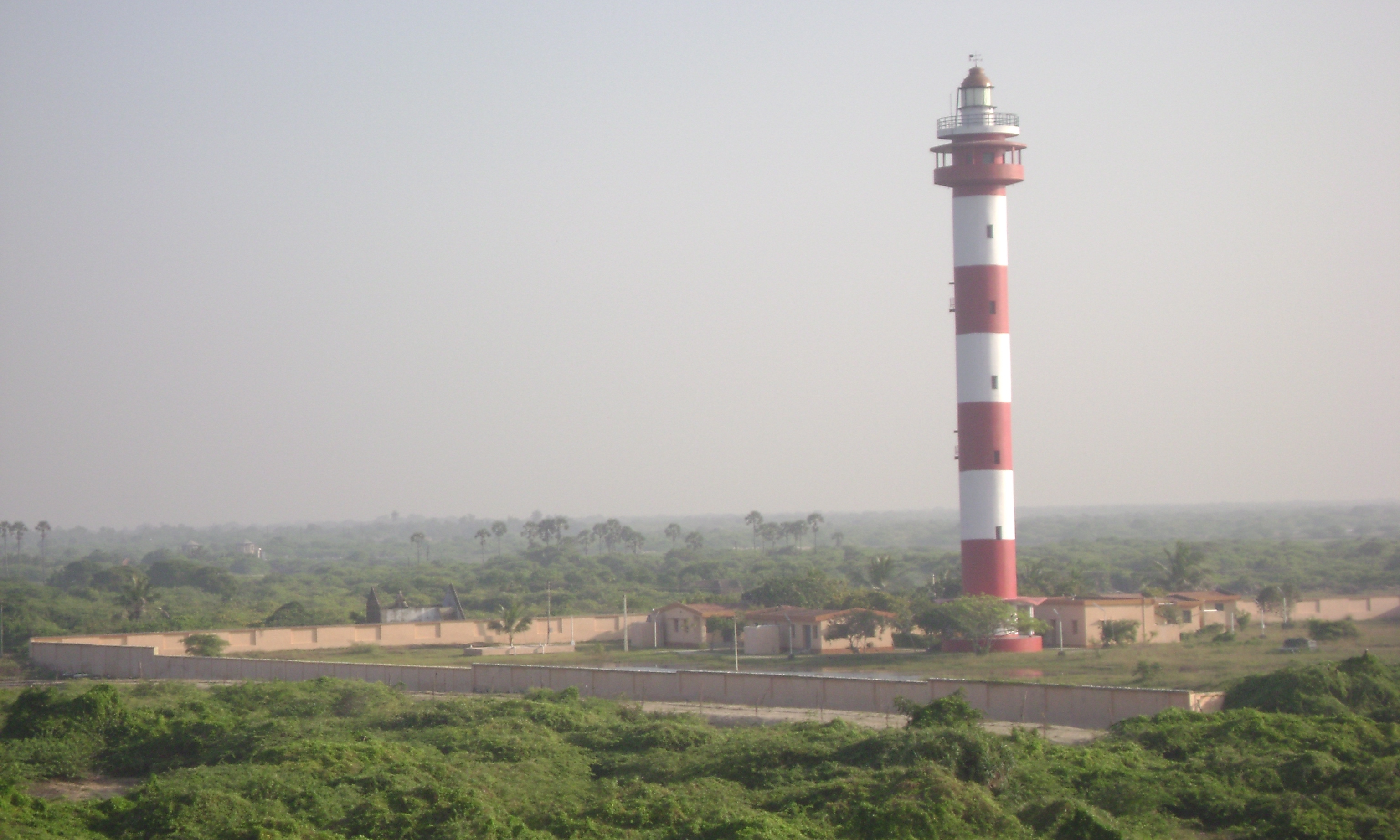
Point Calimere Wildlife and Bird Sanctuary
Every October, the sky above Point Calimere fills with wings. Greater flamingos arrive from the Rann of Kutch, painted storks from across South Asia, and shorebirds from as far as Siberia and northern Russia -- more than 100,000 individuals representing 103 species, all converging on a narrow spit of land where Tamil Nadu pushes into the sea. Created in 1967 to protect the blackbuck, this sanctuary at the southeastern tip of Nagapattinam District has become something far larger: an internationally recognized Ramsar wetland, an Important Bird Area, and one of the subcontinent's premier stages for the ancient drama of migration.
Where Two Seas Collide
Point Calimere occupies a peculiar geography. The sanctuary is effectively an island -- the Bay of Bengal to the east, the Palk Strait to the south, and swampy backwaters and commercial salt pans enclosing it from the west and north. Low sand dunes line the coast, stabilized in the east by invasive mesquite and in the west by dense dry evergreen forests. Between the dunes lie tidal mudflats, shallow seasonal ponds, and coastal plains that flood and dry in rhythm with the monsoons. This patchwork of habitats is what makes the sanctuary so biologically rich. Salt marshes grade into mangroves, which yield to grasslands, which abut some of the finest tropical dry evergreen forest remaining in India. The tallest dune in the sanctuary -- and the highest point in all of Nagapattinam District -- rises at the northwest corner, a place called Ramar Padam, where a small shrine holds the stone footprints of Lord Rama.
The Great Arrival
The birds begin appearing in October. They come from the Rann of Kutch in Gujarat, from the steppes of Central Asia, from Eastern Siberia and northern Russia, and from parts of Europe. By peak season, the sanctuary hosts the second-largest congregation of migratory waterbirds in India, with populations exceeding 100,000. Threatened species are among them: spot-billed pelicans, Nordmann's greenshanks, the critically endangered spoonbill sandpiper, and the statuesque black-necked stork. The Bombay Natural History Society has conducted bird migration studies here since 1959, ringing and releasing over 200,000 birds across decades of research. By January the visitors begin their return journeys, and the mudflats empty -- until the following October, when the cycle repeats. Among the 35 resident species that stay year-round, white-browed bulbuls, brahminy kites, and blue-tailed bee-eaters hold the fort between migrations.
Beyond the Birds
Point Calimere is not only a bird sanctuary. Blackbuck, the elegant spiral-horned antelope for which the reserve was originally established, graze the grasslands alongside chital deer. Golden jackals hunt at the forest margins. Bonnet macaques swing through the canopy of Manilkara hexandra trees -- locally called palai -- whose fruit sustains the forest's bird population. Monitor lizards patrol the undergrowth, and Indian star tortoises pick their way through the leaf litter. Offshore, bottlenose dolphins work the coastal waters, and olive ridley turtles nest on the beaches. In 2002, a pair of Bryde's whales washed ashore near the sanctuary. One -- a 35-foot, ten-ton animal -- was successfully towed back to sea, marking the first successful rescue of a beached whale in Asia. The sanctuary's 364 identified flowering plant species include 198 with medicinal properties, a pharmacopeia growing wild among the salt and sand.
Chola Light and Sacred Ground
Near the point itself stand the remains of a brick-and-mortar lighthouse said to have been built by the Chola dynasty more than a thousand years ago. The 2004 Indian Ocean tsunami badly damaged the structure, but its ruins still emerge in the intertidal zone near a newer British-era lighthouse. A modern lighthouse was commissioned nearby in 1998. These three beacons -- Chola, British, modern -- mark the passage of centuries on a single stretch of coast. The sanctuary also shelters several sacred sites. Ramar Padam draws Hindu devotees who celebrate Ram Navami in April. Mattumunian Kovil, a small temple in the south, hosts festivals in September. Avulaiganni Dargah, the grave of a Muslim saint near Ramar Padam, draws visitors each November for the saint's death anniversary. Deep in the northern forests, Shevrayan Kovil draws congregations from Arcothurai for festivals in June and July. Sacred ground and wild ground coexist here, neither diminishing the other.
Holding the Line
Conservation at Point Calimere is an ongoing negotiation with scarcity. Fresh water has always been the limiting factor. In 1979, the first water troughs were filled from barrels transported by bullock cart. Today, bore wells and an elevated tank on the sanctuary's western edge supply perennial water holes. The invasive mesquite Prosopis juliflora, introduced decades ago to stabilize dunes, now dominates the middle canopy and crowds out native species; current management focuses on its removal rather than new planting. Adjacent salt pans leach salinity into the soil and water. Cattle trespass for grazing. Speed bumps installed in 1999 on the Vedaranyam-Kodaikorai road have effectively stopped vehicles from killing wildlife -- a low-tech solution to a lethal problem. Annual wildlife censuses have run since 1991, tracking the slow pulse of recovery and decline. The sanctuary endures, season by season, holding the line for the birds that will return each October because this narrow spit of land between two seas has no substitute.
From the Air
Located at 10.31N, 79.86E on the southeastern tip of Nagapattinam District, Tamil Nadu, where the Palk Strait meets the Bay of Bengal. From altitude, the sanctuary is visible as a coastal spit extending into the sea, bordered by salt pans that appear as geometric white rectangles to the west and north. The mudflats and shallow wetlands change appearance dramatically between wet and dry seasons. The nearest major airport is Tiruchirappalli (VOTR), approximately 160 km to the west-northwest. Nagapattinam town is about 20 km to the northeast. The point itself is recognizable from the lighthouse and the narrow beach extending into the strait. During migration season (October-January), large concentrations of white and pink birds may be visible from low altitude.