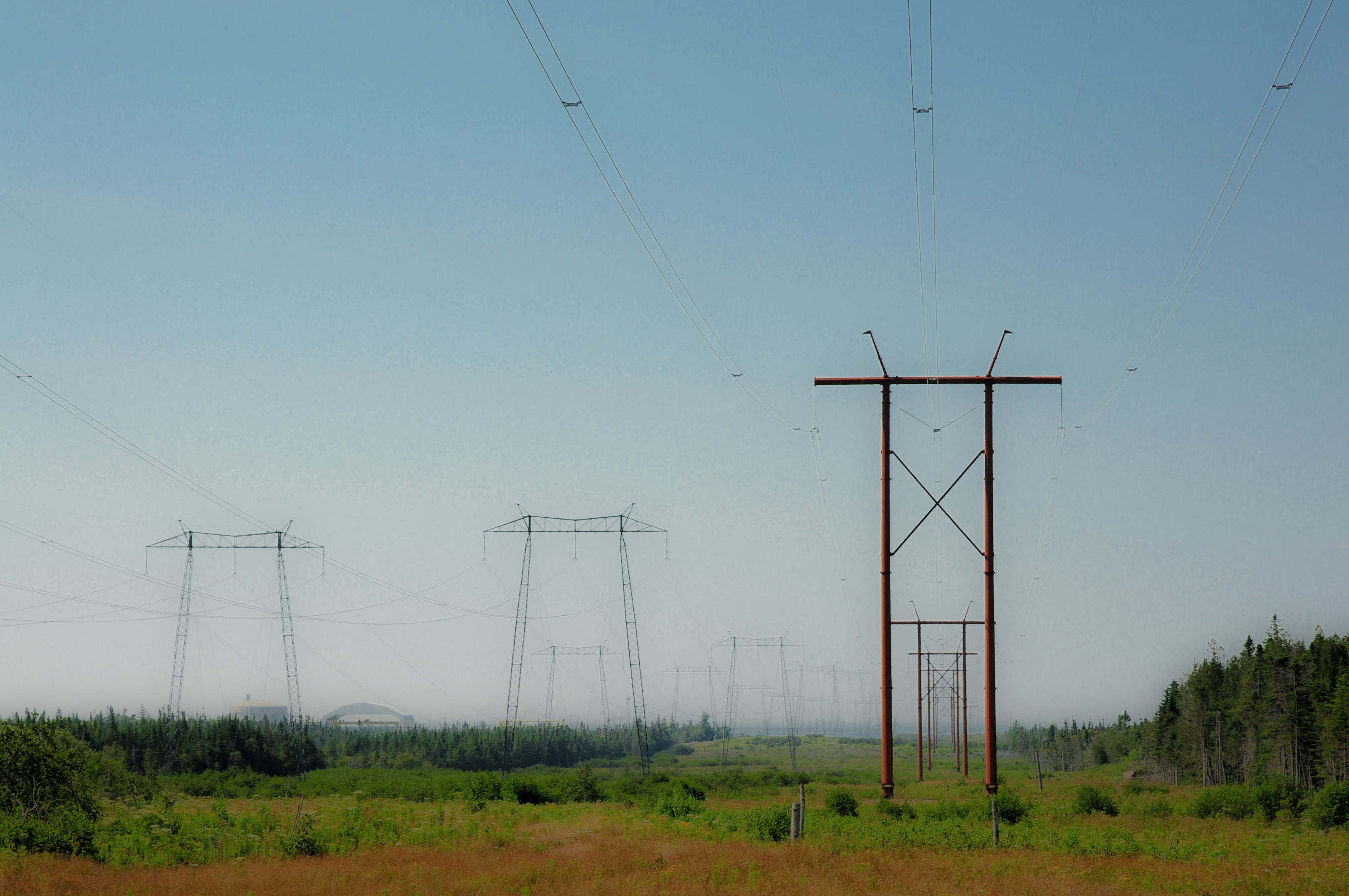
Point Lepreau Nuclear Generating Station
Somewhere on the rocky northern shore of the Bay of Fundy, between the world's highest tides and the spruce-clad headlands of Charlotte County, a single nuclear reactor generates roughly a quarter of New Brunswick's electricity. Point Lepreau Nuclear Generating Station is the only nuclear power plant in Atlantic Canada and the only operating Canadian nuclear station outside Ontario. Its CANDU-6 reactor, with a net capacity of 660 megawatts, has produced over 168,000 gigawatt-hours of energy across its lifetime. That simple output figure conceals a history of political gambles, engineering ordeals, and at least one employee who thought spiking the cafeteria drinks with radioactive heavy water qualified as a joke.
The Oil Crisis Bargain
New Brunswick had been eyeing nuclear power since the late 1950s, sending engineers to Atomic Energy of Canada Limited's Chalk River Laboratories for over fifteen years. But it took the 1973 oil crisis to force the province's hand. New Brunswick depended heavily on oil-fired generation, and diversifying suddenly felt urgent. The problem was money: the province's borrowing capacity was too limited to finance a reactor on its own. Ottawa solved that in January 1974 by announcing a loan program covering half the cost of any province's first nuclear plant. Premier Richard Hatfield declared the project on February 5, 1974, and won re-election that fall despite public misgivings. By March 1975, he went further, announcing on television that the reactor would be built regardless of the ongoing environmental assessment -- what sociologist Ronald Babin called the "nuclear fait accompli policy." Construction ran from 1975 to 1983 at a cost of C$1.4 billion, excluding interest.
A Reactor's Growing Pains
Point Lepreau's first decade was its best. The plant achieved a ten-year average availability of 93.11 percent and generated over 5,000 gigawatt-hours per year. Then the troubles began. In mid-January 1997, a cracked feeder pipe near the reactor core forced a 75-day shutdown, the third in two years. The human error behind the crack cost C$40 million in repairs and C$450,000 per day in replacement power purchased from Quebec. Two years earlier, in 1995, a plywood cover left inside a boiler during maintenance was sucked into the heat transport system when pumps restarted, causing catastrophic damage to a pump and leaving unrecoverable wood and metal debris in the cooling system. That single mishap cost the facility more than $50 million.
The Billion-Dollar Overhaul
The CANDU-6 reactor was designed to last 25 years, which put its expiration date around 2008. Public debate on refurbishment began in 2000. The New Brunswick Energy and Utilities Board ruled in 2002 that refurbishment held "no significant economic advantage" and was "not in the public interest." NB Power pressed ahead anyway, awarding Atomic Energy of Canada Limited a $1.4 billion contract in July 2005. Work began on March 28, 2008, with an 18-month timeline. It did not go well. Two 115-tonne turbine rotors toppled off a barge in Saint John Harbour. Robotic equipment failed to remove pressure tubes on schedule. All 380 calandria tubes had to be pulled and reinstalled a second time. Delays were costing NB Power C$33 million a month. Point Lepreau finally reconnected to the grid on October 23, 2012, and resumed commercial production a month later -- three years late and roughly $1 billion over budget. It was the first CANDU-6 reactor in the world to undergo full refurbishment, and the lessons learned shaped every subsequent CANDU project.
Bad Jokes and Heavy Water
Point Lepreau's most bizarre incident occurred on March 5, 1990, when assistant plant operator Daniel George Maston removed slightly radioactive heavy water from the reactor's moderator system and added it to a cafeteria drink dispenser containing lime-flavored drink. Eight employees drank the contaminated water. One received more than four times the legal yearly radiation limit, though none experienced significant health effects. Maston pleaded guilty in October 1990, describing his act as a bad joke done without "a good reason." In 2011, a heavy water spill inside the reactor building triggered a radiation alert and the first-ever evacuation of the facility. NB Power stated the spill posed no significant public risk, but the event underscored the fine margins nuclear operations demand.
The Next Chapter on the Fundy Shore
Point Lepreau's future extends well beyond its refurbished CANDU reactor. In 2018, the Government of New Brunswick committed $10 million toward an advanced Small Modular Reactor Research Cluster at the site, joined by ARC Nuclear and Moltex Energy, each investing $5 million. By December 2019, New Brunswick, Ontario, and Saskatchewan had signed an interprovincial memorandum of understanding to collaborate on small modular reactor development. If the advanced designs clear the Canadian Nuclear Safety Commission's vendor review process, NB Power envisions commercial demonstrations of both reactor types on the Point Lepreau property. The headland that has hosted Atlantic Canada's nuclear ambitions since the oil crisis era may yet become the testing ground for the next generation of Canadian nuclear power.
From the Air
Located at 45.07°N, 66.46°W on the northern shore of the Bay of Fundy in Saint John County, New Brunswick. The facility's containment structure and associated buildings are visible from moderate altitude against the forested coastline. Saint John Airport (CYSJ) is approximately 40 km to the northeast. Tidal patterns in the Bay of Fundy are dramatic, and fog is common along this coast.