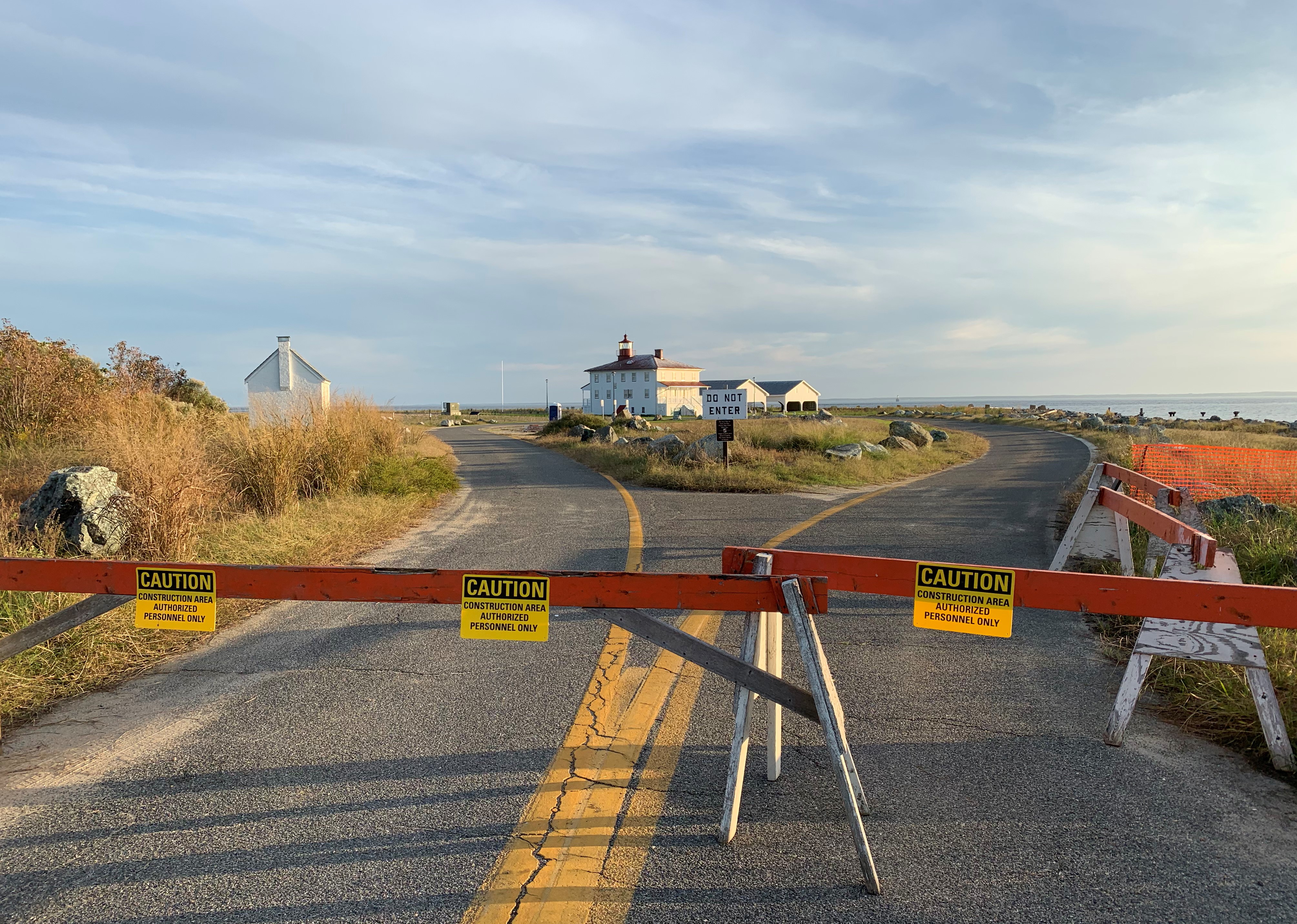
Point Lookout Light
The land deal almost killed the lighthouse before it was ever built. In 1825, the federal government decided that a light was needed at Point Lookout, where the Potomac River meets the Chesapeake Bay at the southernmost tip of Maryland's western shore. They offered the landowner, Jenifer Taylor, five hundred dollars. Taylor refused, then volunteered to accept the price if they made him keeper. What followed was years of bureaucratic wrangling, congressional appropriations, and a construction contract awarded before anyone actually owned the deed. When keeper James Davis finally lit the lamp on September 20, 1830, Taylor was still arguing with the government. He would keep arguing for two more years. The lighthouse, unbothered by politics, simply did what lighthouses do: it warned ships away from the shoals and marked the river's mouth, a duty it would perform through civil war, neglect, and near-demolition for the next 136 years.
A Keeper's Daughter Takes the Lamp
James Davis lasted only a few months as Point Lookout's first keeper before dying in office. His daughter, Ann Davis, stepped into the role and kept the light burning for the next seventeen years, tending the lamp from 1830 until 1847. She was part of a long tradition of women lighthouse keepers along the Chesapeake, though the isolation of Point Lookout made the job especially demanding. The light she maintained was modest: a story-and-a-half house built by contractor John Donahoo for $3,050, standing at the very tip of the peninsula where the wide brown Potomac pours into the Bay. In 1854, the station was upgraded with a fourth-order Fresnel lens, concentrating the beam into something ships could see from miles away across the open water. For three decades, Point Lookout was simply a light station, doing quiet, essential work on a spit of sand at the edge of two great bodies of water.
When the War Came to the Point
The Civil War transformed Point Lookout from a lonely lighthouse station into a place of mass suffering. In 1862, the Hammond General Hospital was built nearby to care for Union wounded. By 1863, Confederate prisoners began arriving, and soon Camp Hoffman sprawled across the point, a vast open-air prison camp that eventually held 20,000 men. More than 3,000 of those prisoners died from harsh conditions, limited food rations, and inadequate shelter against the wind and weather that swept in off the Bay. The lighthouse stood through it all, its beam continuing to sweep the junction of river and bay while thousands of men lived and died within sight of its glow. When the war ended, the camp was dismantled, but its legacy would haunt the point for generations. Local lore and ghost stories would become inseparable from Point Lookout's identity, feeding a reputation as one of the most haunted places on the Chesapeake.
Growth, Neglect, and a Failing Well
The decades after the war brought steady improvement. A fog bell tower went up in 1873. In 1883, the lighthouse was raised to two full stories with a summer kitchen and additional bedroom at the southwest corner. A buoy repair depot and coal storage shed followed in 1883 and 1884. By 1927, the building had been converted into a duplex, more than doubling in size and allowing both a keeper and an assistant keeper to live on-site with some measure of privacy. The U.S. Coast Guard took over control of all American lighthouses in 1939, and in 1951, the Navy began purchasing surrounding property. On January 11, 1966, the light was deactivated after 136 years of service. Civilians continued to live in the house for another fifteen years, until 1981, when a dispute over a failing well led to the revocation of a 99-year lease the state had held with the Navy. The building sat empty, exposed to salt air and neglect.
Rescued from the Edge
Preservation came in stages. The State of Maryland had been carving out Point Lookout State Park from purchased land since the 1960s, and the fog bell tower was relocated to the Chesapeake Bay Maritime Museum in 1968. But the lighthouse itself remained in limbo until 2006, when a land-swap deal finally transferred the property to Maryland. That same year, the Point Lookout Lighthouse Preservation Society was founded with an ambitious goal: restore the complex to its 1927-era appearance. For years, volunteers opened the lighthouse to the public just one day a month. Then, beginning in 2017, extensive renovations re-stabilized the structure, repaired leaks, replaced timbers and drywall, and rebuilt the stairways. A second round of work starting in 2024 converted the duplex into a self-guided museum operated by the Maryland Park Service, with historical exhibits, period furniture, and a small gift shop spread across both levels. Visitors can now climb to the cupola where the lantern once stood. The museum opened on May 15, 2025, welcoming the public from May through September.
From the Air
Point Lookout Light sits at 38.039N, 76.322W at the extreme southern tip of Maryland's western shore, where the Potomac River meets the Chesapeake Bay. Best viewed at 1,000-1,500 feet AGL approaching from the north or east. The lighthouse is a small white duplex structure at the very tip of the peninsula within Point Lookout State Park. The convergence of river and bay is clearly visible from altitude. Nearest airport is St. Mary's County Regional (2W6) approximately 12nm northwest. Patuxent River NAS (KNHK) is roughly 20nm north. Be aware of restricted airspace R-4008 associated with NAS Patuxent River.