Three Hundred Steps Down to the Light
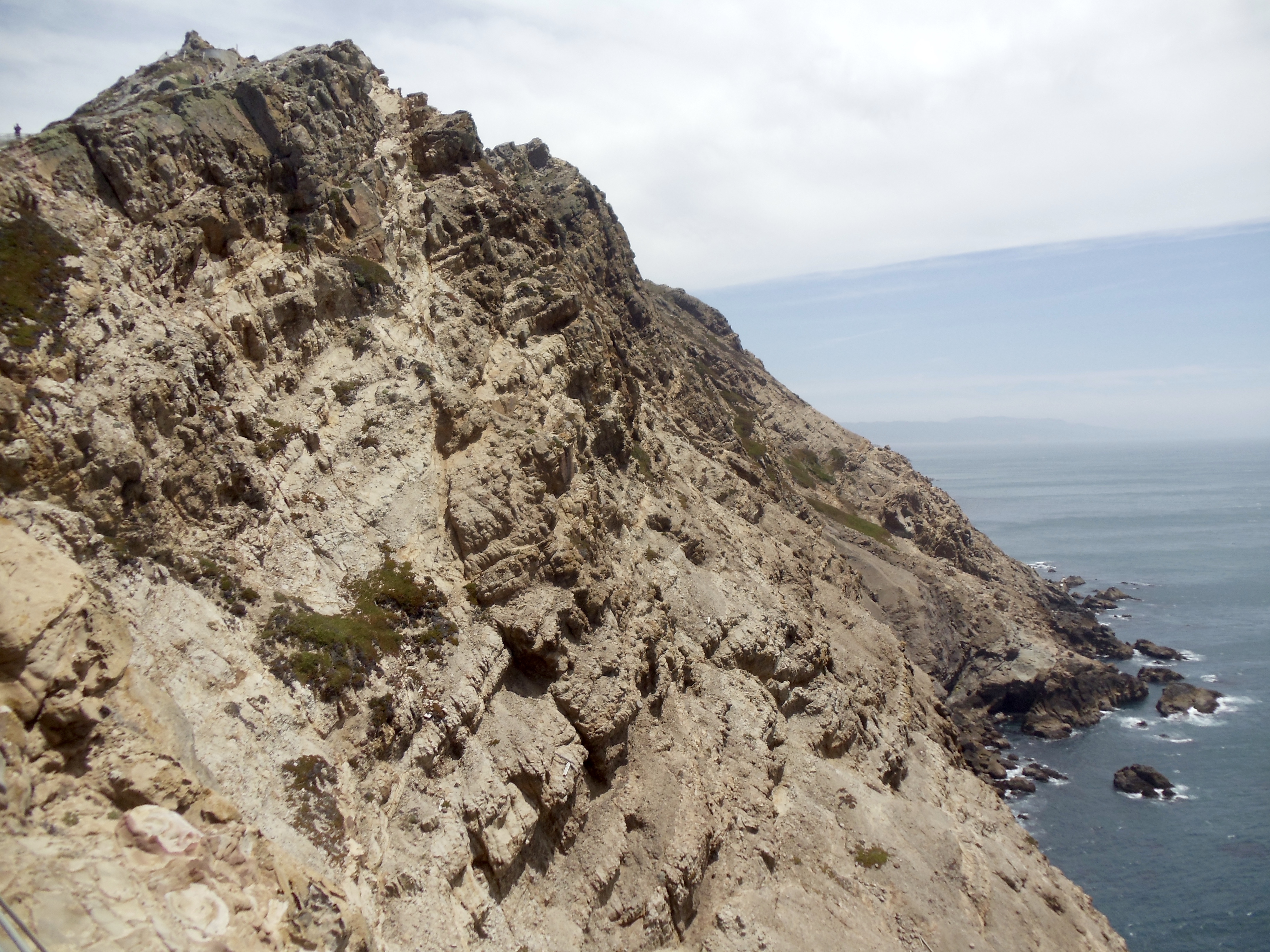
To reach the light, you descend. Not a gentle slope or a winding path, but 308 concrete steps carved into the cliff face of Point Reyes, dropping from the windswept plateau where the keepers lived down to the sixteen-sided iron tower bolted to bare rock at the headland's tip. It is one of the few lighthouses in America where the journey to work went down instead of up - a consequence of building on a promontory so exposed that the only place to anchor a tower was below the cliff edge, 294 feet above the sea but well beneath the fog that was the whole reason for putting a light here in the first place. Point Reyes holds the official distinction of being the windiest and foggiest point on the entire Pacific coast. Gales of seventy-five miles per hour are routine. Week-long blankets of fog are expected. It is, in other words, exactly where you would build a lighthouse - and exactly where you would dread tending one.
Fifteen Years of Argument
The United States Lighthouse Board assigned a light to Point Reyes in 1855. The first ships to reach the headland were already long past by then - Point Reyes had been a landmark on the California coast since the sixteenth century, a massive triangular promontory that European navigators used as a reference point and occasionally crashed into. But assignment and construction proved to be very different things. The landowners who held the Point Reyes property disputed the government's offered price, and neither side would yield. The argument dragged on for fifteen years while ships continued to founder off the headland in fog they could not see through and currents they could not fight. It was not until 1870 that construction was finally completed - a sixteen-sided tower of forged iron plate, a twin of the Cape Mendocino Light to the north, fitted with a first-order Fresnel lens. On December 1, 1870, the lens was lit for the first time.
The Lens and the Fog
A first-order Fresnel lens is a formidable piece of optics. Designed by the French physicist Augustin-Jean Fresnel in the 1820s, these lenses use concentric rings of precisely angled glass prisms to capture light that would otherwise scatter in all directions and concentrate it into a focused beam visible for miles. The Point Reyes lens sits in the main chamber of the lighthouse - the Lens Room - where its clockwork mechanism rotates it to produce a characteristic flash pattern: one flash every five seconds. For over a century, that rhythm has been the signature of Point Reyes, a metronome marking time on a coastline where time moves differently. Electricity reached the lighthouse in 1938, replacing the oil lamps that keepers had trimmed and fueled for nearly seventy years. Concrete steps were built into the cliff in 1939, replacing whatever precarious path the original keepers had used to reach the tower. The station was automated in 1975, ending 105 years of human tending.
The Keepers' Life
A 1962 Coast Guard document captures what it meant to live at Point Reyes Light Station. It was a family station, home to four men and their dependents, nineteen miles from the nearest town of Inverness. The keepers maintained the first-order light, a fog signal, and a radio beacon - three systems designed to reach ships through three different senses. Their quarters sat on the plateau above the cliff, two-story fourplex units built in 1960, containing two-bedroom and three-bedroom apartments. Below them, down the 308 steps, sat the light tower, the fog signal building, the engine room, the pump house. Children traveled three miles by station vehicle to school. Supplies and social life required a trip to Hamilton Air Force Base or the San Francisco area. Between the isolation and the weather, Point Reyes was not a posting that attracted volunteers. But the station's logbook tells another story: on fair summer weekends, hundreds of visitors climbed down to see the lighthouse, and escorting them became, as the Coast Guard noted, a major portion of the keepers' duties.
The Poet and the Filmmaker
Not all visitors came casually. In the mid-1950s, poet Weldon Kees and filmmaker William Heick traveled to Point Reyes to make a documentary about the lighthouse and its surroundings. Kees, a Nebraska-born writer whose dark, precise poems had earned him a reputation among the literary circles of San Francisco, wrote "The Exposed Reef" about the headland - a poem that captures the collision of ocean and rock that defines the place. He and Heick filmed the lighthouse, the keepers, the fog rolling across the headland. It was one of Kees's last projects. In July 1955, his car was found abandoned near the Golden Gate Bridge. He was never seen again, and his disappearance remains one of American poetry's enduring mysteries. The film he made with Heick survives, a record of Point Reyes Light Station in its manned era, shot by a man who would soon vanish as completely as a ship in the fog he documented.
Still Flashing
The lighthouse was listed on the National Register of Historic Places in 1991. Today it is one of Point Reyes National Seashore's most visited attractions, the Lens Room open to the public on a limited basis, weather permitting. That caveat matters. The same fog and wind that made the lighthouse necessary also make visiting it unpredictable. Visitors who reach the top of the steps on a clear day may find the lighthouse closed by the time they reach the bottom, fog having materialized from what seemed like nowhere. The 308 steps remain the only access - there is no elevator, no shortcut, no alternative. What the keepers climbed daily for a century, tourists now descend and climb once, and many find it enough. From above, the lighthouse is a small iron structure on a narrow shelf of rock, dwarfed by the cliff and the ocean. From the Lens Room, looking out through the Fresnel prisms, the Pacific stretches unbroken to Asia. One flash every five seconds. It has not stopped since December 1, 1870.
From the Air
Located at 38.00°N, 123.02°W at the extreme western tip of Point Reyes, the most exposed point on the headland. The sixteen-sided iron tower is small but sits on a distinctive cliff shelf visible from lower altitudes. Point Reyes itself is the most prominent coastal feature north of San Francisco - a massive triangular projection into the Pacific, unmistakable from the air. The lighthouse marks the southwestern tip's western projection; the lifeboat station sits on the eastern projection facing Drake's Bay. Best viewed below 2,000 feet for structural detail; the headland and peninsula are visible from much higher. Nearest airports: Gnoss Field (KDVO) in Novato approximately 25 nm east; San Francisco International (KSFO) approximately 38 nm south. Fog is the defining weather condition - Point Reyes is officially the foggiest point on the Pacific coast. Afternoon clearing more likely than morning.