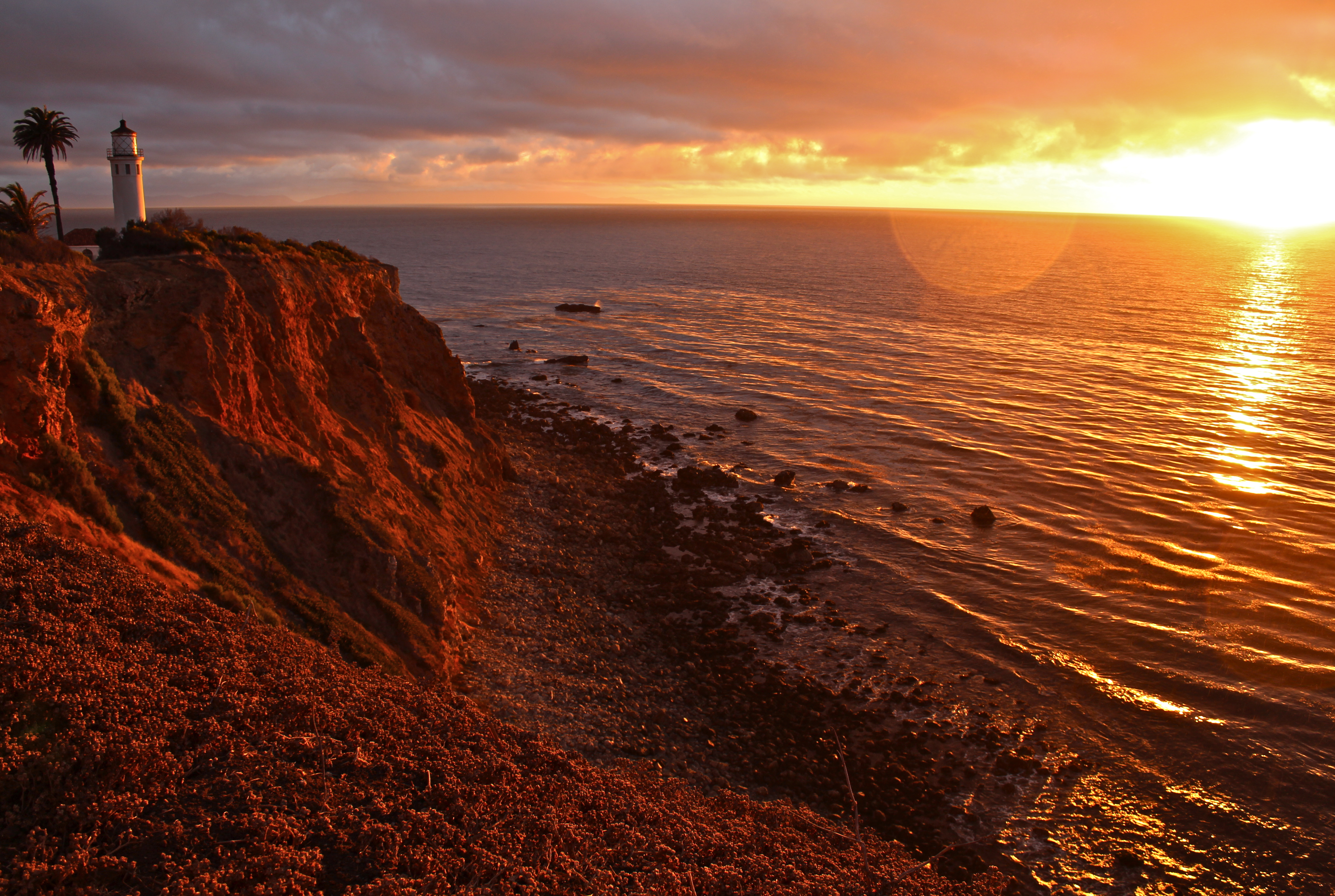
Point Vicente Lighthouse
After World War II, rumors spread of a woman in a white gown pacing the tower at night. Some whispered she was the widow of a lighthouse keeper; others claimed she was the spirit of someone who had leaped from the cliffs. The Coast Guard eventually offered a more prosaic explanation: an extra coat of paint had been applied to reduce the light's reflection on neighboring homes, creating the ghostly illusions. But the 'Lady of the Light' legend persists at Point Vicente, where a lighthouse has stood watch over the approaches to Los Angeles Harbor since 1926.
Light from Alaska
The lens that once rotated in the Point Vicente lantern room had already seen four decades of service before arriving in California. Crafted in 1886 by Barbier, Benard, et Turenne - the oldest lens-making company in the world - this third-order Fresnel lens spent its early years guiding ships through Alaskan waters. The lens is made of hand-ground prisms held in a cast brass frame, a masterpiece of 19th-century optical engineering. When active, its 1.1 million candlepower beam could be seen for miles in clear weather. In February 2019, after nearly a century of service at Point Vicente, the lens was carefully removed and placed on display at the Point Vicente Interpretive Center.
Cliffside Sentinel
Point Vicente Lighthouse stands on the edge of the Palos Verdes Peninsula, its masonry tower rising from cliffs that drop dramatically to the Pacific. The structure was built in 1926, positioning the center of its lantern high above the ocean - a beacon visible to vessels approaching from far out at sea. The lighthouse joined a network of navigation aids protecting the increasingly busy approaches to Los Angeles Harbor, which by the 1920s had become one of the most important ports on the Pacific Coast. In 1934, the Long Beach Radio Station opened in a neighboring building to monitor distress signals.
Dimmed for War
When war came to the Pacific in December 1941, Point Vicente's brilliant beam became a liability. The light source was dimmed to just 25 watts to avoid providing a navigation aid to enemy submarines prowling the California coast. The lighthouse was operated and maintained by the United States Lighthouse Service until 1939, when that service merged with the Coast Guard. Today, the lighthouse flashes a distinctive pattern: two white flashes, repeating every 20 seconds. An emergency light of reduced intensity stands ready if the main light is extinguished. The foghorn that once warned ships during low visibility was dismantled in the early 2000s.
Keepers of the Light
Three head keepers tended Point Vicente during its early decades. George W. L'Hommedieu served from the lighthouse's opening in 1925 until 1930. Anton Trittinger followed, keeping the light through the Depression and the entirety of World War II until 1945. Joseph May completed the era of civilian keepers, serving from 1945 to 1955. These men climbed the tower, maintained the delicate lens mechanism, and ensured that the light never failed the ships that depended on it. Today, the US Coast Guard's Aids to Navigation Team Los Angeles/Long Beach maintains the lighthouse, with Coast Guard Auxiliary members and Naval Sea Cadets leading tours.
Hollywood's Lighthouse
The dramatic setting has attracted filmmakers for decades. Point Vicente doubled for locations in the 2001 film Pearl Harbor and Christopher Nolan's 2017 Dunkirk. The lighthouse and its grounds remain federal property, owned and operated by the Coast Guard. While the lighthouse itself is closed to the public, the grounds open every second Saturday of the month from 10 AM to 3 PM. Three former Coast Guard residences and a museum stand on the property, preserving the legacy of the keepers who once lived in isolation on these windswept cliffs, watching for the Lady of the Light.
From the Air
Located at 33.74N, 118.41W on the western edge of the Palos Verdes Peninsula. The white lighthouse tower is visible on the cliff edge, with the interpretive center nearby. Best viewed at 1,500-2,500 feet for full appreciation of the dramatic cliff setting. Torrance Municipal Airport (KTOA) lies to the northeast. The Palos Verdes Peninsula's distinctive coastline and the lighthouse's clifftop position make it an unmistakable landmark from the air.