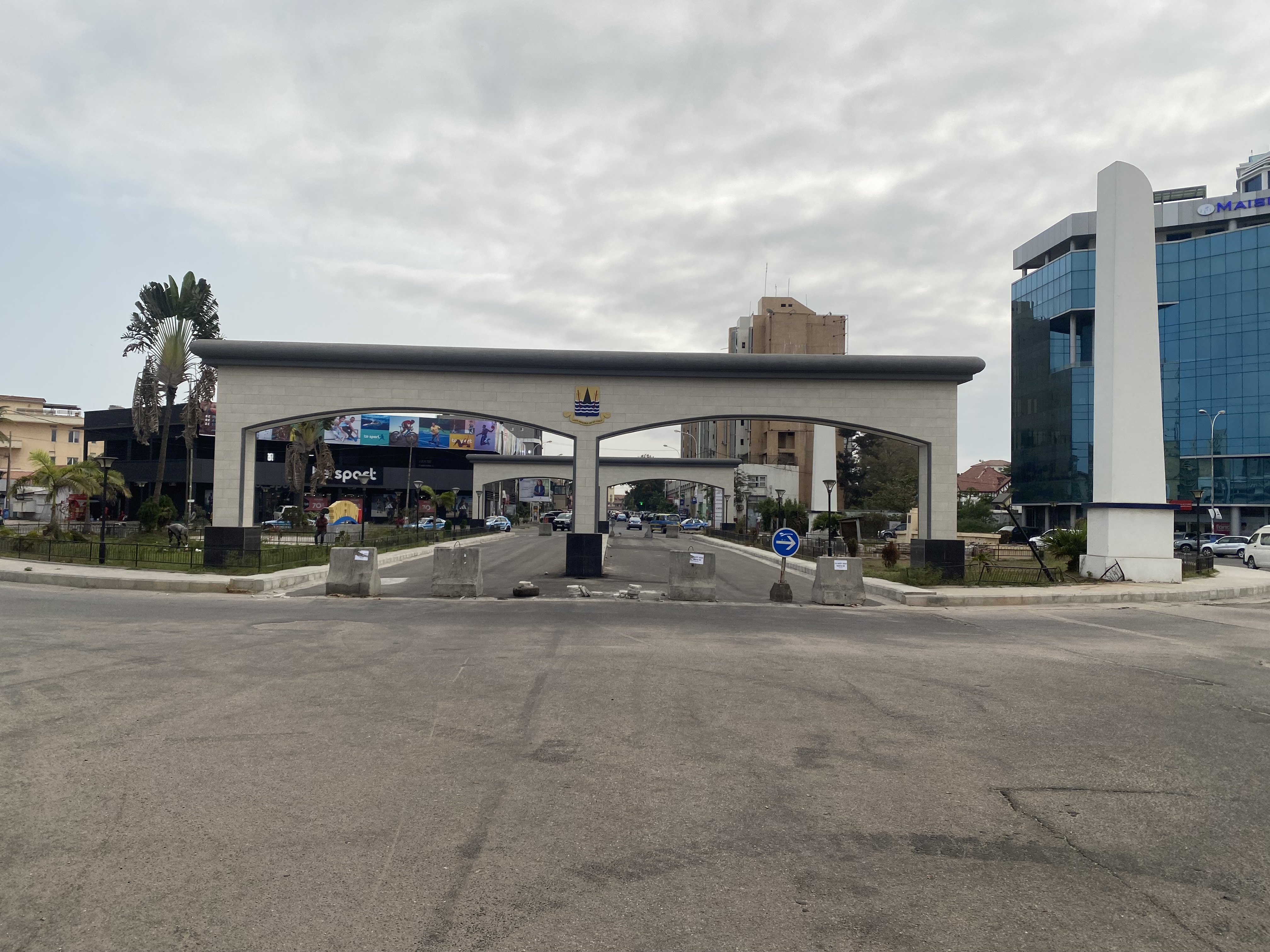
Pointe-Noire
The shared taxis are called 100-100 in Pointe-Noire, named for the flat fare they once charged. Passengers pile in along fixed routes, and the driver stops for anyone waving from the roadside. It is a small detail, but it captures something essential about the Republic of the Congo's second city: Pointe-Noire runs on improvisation, informality, and the constant negotiation between what is planned and what actually works. Commonly known as PNR, the city had around one million residents by 2018, making it the economic engine of a country whose political capital, Brazzaville, sits 500 kilometers to the east on the other side of dense forest.
Black Gold on a Sandy Shore
Pointe-Noire is the center of the Republic of Congo's oil industry, and oil is the reason the city has grown so fast. Congo ranks among the main petroleum producers in Central Africa, and virtually all of that output flows through PNR's port and pipeline infrastructure. The wealth is visible in certain quarters -- expatriate compounds, international hotels, imported SUVs on well-paved city roads. But it coexists uneasily with a fishing industry that predates the oil boom by generations. Fishermen still launch pirogues from the same beaches where offshore platforms dot the horizon. The tension between these two economies defines much of the city's character: one global and capital-intensive, the other local and labor-intensive, both competing for the same stretch of Atlantic coastline.
A French Imprint
Walk through the center of Pointe-Noire and the colonial past is everywhere. The architecture carries a distinctly French feel -- not grand Haussmann boulevards, but the practical structures of a tropical trading post adapted to equatorial heat. This is no accident. France controlled the region from the late nineteenth century through independence in 1960, and the connection endures. A large community of French expatriates lives and works in PNR, many tied to the petroleum sector. French is the language of business, government, and daily life. RFI broadcasts on 93.2 MHz, and the city's restaurants serve baguettes alongside manioc. Credit cards remain rare outside the best hotels, and the CFA franc -- pegged to the euro, a vestige of the colonial monetary system -- is the only reliable currency.
Rhythms of the Wet and Dry
Pointe-Noire's climate divides the year in two. From October through April, the wet season brings temperatures averaging 28 degrees Celsius and heavy rains that turn unpaved roads into red mud. The dry season, May through September, cools things to around 24 degrees and dries out the landscape enough to make overland travel feasible -- though venturing beyond city limits without a four-wheel-drive vehicle and a trusted driver remains inadvisable. The asphalt road to Brazzaville was completed in 2015, a genuine milestone, but sections through the Pool region carry security concerns. For those willing to make the journey, La Gazelle -- the named train service linking PNR to Dolisie and onward to Brazzaville -- offers one of sub-Saharan Africa's more comfortable rail experiences, complete with restaurant car and air conditioning. The fifteen-hour journey across forest and grassland is worth it for the scenery alone.
Markets and Mango Trees
The daily commerce of Pointe-Noire unfolds in its markets. Marche Thystere, Marche de Siafoumou, Marche Voungou -- each has its own character and specialty. The artisan village on Port Side Beach, next to Le Derrik, sells carved wood statues and crafts, though buyers should know that prices shift with every customer and wooden pieces need fumigation before export. Unlike many African cities of its size, PNR is considered quite safe for walking in the main districts and along the beach. The relative absence of aggressive begging gives the streets a relaxed atmosphere. Evenings bring locals to the waterfront, where the Atlantic stretches flat to the horizon and the sun drops into it without ceremony -- just color, then darkness, then the lights of the offshore rigs blinking on one by one.
From the Air
Located at 4.80S, 11.85E on the Atlantic coast of the Republic of the Congo. The city is visible from altitude as a coastal urban area with a distinctive port and offshore oil platform infrastructure. Approach from the west over the Atlantic for the best view of the coastline and harbor. Pointe-Noire Airport (FCPP) serves the city directly. Brazzaville's Maya-Maya Airport (FCBB) is approximately 500 km to the east.